Color aquatint and etching - In excellent condition - Signed in the plate by the artist, hand-signed in pencil by Georgette Magritte, and numbered - Printed by Jacques David, Paris
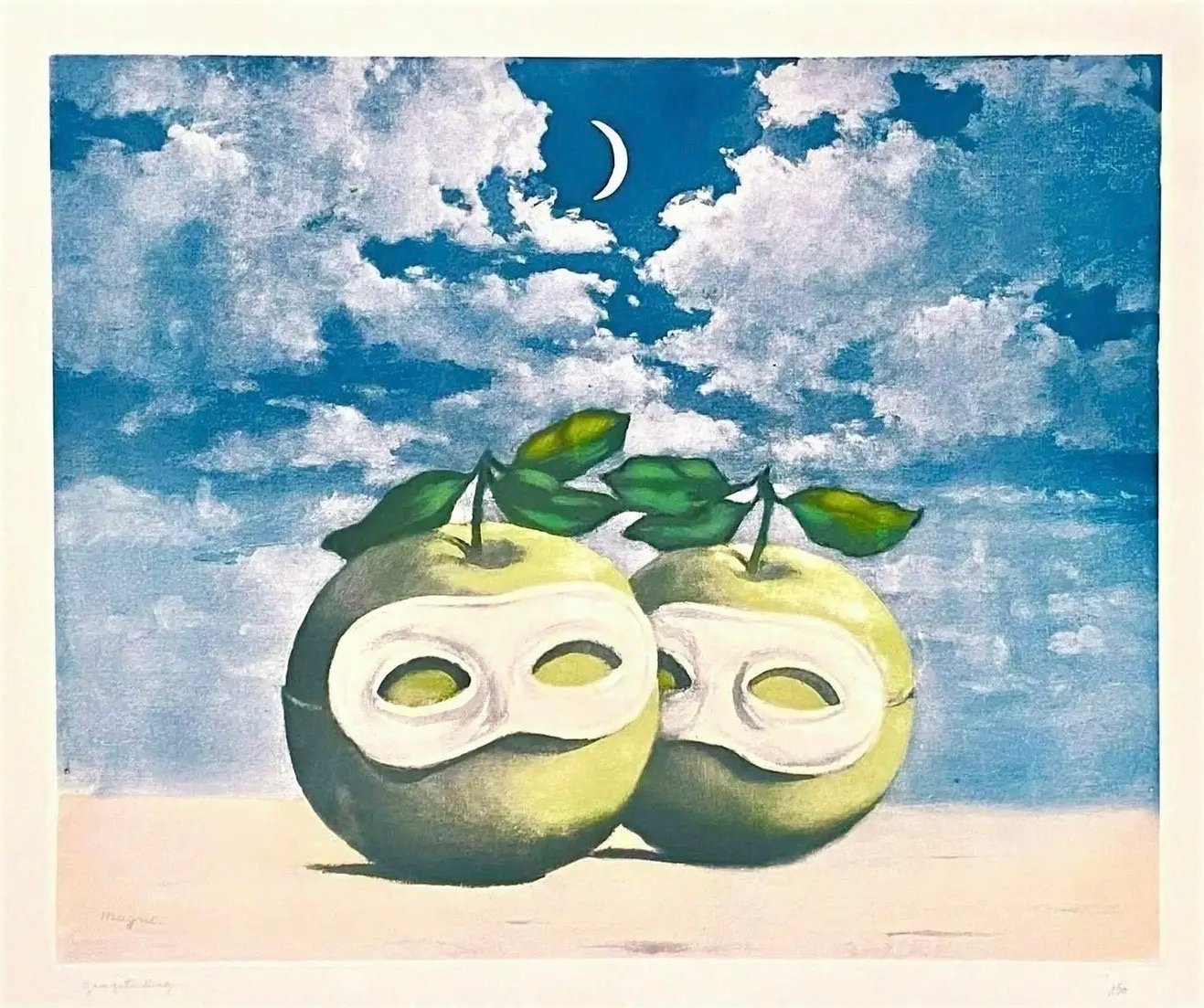
La Valse Hesitation by René Magritte, a limited edition print from 1971, is executed using etching and aquatint techniques. The piece measures 56 x 76.3 cm and is signed in the plate by Magritte and hand-signed by Georgette Magritte. The artwork depicts two green apples, each adorned with a mask, set against a dreamy sky with a crescent moon. This surreal composition showcases Magritte’s fascination with visual ambiguity and juxtaposition, inviting viewers to ponder the enigmatic connection between the objects. The subtle tonal variations and fine detailing achieved through the etching technique enhance the mysterious and poetic quality of the scene.
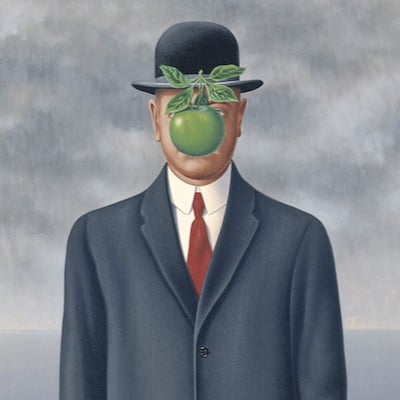
René Magritte (Belgium, 1898–1967) was a surrealist artist renowned for his thought-provoking images that challenge observers' perceptions of reality. His works often depict ordinary objects in unusual contexts, prompting viewers to question their assumptions. Notable pieces include 'The Treachery of Images' and 'The Son of Man.' Magritte's influence extends into pop art, minimalism, and conceptual art.
Etching and AquatintEtching and aquatint are printmaking techniques. In aquatint, the printing plate is etched with a pattern of tiny pits and cracks to create a wide range of tonal gradations. This technique allows artists to replicate the broad, flat tones found in watercolor paintings and ink washes.
Color aquatint and etching - In excellent condition - Signed in the plate by the artist, hand-signed in pencil by Georgette Magritte, and numbered - Printed by Jacques David, Paris
La Valse Hesitation by René Magritte, a limited edition print from 1971, is executed using etching and aquatint techniques. The piece measures 56 x 76.3 cm and is signed in the plate by Magritte and hand-signed by Georgette Magritte. The artwork depicts two green apples, each adorned with a mask, set against a dreamy sky with a crescent moon. This surreal composition showcases Magritte’s fascination with visual ambiguity and juxtaposition, inviting viewers to ponder the enigmatic connection between the objects. The subtle tonal variations and fine detailing achieved through the etching technique enhance the mysterious and poetic quality of the scene.
René Magritte (Belgium, 1898–1967) was a surrealist artist renowned for his thought-provoking images that challenge observers' perceptions of reality. His works often depict ordinary objects in unusual contexts, prompting viewers to question their assumptions. Notable pieces include 'The Treachery of Images' and 'The Son of Man.' Magritte's influence extends into pop art, minimalism, and conceptual art.
Art evokes the mystery without which the world would not exist.
- Rene Magritte
Belgian painter René Magritte was a member of the Surrealist movement that started in Paris in the 1920s and swept across the world, flourishing actively for several decades. Surrealism was concerned with the exploration of the subconscious and the dream-state, and his paintings are indeed very dreamlike in quality. René Magritte used a realistic style to portray commonplace objects in odd juxtapositions, such as a train emerging from a fireplace, pieces of fruit wearing masks, or an enormous green apple that filled an entire room. René Magritte worked in oil paint on canvas in a representational, illustrative style, in which subject matter was more important than painting technique. René Magritte used many iconic images repeatedly in his work, such as the bowler hat, fluffy white clouds in a blue sky, and round steel bells. He liked to challenge people's preconceptions, albeit in a friendly way, and his paintings are well-known for being clever and even somewhat irreverent. A good example of this is his painting of a pipe with the words Ceci n'est pas une pipe This is not a pipe) to remind the viewer that it is indeed not a pipe, but a painting Just try to stuff it with tobacco he observed). The title of this work, The Treachery of Images, reminds us not to take what we see too seriously. (Artist website)
Surrealism began in the 1920s as an art and literary movement with the goal of revealing the unconscious mind and unleashing the imagination by exploring unusual and dream-like imagery. Influenced by Sigmund Freud’s theories of psychoanalysis, Surrealist artists and writers sought to bring the unconscious into rational life, blurring the lines between reality and dreams. The movement aimed to challenge conventional perceptions and express the irrational aspects of the human experience.