

Etching and aquatint in colors on Japon nacré - Stamped signature, and hand-numbered in pencil
René Magritte's L'Art de Vivre (1968) is a limited edition etching and aquatint, exemplifying his surrealist approach. The artwork portrays a figure in a suit with a large, moon-like head, set against a landscape of mountains and a cloudy sky. This surreal composition invites viewers to contemplate the bizarre and the ordinary, a hallmark of Magritte’s work where objects and contexts are juxtaposed to challenge our perception of reality. The print, created on Japon nacré paper, is stamped with the artist’s signature and hand-numbered in pencil, limited to an edition of 150.
Artwork Copyright © Rene MagritteRené Magritte (Belgium, 1898–1967) was a surrealist artist renowned for his thought-provoking images that challenge observers' perceptions of reality. His works often depict ordinary objects in unusual contexts, prompting viewers to question their assumptions. Notable pieces include 'The Treachery of Images' and 'The Son of Man.' Magritte's influence extends into pop art, minimalism, and conceptual art.
Artwork Copyright © Rene MagritteL'Art de Vivre, 1968
Form
Medium
Size
- Inches
- Centimeters
Edition
Price
Available works →
- Authenticity Guaranteed
- Insured Shipping
- Online Since 2005
●
●Inventory 13292
●Stamp signed
●Comes with gallery invoice and certificate
●Sell Us a Similar Artwork. Learn more.
Etching and aquatint in colors on Japon nacré - Stamped signature, and hand-numbered in pencil
René Magritte's L'Art de Vivre (1968) is a limited edition etching and aquatint, exemplifying his surrealist approach. The artwork portrays a figure in a suit with a large, moon-like head, set against a landscape of mountains and a cloudy sky. This surreal composition invites viewers to contemplate the bizarre and the ordinary, a hallmark of Magritte’s work where objects and contexts are juxtaposed to challenge our perception of reality. The print, created on Japon nacré paper, is stamped with the artist’s signature and hand-numbered in pencil, limited to an edition of 150.
Artwork Copyright © Rene MagritteRené Magritte (Belgium, 1898–1967) was a surrealist artist renowned for his thought-provoking images that challenge observers' perceptions of reality. His works often depict ordinary objects in unusual contexts, prompting viewers to question their assumptions. Notable pieces include 'The Treachery of Images' and 'The Son of Man.' Magritte's influence extends into pop art, minimalism, and conceptual art.
Artwork Copyright © Rene Magritte- Recently Added
- Price (Low-High)
- Price (High-Low)
- Year (Low-High)
- Year (High-Low)
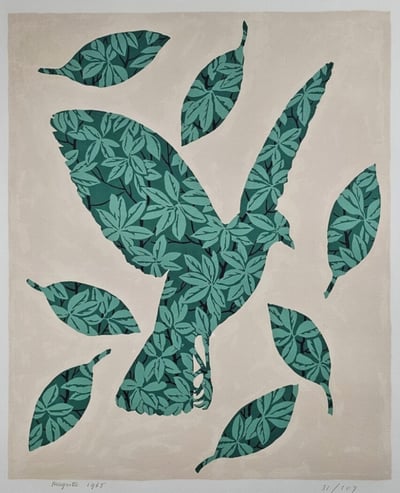
Rene Magritte
Salon de Mai, 1965
Limited Edition Print
Lithograph
EUR 37,000

Rene Magritte
Nude Study (Etudes de Nus)
Drawing / Watercolor
Pencil
GBP 11,500 - 13,500

Rene Magritte
La Valse Hesitation, 1971
Limited Edition Print
Etching and Aquatint
Currently Not Available
Available works by Rene Magritte
See all →Rene Magritte
Salon de Mai, 1965
Limited Edition Print
Lithograph
EUR 37,000
Rene Magritte
Nude Study (Etudes de Nus)
Drawing / Watercolor
Pencil
GBP 11,500 - 13,500
Related Artists


Artwork by Laure Prouvost
What is Lettrism?
Lettrism is an art form that uses letters, words, and symbols to create artwork. The movement was established in Paris in the 1940s and later gained popularity in the 1950s in America. Lettrisme is the French spelling of the movement's name, derived from the French word for letter.


