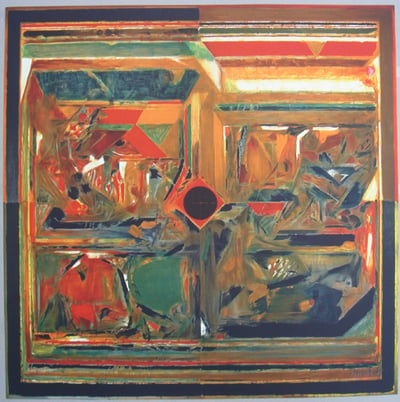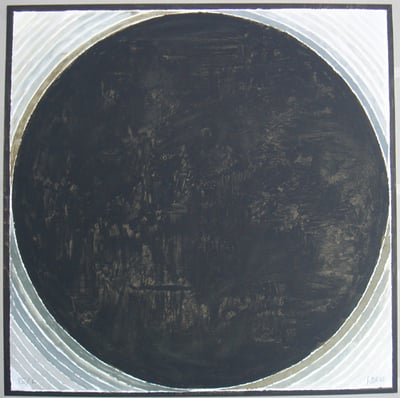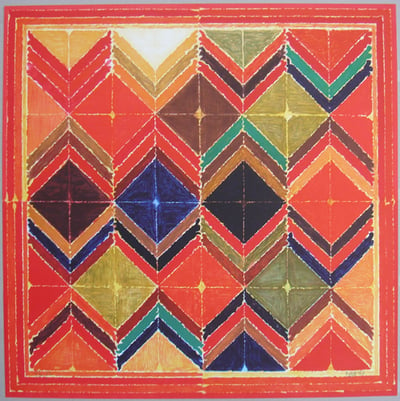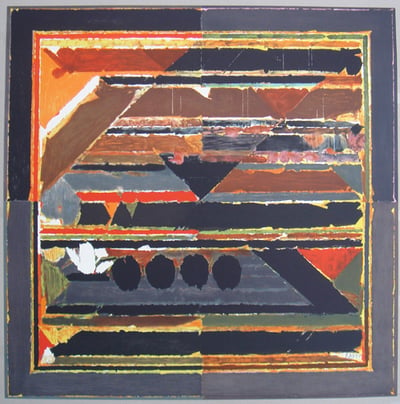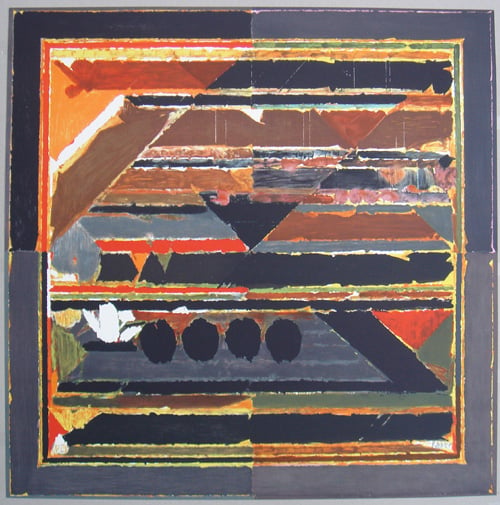
Symboles 3 by S.H. Raza is a lithograph created in 2007, part of a limited edition of 50, numbered in Roman numerals. This vibrant composition features Raza’s exploration of geometric abstraction, employing bold colors such as deep reds, oranges, and blacks, layered with earthy tones. The arrangement of triangles, lines, and circular forms within a structured square layout gives the piece a sense of harmony and order, while also evoking elements of traditional Indian symbolism. Raza’s work often reflects his interest in spirituality and the relationship between form and color, and in Symboles 3, these shapes appear almost as mystical symbols, inviting contemplation. The artwork’s dynamic symmetry and rich hues exemplify Raza’s signature style, blending modern abstraction with cultural depth.
Sayed Haider Raza (India, 1922–2016) was a distinguished painter renowned for his abstract works that seamlessly blend Western modernism with Indian visual traditions. A founding member of the Progressive Artists' Group, Raza's iconic 'Bindu' series symbolizes the point of creation in Hindu philosophy. His contributions earned him prestigious honors, including the Padma Vibhushan and the Commandeur de la Légion d'Honneur.
LithographLithography is a printing method based on the principle that water and oil do not mix. It can be used to print artwork or text onto paper or other suitable materials. Traditionally, an image was drawn with wax, fat, or oil onto a lithographic limestone surface or plate. Today, metal plates and other surfaces are also used in lithographic printing.
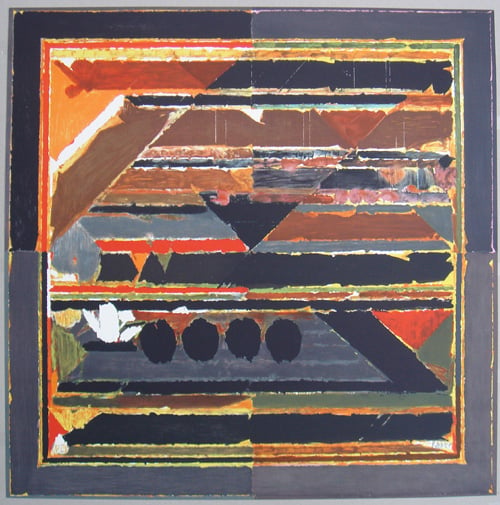
Symboles 3 by S.H. Raza is a lithograph created in 2007, part of a limited edition of 50, numbered in Roman numerals. This vibrant composition features Raza’s exploration of geometric abstraction, employing bold colors such as deep reds, oranges, and blacks, layered with earthy tones. The arrangement of triangles, lines, and circular forms within a structured square layout gives the piece a sense of harmony and order, while also evoking elements of traditional Indian symbolism. Raza’s work often reflects his interest in spirituality and the relationship between form and color, and in Symboles 3, these shapes appear almost as mystical symbols, inviting contemplation. The artwork’s dynamic symmetry and rich hues exemplify Raza’s signature style, blending modern abstraction with cultural depth.
Sayed Haider Raza (India, 1922–2016) was a distinguished painter renowned for his abstract works that seamlessly blend Western modernism with Indian visual traditions. A founding member of the Progressive Artists' Group, Raza's iconic 'Bindu' series symbolizes the point of creation in Hindu philosophy. His contributions earned him prestigious honors, including the Padma Vibhushan and the Commandeur de la Légion d'Honneur.
Art is being bought with a view to speculation and material value. This is becoming priority. Art is to be loved, not speculated.
- S.H. Raza
Syed Haider "S. H." Raza was an Indian painter and a leading member of the Progressive Artists' Group. He first pursued his passion for art at the Nagpur School of Art in India before studying at the prestigious Sir J. J. School of Art in Bombay. After relocating to France, he continued his education at the École Nationale Supérieure des Beaux-Arts in Paris.
Raza used color, geometric forms, and symbolic motifs to create works inspired by Indian philosophy, spirituality, and cosmology. Throughout his career, he received numerous prestigious honors, including a Fellowship of the Lalit Kala Akademi, the Padma Shri, the Padma Bhushan, and the Padma Vibhushan—India's second-highest civilian award. France also recognized his achievements by awarding him the Legion of Honour, the country's highest civilian distinction.
Raza's first solo exhibition took place in 1946 at the Bombay Art Society Salon, where he received a silver medal for his work. Over the following decades, his art was exhibited in galleries and museums throughout Europe and Asia. His celebrated painting Saurashtra sold for approximately US$3.5 million at a Christie's auction in New York, making him one of the highest-selling Indian artists.
Together with K. H. Ara and F. N. Souza, Raza co-founded the Bombay Progressive Artists' Group, one of the most influential movements in modern Indian art. In 2013, Indian television recognized him as one of the country's greatest living artistic legends. From 1950 until the end of his life, Raza lived in France.
Gestural art is a term that describes painting with freely sweeping brushstrokes. The primary goal of gestural art is to allow the artist to physically express emotional impulses. The varied, yet expressive paint marks are intended to convey the artist's inner thoughts and emotions, which viewers are believed to understand through the dynamic and spontaneous application of paint.