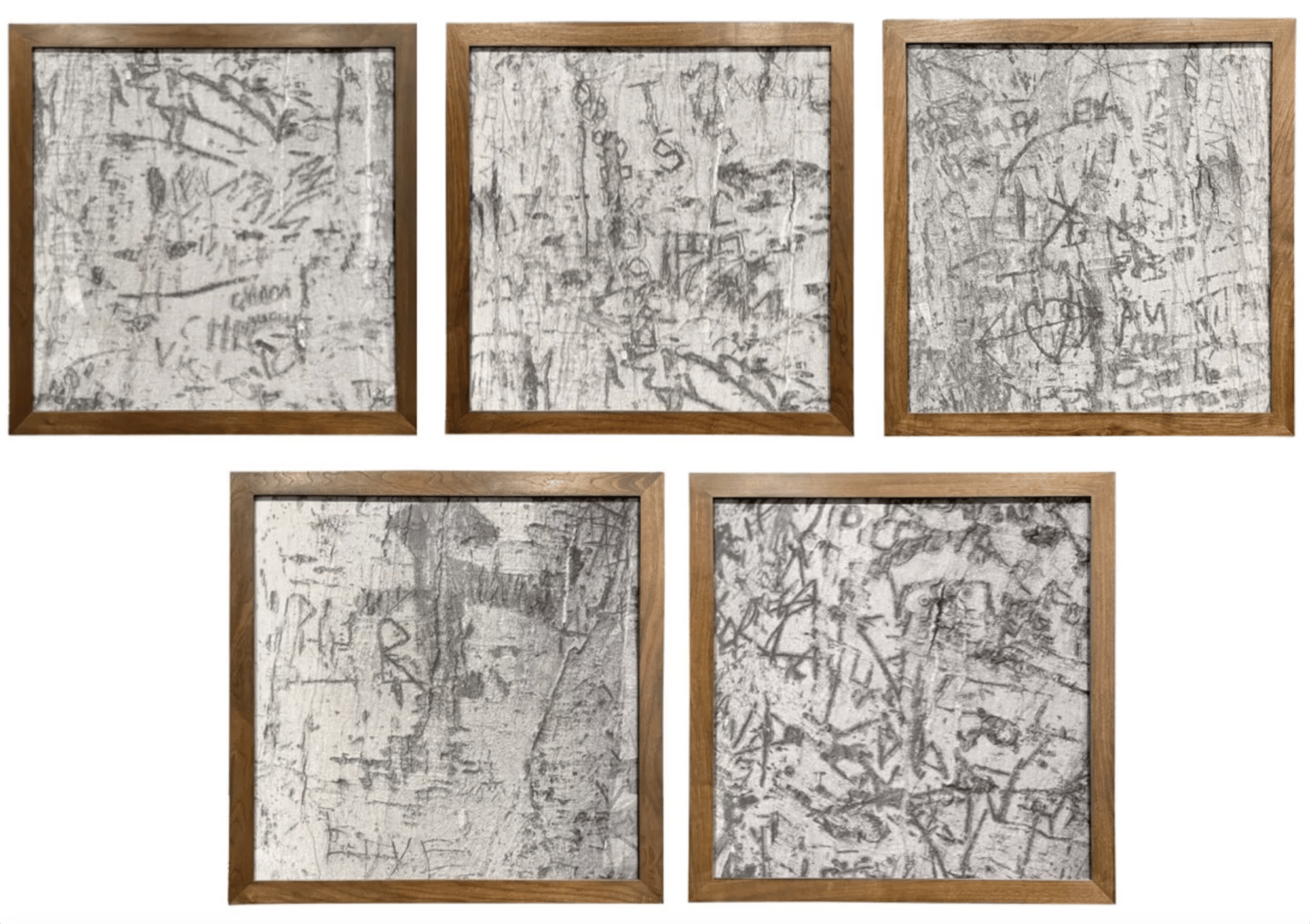
1 work in 5 parts with frames. Chromogenic print. Each 35 x 35 Inches. Framed by the artist.
Five nearly square panels, each framed in raw wood, hang together as one work, their surfaces covered in dense, scratched and gouged markings — tangled scrawls, half-legible letters, and scored diagonal lines that recall bark stripped by a knife or graffiti carved into a tree trunk. Rendered as chromogenic photographs rather than drawings, the images blur the line between photographic document and abstract mark-making. Spread across five separate frames, the work behaves like a fractured photograph of a single surface, each panel a close-up fragment of the same restless, carved-over texture.
Artwork Copyright © Sterling RubySterling Ruby (American/Dutch, 1972) is a contemporary artist known for his diverse practice encompassing ceramics, painting, sculpture, and textiles. His work often explores themes of American culture, violence, and social issues, challenging traditional artistic boundaries. Ruby's pieces are featured in major institutions like the Museum of Modern Art and the Tate Modern.
Artwork Copyright © Sterling RubyCurving (Tree), 2006
Form
Medium
Size
- Inches
- Centimeters
Edition
Price
- USD
- EUR
- GBP
- CHF
- Authenticity Guaranteed
- Insured Shipping
- Online Since 2005
●Inventory 17678
●Signed
●Comes with gallery invoice and certificate
●Sell Us a Similar Artwork. Learn more.
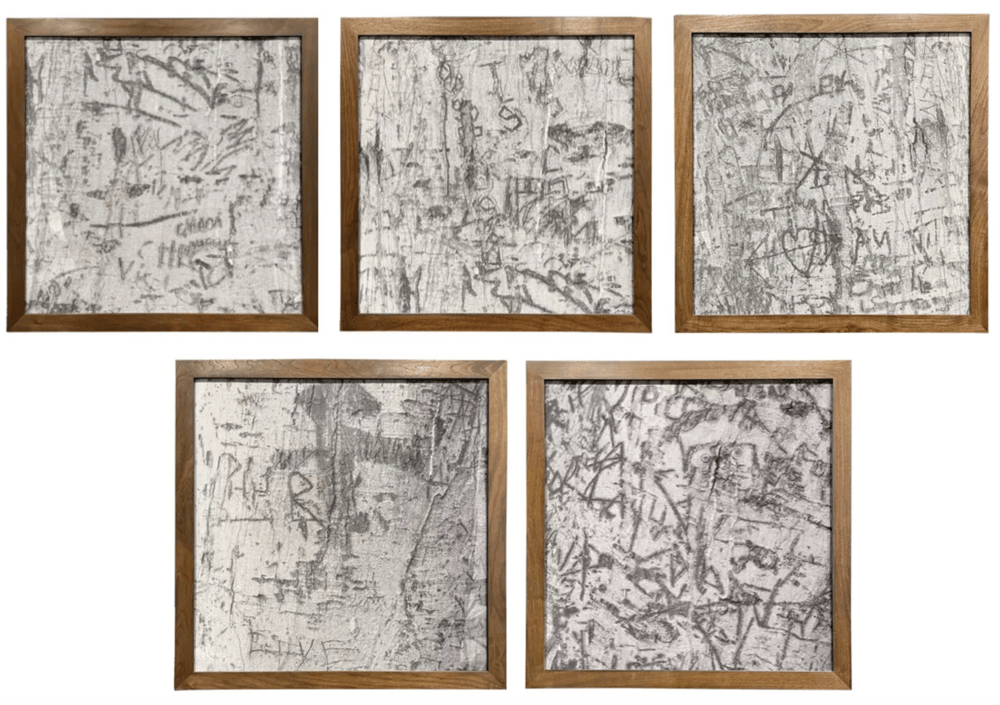
1 work in 5 parts with frames. Chromogenic print. Each 35 x 35 Inches. Framed by the artist.
Five nearly square panels, each framed in raw wood, hang together as one work, their surfaces covered in dense, scratched and gouged markings — tangled scrawls, half-legible letters, and scored diagonal lines that recall bark stripped by a knife or graffiti carved into a tree trunk. Rendered as chromogenic photographs rather than drawings, the images blur the line between photographic document and abstract mark-making. Spread across five separate frames, the work behaves like a fractured photograph of a single surface, each panel a close-up fragment of the same restless, carved-over texture.
Artwork Copyright © Sterling RubySterling Ruby (American/Dutch, 1972) is a contemporary artist known for his diverse practice encompassing ceramics, painting, sculpture, and textiles. His work often explores themes of American culture, violence, and social issues, challenging traditional artistic boundaries. Ruby's pieces are featured in major institutions like the Museum of Modern Art and the Tate Modern.
Artwork Copyright © Sterling Ruby- Recently Added
- Price (Low-High)
- Price (High-Low)
- Year (Low-High)
- Year (High-Low)

Sterling Ruby
Curving (Tree), 2006
Limited Edition Print
C-Print
USD 29,250

Sterling Ruby
Deep Orange, 2016
Limited Edition Print
Mixed Media
Currently Not Available
Related Artists


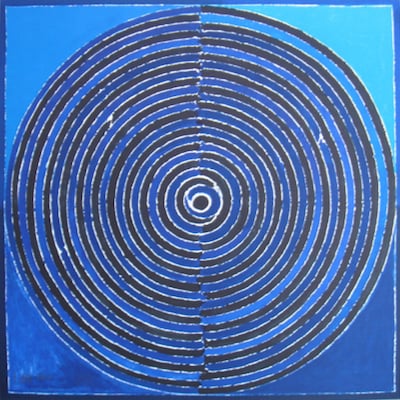
Artwork by SH Raza
What is Contemporary art from India?
Contemporary art from India dates from 1985 to the present, marking the post-liberalization era. During this period, artists have felt free to create independently of traditional Hindu or social conventions. They often incorporate distinctly Indian materials and objects in their work, reflecting a blend of modern ideas and cultural heritage.