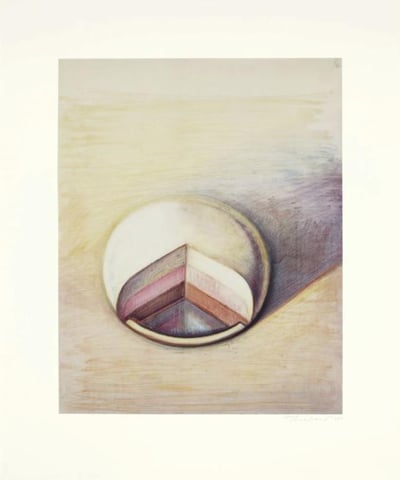
Neapolitan Pie by Wayne Thiebaud, created in 1990, is a lithograph that captures the artist’s characteristic approach to commonplace objects with a playful yet thoughtful lens. The composition centers on a round slice of Neapolitan ice cream, meticulously rendered with soft pastel tones of chocolate, vanilla, and strawberry layers, resting on a plate. Thiebaud’s use of subtle shadowing and texture emphasizes the three-dimensionality of the dessert, giving it a tactile presence. Known for his fascination with everyday Americana, Thiebaud elevates a simple dessert to a contemplative object, merging nostalgia with precision in a minimalist yet warm portrayal.
Wayne Thiebaud (USA, 1920–2021) was a celebrated painter known for his vibrant depictions of everyday objects like cakes, pies, and gumball machines. His textured brushwork and use of bold color captured the charm of Americana. A key figure in American art, Thiebaud bridged Pop Art and realism.
Lithograph Lithography is a printing method based on the principle that water and oil do not mix. It can be used to print artwork or text onto paper or other suitable materials. Traditionally, an image was drawn with wax, fat, or oil onto a lithographic limestone surface or plate. Today, metal plates and other surfaces are also used in lithographic printing.
Neapolitan Pie by Wayne Thiebaud, created in 1990, is a lithograph that captures the artist’s characteristic approach to commonplace objects with a playful yet thoughtful lens. The composition centers on a round slice of Neapolitan ice cream, meticulously rendered with soft pastel tones of chocolate, vanilla, and strawberry layers, resting on a plate. Thiebaud’s use of subtle shadowing and texture emphasizes the three-dimensionality of the dessert, giving it a tactile presence. Known for his fascination with everyday Americana, Thiebaud elevates a simple dessert to a contemplative object, merging nostalgia with precision in a minimalist yet warm portrayal.
Wayne Thiebaud (USA, 1920–2021) was a celebrated painter known for his vibrant depictions of everyday objects like cakes, pies, and gumball machines. His textured brushwork and use of bold color captured the charm of Americana. A key figure in American art, Thiebaud bridged Pop Art and realism.
My sin as a painter is that I just want to paint anything I want to paint - and
repaint.
- Wayne Thiebaud
Wayne Thiebaud (b. 1920 USA, d. 2021 USA) was an American painter best known for his vibrant depictions of everyday objects, particularly his iconic paintings of cakes, pies, and other desserts. His work is celebrated for its rich use of color, thickly applied paint, and a keen sense of light and shadow, which give his subjects a three-dimensional, almost tactile quality. Thiebaud's style blends Pop art sensibilities with a deep appreciation for traditional American realism, creating works that are both nostalgic and visually striking. Although often associated with Pop Art due to his focus on consumer goods, Thiebaud's work is distinguished by its emotional depth and subtle commentary on the passage of time and the pleasures of life. His paintings have been widely exhibited in major museums, including the Whitney Museum of American Art and the San Francisco Museum of Modern Art, establishing him as a beloved figure in American art.
Sometimes known as Figurativism, figurative art refers to sculptures and paintings that are clearly or specifically derived from real objects, making them representational. The term figurative art is often used in contrast to abstract art. However, since the emergence of abstract art, figurative art has come to describe any form of modern art that has strong references to the real world or actual situations.