

Offset print on thick archival HQ paper.
Hand signed and numbered verso in pencil.
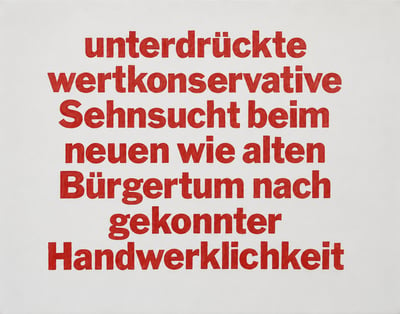
In an abysmal reaction to a review of his work in the Berlin art magazine 'Text zur Kunst', Demand has cut out the corresponding letters of an essential line in this article from red paper by hand, and combined them into a text image in the wake of conceptualism. With this volte-face of a “critique of critique” he establishes an art-historical reference to works of post-war art in which artists explicitly refer to the practice of art criticism.
Thomas Demand’s Texte zur Kunst (2010) is an offset print that transforms language into a striking visual composition through scale, typography, and graphic clarity. The work presents a block of bold red German text arranged against a white background, emphasizing both the material presence of words and their ideological charge. Demand frequently explores the relationship between image, media, and interpretation, often focusing on how meaning is constructed and reproduced. Here, the enlarged typographic format recalls advertising, political slogans, or editorial design, while the dense phrasing invites closer reading and reflection. The tension between visual immediacy and intellectual complexity reflects Demand’s broader engagement with communication, cultural memory, and systems of representation.
Artwork Copyright © Thomas DemandThomas Demand (Germany, 1964) is a conceptual artist known for his meticulously crafted, life-sized paper and cardboard models, which he photographs to create hyper-realistic images. His works often reconstruct significant or mundane scenes, exploring memory, truth, and artifice. Demand’s art has been exhibited globally, including at the Venice Biennale.
Artwork Copyright © Thomas DemandTexte zur Kunst, 2010
Form
Medium
Size
- Inches
- Centimeters
Edition
Price
- USD
- EUR
- GBP
- CHF
- Authenticity Guaranteed
- Insured Shipping
- Online Since 2005
●Inventory 17541
●Signed
●Comes with gallery invoice and certificate
●Sell Us a Similar Artwork. Learn more.
Offset print on thick archival HQ paper.
Hand signed and numbered verso in pencil.
In an abysmal reaction to a review of his work in the Berlin art magazine 'Text zur Kunst', Demand has cut out the corresponding letters of an essential line in this article from red paper by hand, and combined them into a text image in the wake of conceptualism. With this volte-face of a “critique of critique” he establishes an art-historical reference to works of post-war art in which artists explicitly refer to the practice of art criticism.
Thomas Demand’s Texte zur Kunst (2010) is an offset print that transforms language into a striking visual composition through scale, typography, and graphic clarity. The work presents a block of bold red German text arranged against a white background, emphasizing both the material presence of words and their ideological charge. Demand frequently explores the relationship between image, media, and interpretation, often focusing on how meaning is constructed and reproduced. Here, the enlarged typographic format recalls advertising, political slogans, or editorial design, while the dense phrasing invites closer reading and reflection. The tension between visual immediacy and intellectual complexity reflects Demand’s broader engagement with communication, cultural memory, and systems of representation.
Artwork Copyright © Thomas DemandThomas Demand (Germany, 1964) is a conceptual artist known for his meticulously crafted, life-sized paper and cardboard models, which he photographs to create hyper-realistic images. His works often reconstruct significant or mundane scenes, exploring memory, truth, and artifice. Demand’s art has been exhibited globally, including at the Venice Biennale.
Artwork Copyright © Thomas Demand- Recently Added
- Price (Low-High)
- Price (High-Low)
- Year (Low-High)
- Year (High-Low)
Thomas Demand
Texte zur Kunst, 2010
Limited Edition Print
Offset Print
EUR 780

Thomas Demand
Ex Libris #9, 2006
Limited Edition Print
Screen-print
EUR 2,400

Thomas Demand
Bullion, 2003
Limited Edition Print
Lambda print
EUR 4,250
Related Artists


Artwork by John Baldessari
What is conceptual art?
Sometimes referred to as Conceptualism, this is an art form where the idea(s) or concept(s) behind the work take precedence over material concerns and traditional aesthetics. Many conceptual artworks can be created by anyone simply by following written instructions. The concept or idea is the most essential aspect of the artwork.


Thomas Demand
Texte zur Kunst, 2010
102 x 122 cm


