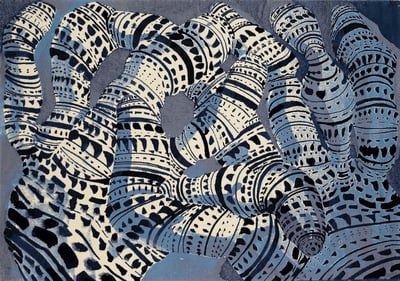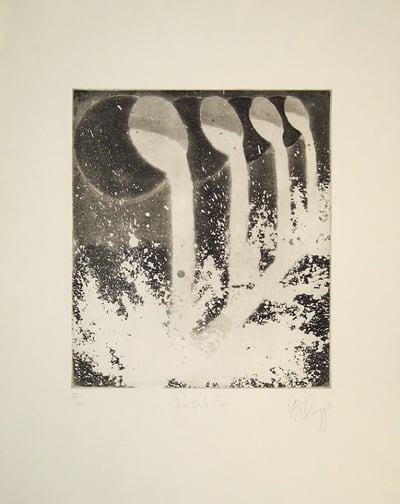
// Administred Landscape II by Tony Cragg is a limited edition lithograph that explores organic forms through a monochromatic palette. This piece, part of an edition of 50, showcases Cragg’s fascination with textures and fluid, almost geological shapes. The forms appear like rounded, eroded stones or abstracted organic matter, with sweeping brush-like strokes that add depth and motion. Cragg, a renowned British sculptor, often investigates the relationship between natural forms and human intervention, and this lithograph captures that dialogue in a simplified, yet evocative composition. Measuring 58.5 cm by 45.5 cm, this artwork invites contemplation on the transformation of natural landscapes through human influence.
Tony Cragg (UK, 1949) is an influential sculptor known for his innovative use of materials, including wood, metal, plastic, and glass. His abstract, dynamic forms explore the relationship between nature, man-made objects, and space. A Turner Prize winner, Cragg’s work has been exhibited globally, cementing his legacy in contemporary sculpture.
Lithograph Lithography is a printing method based on the principle that water and oil do not mix. It can be used to print artwork or text onto paper or other suitable materials. Traditionally, an image was drawn with wax, fat, or oil onto a lithographic limestone surface or plate. Today, metal plates and other surfaces are also used in lithographic printing.
// Administred Landscape II by Tony Cragg is a limited edition lithograph that explores organic forms through a monochromatic palette. This piece, part of an edition of 50, showcases Cragg’s fascination with textures and fluid, almost geological shapes. The forms appear like rounded, eroded stones or abstracted organic matter, with sweeping brush-like strokes that add depth and motion. Cragg, a renowned British sculptor, often investigates the relationship between natural forms and human intervention, and this lithograph captures that dialogue in a simplified, yet evocative composition. Measuring 58.5 cm by 45.5 cm, this artwork invites contemplation on the transformation of natural landscapes through human influence.
Tony Cragg (UK, 1949) is an influential sculptor known for his innovative use of materials, including wood, metal, plastic, and glass. His abstract, dynamic forms explore the relationship between nature, man-made objects, and space. A Turner Prize winner, Cragg’s work has been exhibited globally, cementing his legacy in contemporary sculpture.
I am most interested in the emotional qualities of things.
- Tony Cragg
One of the most prominent sculptors in the world, Tony Cragg is renowned for his liberal use of a wide range of materials throughout his art. Cragg's works can vary from swirling abstractions - as seen in his Point of View piece - to political statements; Britain Seen From the North is one of his earliest outputs and is comprised of various scrap materials - the piece outlines the island of Britain and depicts a figure observing it – this figure is said to represent Cragg viewing his nation as an outsider, a theme that relates to Britain under Thatcher’s reign as Prime Minister. Materials used in Cragg’s sculptures range from wood to Kevlar to plastic – his work is designed with the idea of challenging pre-existing notions regarding certain materials; Early Forms makes use of various different containers, all of which are manipulated and assembled to take on a new form and present the viewer with a different perspective. (Artist website)
New British Sculpture is the name referring to the work produced by a group of sculptors, installation artists, and other creators who exhibited together in London during the 1980s. This group included artists like Richard Deacon, Richard Wentworth, and Tony Cragg. Tim Woods helped define this movement by identifying four major themes: the blending of kitsch and pop culture, the use of UK urban waste in a bricolage style, the assignment of new meanings to everyday objects, and a playful approach using wit and humor.