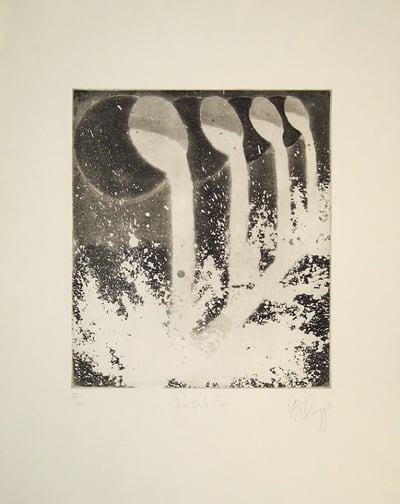
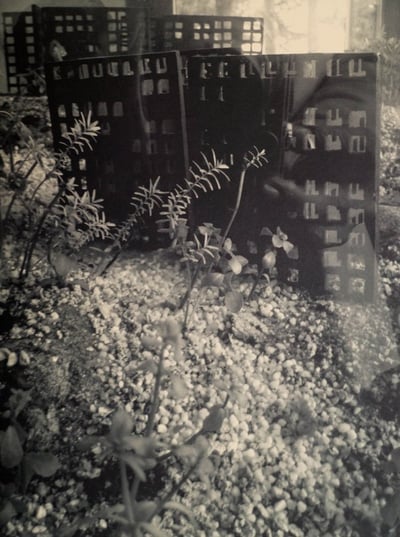
// Die erste Ära (The First Era) by Tony Cragg is an etching that evokes a sense of cosmic mystery and the passage of time. The monochromatic composition features a series of elongated, organic forms rising upward, resembling silhouettes of abstracted plant stems or celestial bodies emerging from a textured, almost explosive background. The artwork’s tonal variations, with its rich blacks and faded whites, create depth and suggest movement, as if capturing a primordial scene or an otherworldly landscape. Cragg, known for his exploration of form and materials, here experiments with abstraction to convey the beginning of an unknown journey or era. Measuring 53.5 cm by 41 cm, this limited edition print encourages viewers to interpret its imagery as they ponder themes of creation, evolution, and transformation.
Tony Cragg (UK, 1949) is an influential sculptor known for his innovative use of materials, including wood, metal, plastic, and glass. His abstract, dynamic forms explore the relationship between nature, man-made objects, and space. A Turner Prize winner, Cragg’s work has been exhibited globally, cementing his legacy in contemporary sculpture.
EtchingEtching is a technique where a design is created on a metal surface by using a strong acid or mordant to eat away the unprotected parts of the metal, leaving the desired pattern in relief (intaglio). In modern art and manufacturing, different chemicals may be used depending on the material being etched.
// Die erste Ära (The First Era) by Tony Cragg is an etching that evokes a sense of cosmic mystery and the passage of time. The monochromatic composition features a series of elongated, organic forms rising upward, resembling silhouettes of abstracted plant stems or celestial bodies emerging from a textured, almost explosive background. The artwork’s tonal variations, with its rich blacks and faded whites, create depth and suggest movement, as if capturing a primordial scene or an otherworldly landscape. Cragg, known for his exploration of form and materials, here experiments with abstraction to convey the beginning of an unknown journey or era. Measuring 53.5 cm by 41 cm, this limited edition print encourages viewers to interpret its imagery as they ponder themes of creation, evolution, and transformation.
Tony Cragg (UK, 1949) is an influential sculptor known for his innovative use of materials, including wood, metal, plastic, and glass. His abstract, dynamic forms explore the relationship between nature, man-made objects, and space. A Turner Prize winner, Cragg’s work has been exhibited globally, cementing his legacy in contemporary sculpture.
I am most interested in the emotional qualities of things.
- Tony Cragg
One of the most prominent sculptors in the world, Tony Cragg is renowned for his liberal use of a wide range of materials throughout his art. Cragg's works can vary from swirling abstractions - as seen in his Point of View piece - to political statements; Britain Seen From the North is one of his earliest outputs and is comprised of various scrap materials - the piece outlines the island of Britain and depicts a figure observing it – this figure is said to represent Cragg viewing his nation as an outsider, a theme that relates to Britain under Thatcher’s reign as Prime Minister. Materials used in Cragg’s sculptures range from wood to Kevlar to plastic – his work is designed with the idea of challenging pre-existing notions regarding certain materials; Early Forms makes use of various different containers, all of which are manipulated and assembled to take on a new form and present the viewer with a different perspective. (Artist website)
Contemporary art refers to avant-garde or innovative art created in the recent past or present day. The exact starting point of contemporary art varies depending on the institution, often tied to the founding year of museums or galleries that showcase the style. Contemporary art is characterized by its focus on current ideas, diverse media, and the exploration of new concepts and techniques.