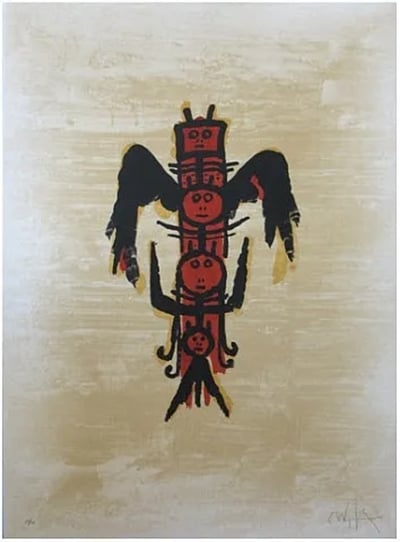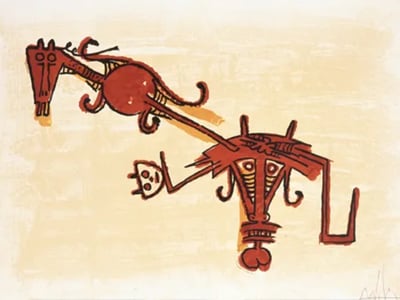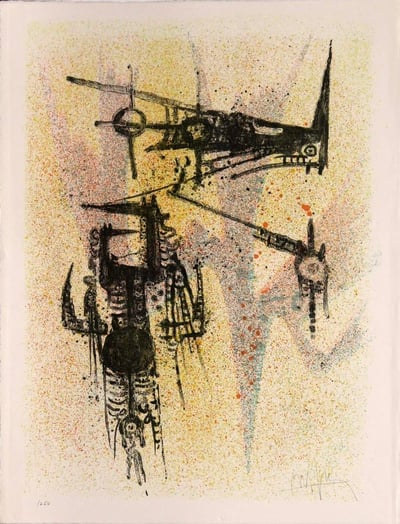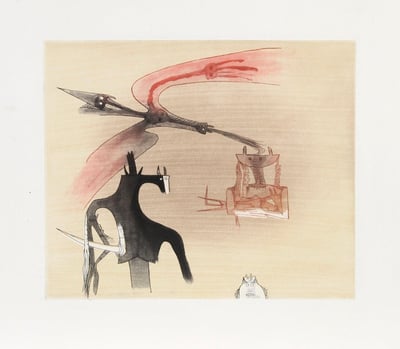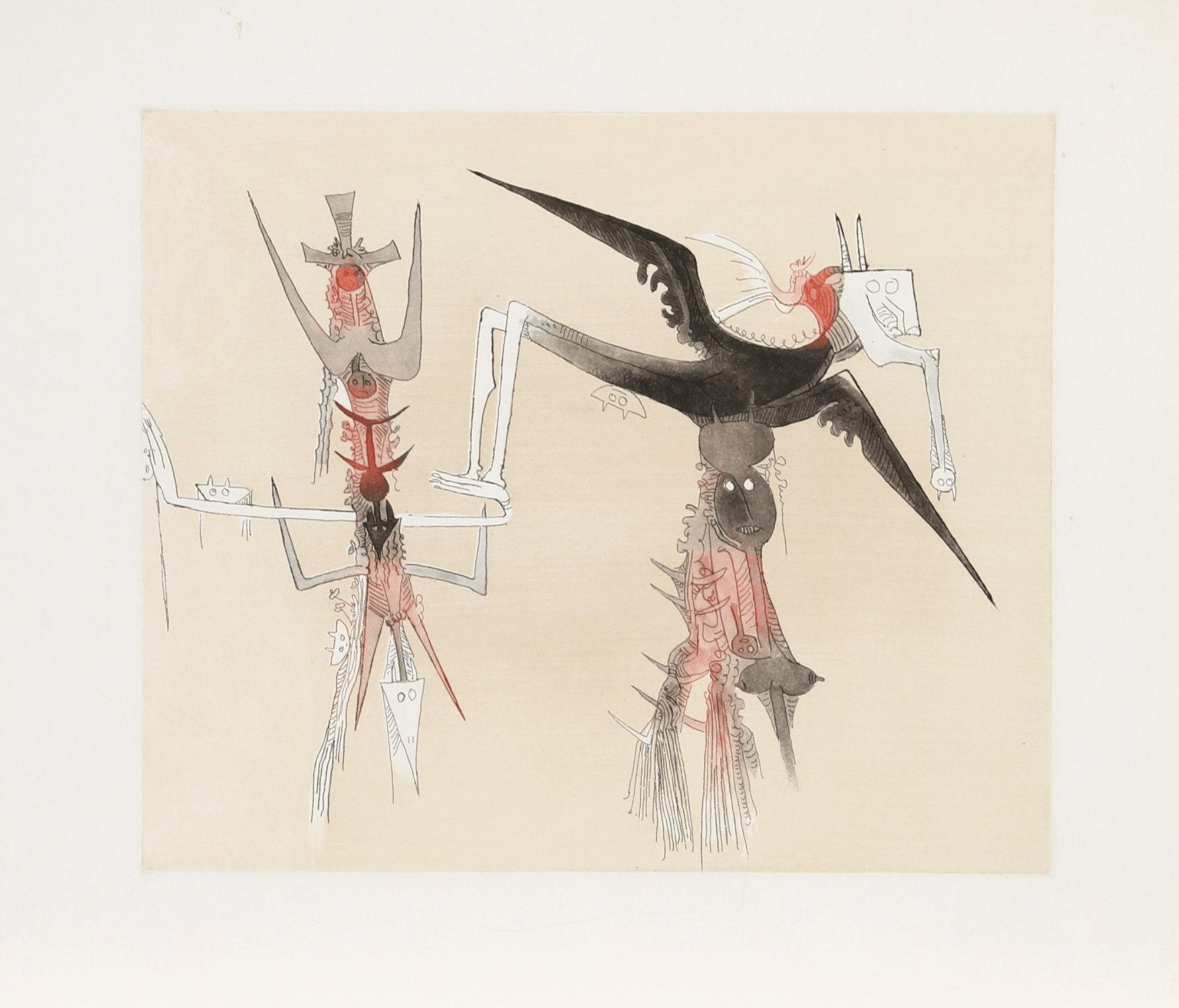
Work signed on the bottom right. - Published by Societè Internationale d'Art WWe Siecie, Paris. - From portfolio: Contre une maison sèche, 1977 - Size: 33x39 cm. (plate), 50x66 cm. (sheet)
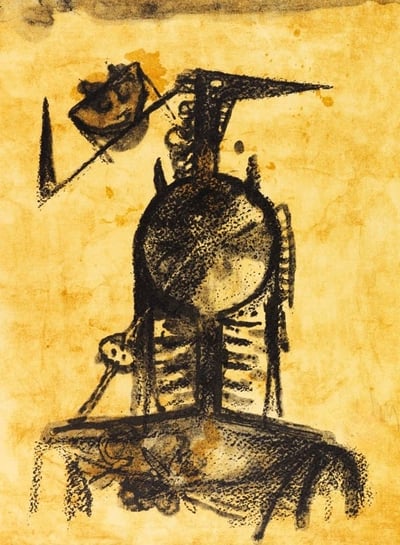
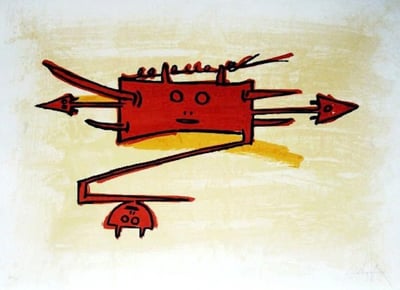
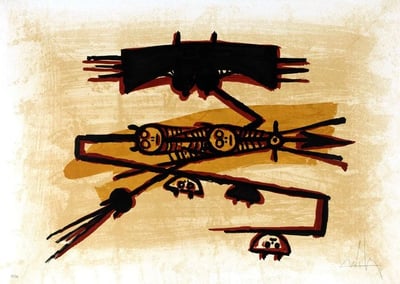
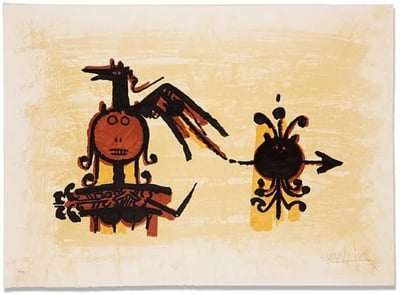
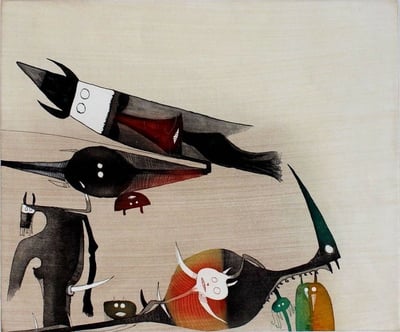
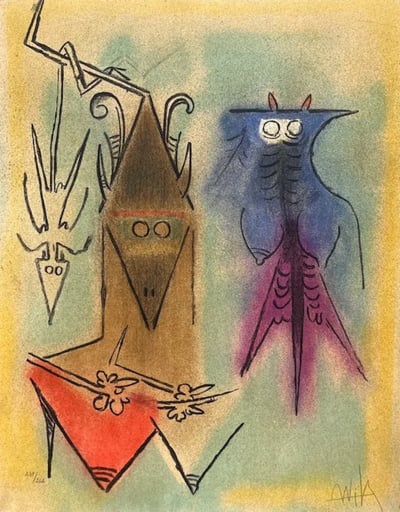
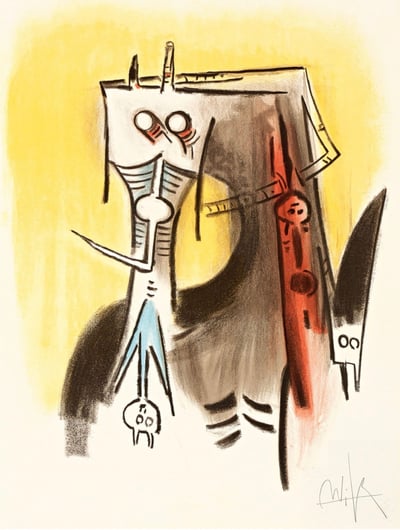
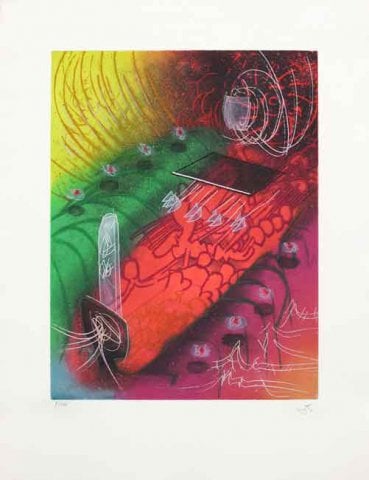
Contre une maison sèche (light) by Wifredo Lam, created in 1977, is an etching and aquatint print that embodies the artist’s fascination with mythical figures and surrealist forms. The artwork features two elongated, humanoid creatures with intricate, skeletal limbs and expressive gestures. One figure has wings, evoking a bird-like, otherworldly presence, while the other has angular, elongated shapes. The muted color palette and delicate lines give the composition an ethereal, dreamlike quality, reminiscent of both African and Caribbean spiritual imagery, which heavily influenced Lam's work. This piece reflects Lam’s exploration of identity, spirituality, and mysticism.
Wifredo Lam (Cuba, 1902–1982) was a groundbreaking painter known for blending Surrealism, Cubism, and Afro-Cuban symbolism. Influenced by his Afro-Caribbean heritage and European modernism, his works, such as The Jungle (1943), explore identity and spiritual themes. Lam’s unique style made him a pivotal figure in 20th-century modern art.
Etching and AquatintEtching and aquatint are printmaking techniques. In aquatint, the printing plate is etched with a pattern of tiny pits and cracks to create a wide range of tonal gradations. This technique allows artists to replicate the broad, flat tones found in watercolor paintings and ink washes.
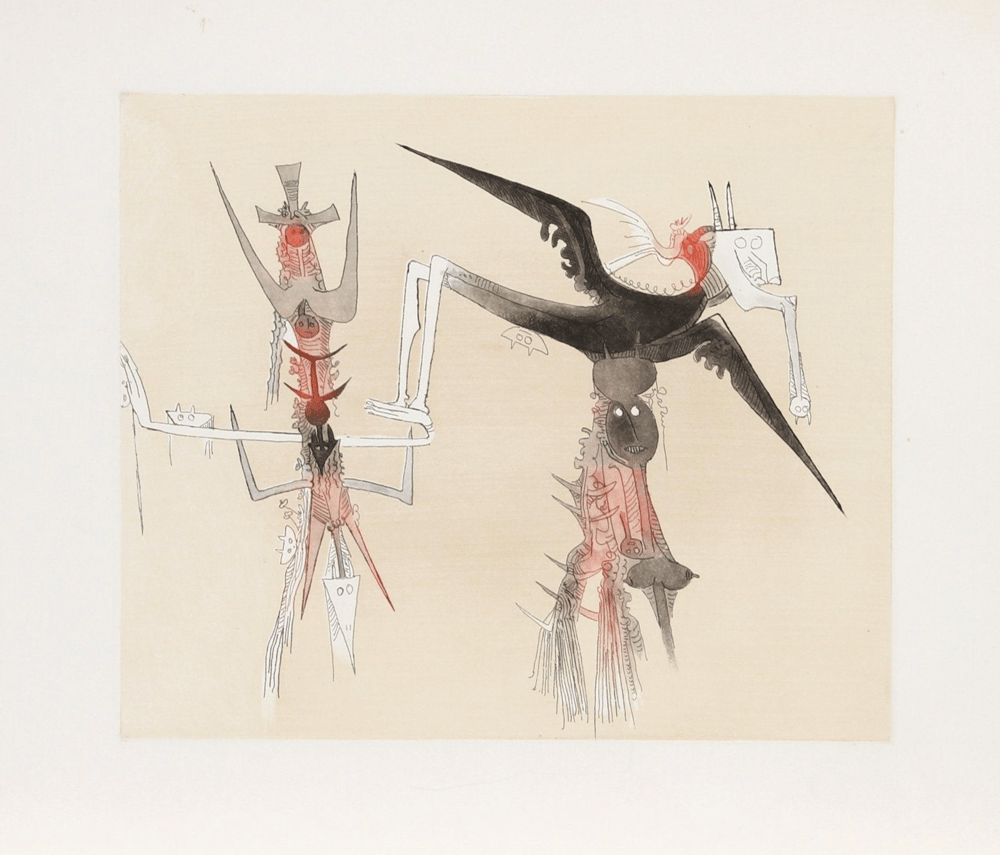
Work signed on the bottom right. - Published by Societè Internationale d'Art WWe Siecie, Paris. - From portfolio: Contre une maison sèche, 1977 - Size: 33x39 cm. (plate), 50x66 cm. (sheet)
Contre une maison sèche (light) by Wifredo Lam, created in 1977, is an etching and aquatint print that embodies the artist’s fascination with mythical figures and surrealist forms. The artwork features two elongated, humanoid creatures with intricate, skeletal limbs and expressive gestures. One figure has wings, evoking a bird-like, otherworldly presence, while the other has angular, elongated shapes. The muted color palette and delicate lines give the composition an ethereal, dreamlike quality, reminiscent of both African and Caribbean spiritual imagery, which heavily influenced Lam's work. This piece reflects Lam’s exploration of identity, spirituality, and mysticism.
Wifredo Lam (Cuba, 1902–1982) was a groundbreaking painter known for blending Surrealism, Cubism, and Afro-Cuban symbolism. Influenced by his Afro-Caribbean heritage and European modernism, his works, such as The Jungle (1943), explore identity and spiritual themes. Lam’s unique style made him a pivotal figure in 20th-century modern art.
A true picture has the power to set the imagination to work.
- Wifredo Lam
Wifredo Lam was a Cuban-born artist who attained fame for his work as a painter. A participant in the Modern Art movement, Lam studied at the Escuela de Bellas Artes in Madrid, Spain after leaving his native Havana. Lam's Afro-Cuban ancestry, coupled with his sympathy towards the poor, underrepresented and oppressed inspired him to depict typically dark, emotionally intense images of people in struggle. Wifredo Lam enjoyed a long-standing friendship with famed artist Pablo Picasso, who often championed Lam's work. Wifredo Lam’s first exhibition happened at the Gallerie Pierre Loeb in Paris, France in 1939. Later that year, he exhibited his work alongside Picasso at an exhibition inside New York City's Perls Galleries. At the time of his death more than forty years hence, Lam's art had been featured in over one hundred museums and galleries across the globe and a number of his individual works have hung at world-renowned museums like the Art Institute of Chicago, the Museum of Modern Art (MoMA) in New York City, as well as New York's Solomon R. Guggenheim Museum. After fleeing war-ravaged France in 1941, Wifredo Lam was detained in a prison on the Caribbean island of Martinique for forty days. In 2015, Wifredo Lam’s creations will be featured as part of a traveling exhibition, which will begin at the Centre Pompidou Museum in Paris and make stops, first at the Reina Sofia Museum in Spain and finally at London's Tate Museum. Lam died in Paris in 1982 at the age of 79. (Artist website)
Latin American Art is a style which takes inspiration from its culture, society, politics, native traditions, religions and landscape. Op-Art and Kinetic Art figure prominently in Latin artworks. Colors in Latin American compositions are often bold. Latin American artists work in all media and movements.