
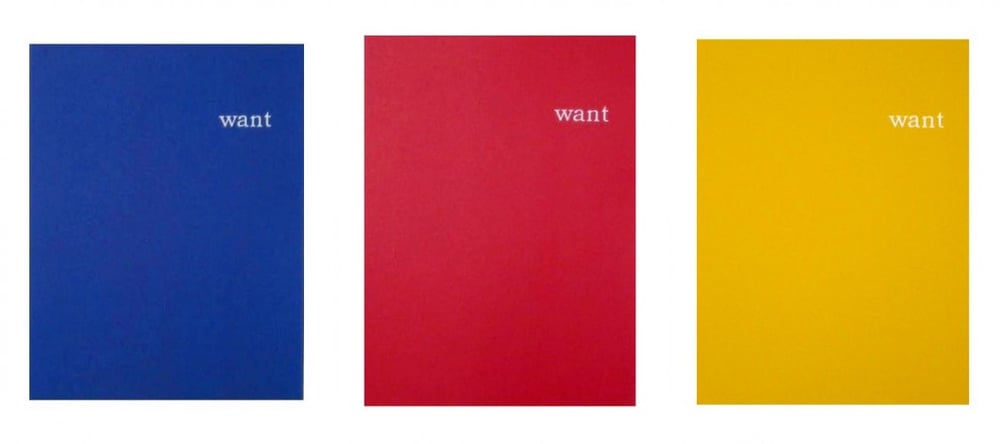
Edition of 34 Silkscreen, Price is for the set of three. size: 66 x 59 cm each
The Want Portfolio (3) by William Anastasi is a minimalist silkscreen print series that explores the concept of desire through simplicity and repetition. Each print in the set of three features the word want in lowercase, placed subtly on monochromatic backgrounds of blue, red, and yellow, which are bold primary colors. The unembellished presentation of a single word on each print encourages viewers to reflect on the nature of desire itself, stripped of context or object, and perhaps to question what want signifies in its purest form. This limited edition series, with only 34 sets produced, embodies Anastasi's philosophical approach to language and art, where minimalism becomes a medium for profound inquiry.
Artwork Copyright © William AnastasiWilliam Anastasi (USA, 1933–2023) was a pioneering conceptual artist whose work explored chance, indeterminacy, and the unconscious. Known for his 'Subway Drawings,' created in transit with closed eyes, Anastasi challenged traditional artistic authorship. His innovative practice included drawing, sculpture, photography, and sound art, with works held in major museums like MoMA and the Whitney.
Artwork Copyright © William AnastasiThe Want Portfolio (3)
Form
Medium
Size
- Inches
- Centimeters
Edition
Price
- USD
- EUR
- GBP
- CHF
- Authenticity Guaranteed
- Insured Shipping
- Online Since 2005
●Inventory 3198
●Signed
●Comes with gallery invoice and certificate
●Sell Us a Similar Artwork. Learn more.
Edition of 34 Silkscreen, Price is for the set of three. size: 66 x 59 cm each
The Want Portfolio (3) by William Anastasi is a minimalist silkscreen print series that explores the concept of desire through simplicity and repetition. Each print in the set of three features the word want in lowercase, placed subtly on monochromatic backgrounds of blue, red, and yellow, which are bold primary colors. The unembellished presentation of a single word on each print encourages viewers to reflect on the nature of desire itself, stripped of context or object, and perhaps to question what want signifies in its purest form. This limited edition series, with only 34 sets produced, embodies Anastasi's philosophical approach to language and art, where minimalism becomes a medium for profound inquiry.
Artwork Copyright © William AnastasiWilliam Anastasi (USA, 1933–2023) was a pioneering conceptual artist whose work explored chance, indeterminacy, and the unconscious. Known for his 'Subway Drawings,' created in transit with closed eyes, Anastasi challenged traditional artistic authorship. His innovative practice included drawing, sculpture, photography, and sound art, with works held in major museums like MoMA and the Whitney.
Artwork Copyright © William Anastasi- Recently Added
- Price (Low-High)
- Price (High-Low)
- Year (Low-High)
- Year (High-Low)

William Anastasi
A Painting of a Soup Can
Limited Edition Print
Silkscreen
USD 2,400

William Anastasi
The Want Portfolio (3)
Limited Edition Print
Silkscreen
USD 7,800

William Anastasi
Red Marilyn
Limited Edition Print
Etching
USD 3,800
Related Artists

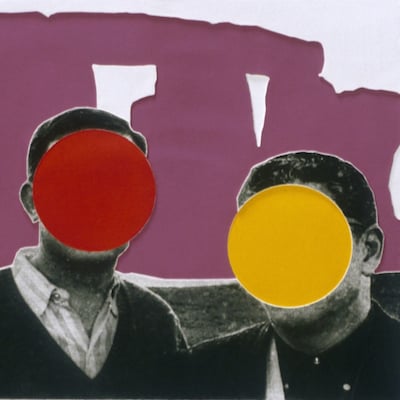
Artwork by John Baldessari
What is conceptual art?
Sometimes referred to as Conceptualism, this is an art form where the idea(s) or concept(s) behind the work take precedence over material concerns and traditional aesthetics. Many conceptual artworks can be created by anyone simply by following written instructions. The concept or idea is the most essential aspect of the artwork.


William Anastasi
The Want Portfolio (3)
66 x 59 cm


