

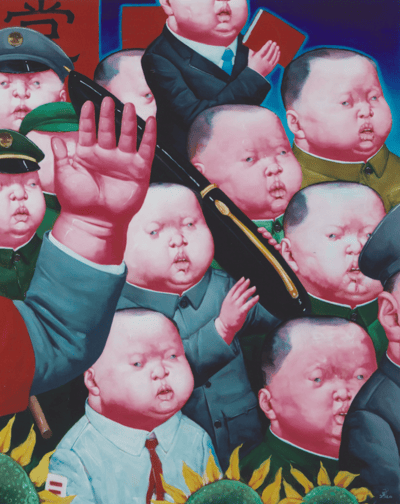
// Chinese Fairytale - Ceremony 3 by Yin Kun is a vivid oil painting created in 2013 that satirizes authoritarian imagery with a surreal twist. The artwork features a collection of infant-like figures dressed in military and formal attire, their exaggeratedly round faces and closed eyes giving them a peculiar, almost robotic appearance. The figures appear in a crowded, ceremonial setting, some making gestures reminiscent of official salutes or symbolic movements, alluding to themes of conformity and control. The background is a bold mix of red and blue, intensifying the sense of surrealism. Yin Kun uses humor and absurdity to critique political and cultural rituals, creating a powerful commentary on identity, authority, and individuality within collective ideology. Measuring 150 cm by 120 cm, this work encapsulates the artist’s unique approach to social critique through playful yet unsettling imagery.
Artwork Copyright © Yin KunYin Kun (China, 1969) is a contemporary artist renowned for his provocative paintings that critique political power, consumerism, and societal norms. His surreal imagery often features exaggerated figures and distorted realities, challenging perceptions and sparking dialogue. Exhibited internationally, Yin’s work offers a sharp lens on modern social issues.
Artwork Copyright © Yin KunChinese Fairytale - Ceremony 3, 2013
Form
Medium
Size
- Inches
- Centimeters
Edition
Price
- Authenticity Guaranteed
- Insured Shipping
- Online Since 2005
●Inventory 6673
●Signed
●Comes with gallery invoice and certificate
●Sell Us a Similar Artwork. Learn more.
// Chinese Fairytale - Ceremony 3 by Yin Kun is a vivid oil painting created in 2013 that satirizes authoritarian imagery with a surreal twist. The artwork features a collection of infant-like figures dressed in military and formal attire, their exaggeratedly round faces and closed eyes giving them a peculiar, almost robotic appearance. The figures appear in a crowded, ceremonial setting, some making gestures reminiscent of official salutes or symbolic movements, alluding to themes of conformity and control. The background is a bold mix of red and blue, intensifying the sense of surrealism. Yin Kun uses humor and absurdity to critique political and cultural rituals, creating a powerful commentary on identity, authority, and individuality within collective ideology. Measuring 150 cm by 120 cm, this work encapsulates the artist’s unique approach to social critique through playful yet unsettling imagery.
Artwork Copyright © Yin KunYin Kun (China, 1969) is a contemporary artist renowned for his provocative paintings that critique political power, consumerism, and societal norms. His surreal imagery often features exaggerated figures and distorted realities, challenging perceptions and sparking dialogue. Exhibited internationally, Yin’s work offers a sharp lens on modern social issues.
Artwork Copyright © Yin KunAvailability
Size
SORT BY
Yin Kun
Private Listing
Painting
request info
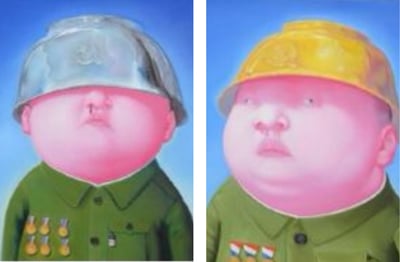
Yin Kun
Commentator Golden & Iron Bowl, 2014
Painting
Oil on canvas
USD 43,750

Yin Kun
Chinese Fairytales - Walk, 2013
Painting
Oil on canvas
USD 6,500
Yin Kun
Chinese Fairytale - Ceremony 3, 2013
Painting
Oil on canvas
Make Your Offer

Yin Kun
Chinese Baby 11-05, 2011
Painting
Oil on canvas
USD 17,200

Yin Kun
Chinese honey, 2005
Painting
Oil on canvas
EUR 4,620
Related Artists


Artwork by Raymond Pettibon
What is Comic Strip Art?
Comic strip art refers to artwork that utilizes the subject matter and commercial printing techniques found in comic strips. In the 1960s, a group of artists began creating paintings that incorporated Ben-Day dots—commonly used in comics and advertising—to produce highly graphic designs in bright colors, using traditional art media.

Yin Kun
Chinese Fairytale - Ceremony 3, 2013
150 x 120 cm


