

Hiroshi Sugimoto
Hiroshi Sugimoto (Japan, 1948) is a celebrated photographer and multidisciplinary artist, renowned for his black-and-white series that explore time, memory, and perception. Iconic works include 'Seascapes,' capturing serene horizons, and 'Theaters,' long exposures of illuminated screens. His art bridges conceptual and minimalist traditions, with pieces held in top museums worldwide.
© Hiroshi Sugimoto. All rights reserved.
- Recently Added
- Price (Low-High)
- Price (High-Low)
- Year (Low-High)
- Year (High-Low)

Hiroshi Sugimoto
Necklace of Jane Seymour, 2000
Sculpture / Object
Mixed Media
EUR 1,100

Hiroshi Sugimoto
Mechanical Form 0046, Material Testing Machine, 2005
Photography
Gelatin Silver Print
EUR 12,250
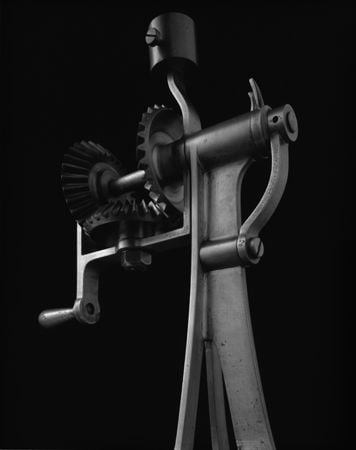
Hiroshi Sugimoto
Differential bevel gear, 2004
Photography
Gelatin Silver Print
EUR 21,400
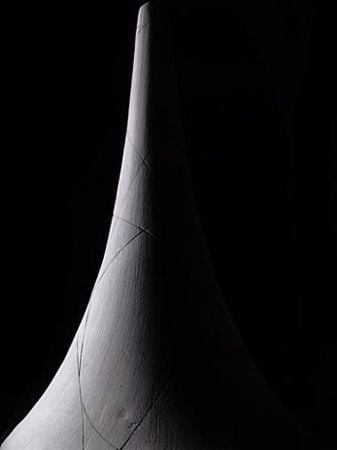
Hiroshi Sugimoto
Surface of revolution with constant negative curvature, 2004
Photography
Gelatin Silver Print
EUR 21,400
I try to never be satisfied; this way I will always be challenging my spirit.
- Hiroshi Sugimoto
- Hiroshi Sugimoto
Hiroshi Sugimoto is a photographer from Japan. He speaks of his work as showing "time exposed," which means that his images provide a lasting record for events that happen. Hiroshi Sugimoto’s image also center around the transience that is a part of life and the ongoing struggle between death and life. He took many of his influences from the works and writings of Marcel Duchamp as well as other Surrealist and Dadaist artists. Hiroshi Sugimoto also draws from influences in architecture from the late twentieth century. Sugimoto's photography involves using an 8x10 large-format camera with lengthy exposures. These choices have brought him a reputation for extreme technical skill. He has also received kudos for the philosophical and thematic elements of his photographs. Hiroshi Sugimoto’s most famous series are Dioramas, Portraits, Theaters and Seascapes. Dioramas focused on natural history museum displays, first at the American Museum of National History and later at other museums. Theatre’s includes photos of old movie theaters and drive-ins in the United States, shot with a 4x5 folding camera with tripod.Seascapes is a series of images of the horizon of the sea, with a large-format camera. Hiroshi Sugimoto also has taken pictures of many modern architectural works, starting with the Hall of 33 Bays in Kyoto but then moving to a series of important buildings around the globe, commissioned by Chicago's Museum of Contemporary Art. (Artist website)
Related Artists


Related Articles

Collecting - March 27, 2025
Collecting Photography: A Beginner’s Guide to Fine Art Photos
Learn how to collect fine art photography—from print types and editioning to care tips and top photographers like Adams, Sherman, and Gursky.Read More
Artists, Art Movements - October 5, 2023
Superflat: A Modern Mirror to Traditional Japanese Art
Explore the Superflat art movement and its blend of traditional Japanese aesthetics with modern culture. Discover Murakami’s iconic works and their impact.Read More
News, Popular, Collecting, Artists - August 12, 2026
In Minor Keys: Finding Intimacy and Identity at the 61st Venice Biennale — and in Your Collection
Explore how Koyo Kouoh’s 61st Venice Biennale vision, In Minor Keys, is shifting contemporary collecting toward quiet introspection, memory, and personal identi…Read More Artwork by James Turrell
What is ‘light and space’?
The Light and Space Movement refers to loosely affiliated art movements connected to minimalism, geometric abstraction, and op art that originated in Southern California in the 1960s. Greatly influenced by artist John McLaughlin, these artists focused on sensory phenomena such as light, perception, and space as central elements of their work. They also incor…
Explore »

