

What is a plate?
A plate is a broad, primarily flat vessel used for serving food, but it can also serve ceremonial or decorative purposes. Plates are typically circular, though they can be any shape and made from various water-resistant materials. Most plates have raised edges, either by curving upward or featuring a wider lip. Vessels without a raised edge or with a more rounded profile are often considered bowls or dishes, while very large, plate-shaped vessels might also be classified as dishes.
Show All
- Show All
- Established
- Discoveries
Show All
- Show All
Artworks Related to Plate

Pablo Picasso
Face No 0 Round Plate, 1963
Ceramics
Plate
USD 15,200

Pablo Picasso
Face with palm-leaves #366, 1956
Ceramics
Plate
USD 17,900
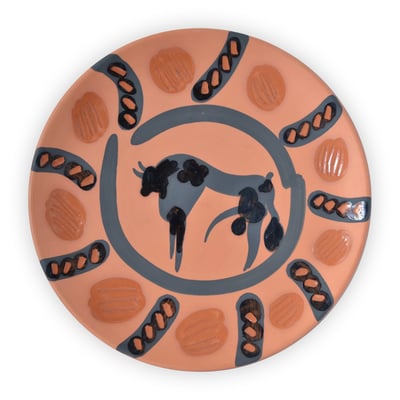
Pablo Picasso
Bull #392 R529, 1957
Ceramics
Plate
USD 15,900

Pablo Picasso
Big Fish #332 B95, 1956
Ceramics
Plate
USD 17,800

Pablo Picasso
Picador, 1952
Ceramics
Plate
USD 6,700
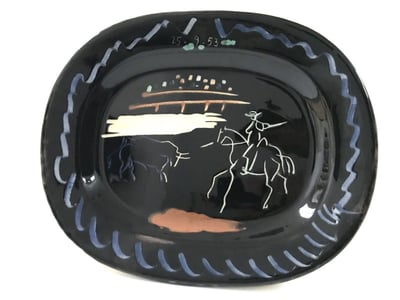
Pablo Picasso
Corrida sur fond noir, 1953
Ceramics
Plate
EUR 12,000 - 15,000
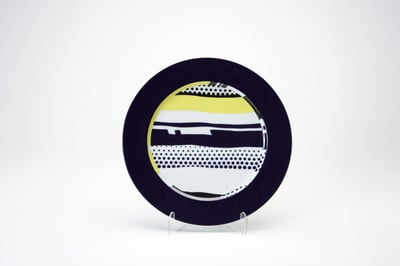
Roy Lichtenstein
Rosenthal plate 1, 2000
Sculpture / Object
Plate
EUR 700
Related Articles
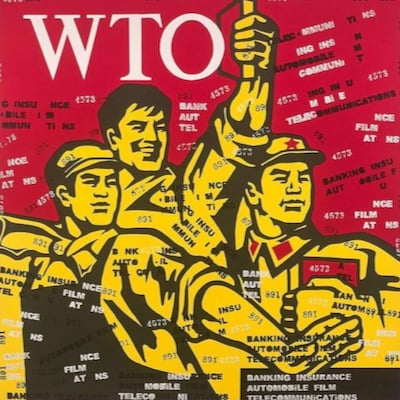
Political Pop was an art movement that emerged in China during the 1980s, blending the Pop Art style of Western countries with the socialist realism of China. This movement arose during a time of rapid social and political change in China, as artists sought to create works that questioned and critiqued these cultural shifts. Political Pop often juxtaposed iconic images from Chinese propaganda with Western consumer culture, highlighting the tensions between tradition and modernization.
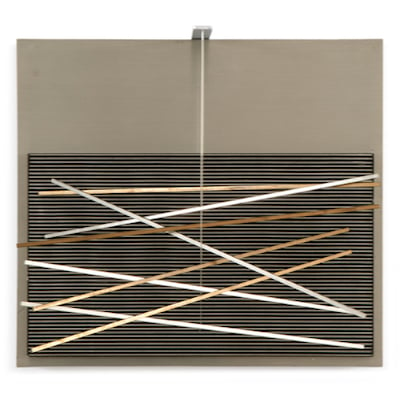
Kinetic art is an international movement that emerged in the 1920s and gained prominence in the 1960s, referring to art that involves both apparent and real motion. It encompasses any medium that includes movement, either relying on actual motion for its effect or being perceived as moving by the viewer. Early examples include canvas paintings designed to create optical illusions of movement. Today, kinetic art often refers to three-dimensional figures and sculptures, such as those operated by machines or those that move naturally. The movement covers a variety of styles and techniques that frequently overlap.

Neo-Figurative Art is a collective term that refers to the revival of figurative art in America and Europe during the 1960s, following a period dominated by abstraction. Michel Ragon, a French art critic, argued that this resurgence of figuration occurred during a critical time of social and political upheaval in both regions.
Can't find your Answer?
Thank you! Your question has been sent — we'll get back to you shortly.
