

Tela estrofelessa and Tempera
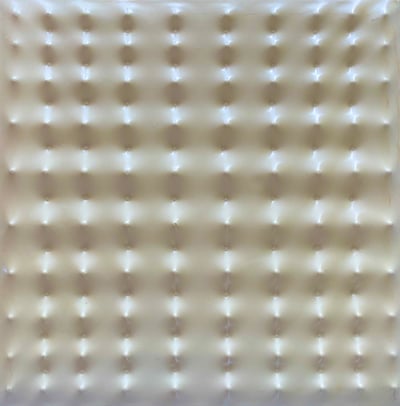
Agostino Bonalumi's Giallo (1979) is a striking mixed-media work that utilizes the technique of tela estroflessa (stretched canvas) combined with tempera. The monochromatic yellow surface is sculpted into rhythmic, three-dimensional forms, creating an interplay of light and shadow that shifts depending on the viewer's perspective. These protrusions and indentations lend a dynamic, architectural quality to the canvas, as if the artwork is emerging from within. Bonalumi’s use of a single color emphasizes the purity of form and depth, inviting contemplation of spatiality and the limits of two-dimensional surfaces in art.
Artwork Copyright © Agostino BonalumiAgostino Bonalumi (Italy, 1935–2013) was a key figure in post-war Italian art, known for his 'extroflexed' canvases that push painting into three dimensions. Associated with the Spatialist movement, his innovative works combined geometric precision with dynamic forms, redefining the boundaries between painting and sculpture.
Artwork Copyright © Agostino BonalumiGiallo, 1979
Form
Medium
Size
- Inches
- Centimeters
Edition
Price
Available works →
- Authenticity Guaranteed
- Insured Shipping
- Online Since 2005
●
●Inventory 5481
●Signed
●Comes with gallery invoice and certificate
●Sell Us a Similar Artwork. Learn more.
Tela estrofelessa and Tempera
Agostino Bonalumi's Giallo (1979) is a striking mixed-media work that utilizes the technique of tela estroflessa (stretched canvas) combined with tempera. The monochromatic yellow surface is sculpted into rhythmic, three-dimensional forms, creating an interplay of light and shadow that shifts depending on the viewer's perspective. These protrusions and indentations lend a dynamic, architectural quality to the canvas, as if the artwork is emerging from within. Bonalumi’s use of a single color emphasizes the purity of form and depth, inviting contemplation of spatiality and the limits of two-dimensional surfaces in art.
Artwork Copyright © Agostino BonalumiAgostino Bonalumi (Italy, 1935–2013) was a key figure in post-war Italian art, known for his 'extroflexed' canvases that push painting into three dimensions. Associated with the Spatialist movement, his innovative works combined geometric precision with dynamic forms, redefining the boundaries between painting and sculpture.
Artwork Copyright © Agostino Bonalumi- Recently Added
- Price (Low-High)
- Price (High-Low)
- Year (Low-High)
- Year (High-Low)

Agostino Bonalumi
Senza titolo, 1990
Sculpture / Object
Bronze
EUR 3,750

Agostino Bonalumi
Senza titolo, 1993
Limited Edition Print
Mixed Media
Currently Not Available
Available works by Agostino Bonalumi
See all →Agostino Bonalumi
Senza titolo, 1990
Sculpture / Object
Bronze
EUR 3,750
Related Artists

Artwork by Gunther Uecker
What is the Zero Movement?
ZERO was an art movement founded by Otto Piene and Heinz Mack, aiming to develop into a large international and cross-border movement. The name ZERO originated from a magazine founded by Heinz Mack in 1957, which became a platform for the group's ideas. The magazine was published for several years before ceasing in 1967. The ZERO movement sought to create a new beginning in art, emphasizing light, space, and movement, and became influential in post-war European art.


