

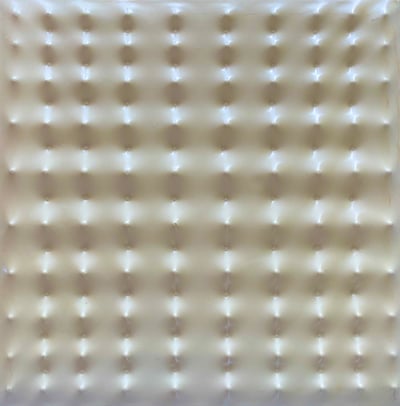
// Senza titolo by Agostino Bonalumi, created in 1990, is a bronze sculpture that reflects the artist's interest in form, tension, and the manipulation of materials to evoke a sense of movement. The piece features a rectangular shape with its surface distorted as if stretched and pulled from within, creating an illusion of elasticity despite the solid bronze medium. This tension between material and form highlights Bonalumi’s unique approach to three-dimensional art, where abstract shapes invite viewers to ponder the invisible forces acting upon them. This sculpture combines a polished finish with soft contours, lending it both a dynamic presence and an understated elegance, characteristic of Bonalumi's sculptural work.
Artwork Copyright © Agostino BonalumiAgostino Bonalumi (Italy, 1935–2013) was a key figure in post-war Italian art, known for his 'extroflexed' canvases that push painting into three dimensions. Associated with the Spatialist movement, his innovative works combined geometric precision with dynamic forms, redefining the boundaries between painting and sculpture.
Artwork Copyright © Agostino BonalumiSenza titolo, 1990
Form
Medium
Size
- Inches
- Centimeters
Edition
Price
- USD
- EUR
- GBP
- CHF
- Authenticity Guaranteed
- Insured Shipping
- Online Since 2005
●Inventory 5506
●Signed
●Comes with gallery invoice and certificate
●Sell Us a Similar Artwork. Learn more.
// Senza titolo by Agostino Bonalumi, created in 1990, is a bronze sculpture that reflects the artist's interest in form, tension, and the manipulation of materials to evoke a sense of movement. The piece features a rectangular shape with its surface distorted as if stretched and pulled from within, creating an illusion of elasticity despite the solid bronze medium. This tension between material and form highlights Bonalumi’s unique approach to three-dimensional art, where abstract shapes invite viewers to ponder the invisible forces acting upon them. This sculpture combines a polished finish with soft contours, lending it both a dynamic presence and an understated elegance, characteristic of Bonalumi's sculptural work.
Artwork Copyright © Agostino BonalumiAgostino Bonalumi (Italy, 1935–2013) was a key figure in post-war Italian art, known for his 'extroflexed' canvases that push painting into three dimensions. Associated with the Spatialist movement, his innovative works combined geometric precision with dynamic forms, redefining the boundaries between painting and sculpture.
Artwork Copyright © Agostino Bonalumi- Recently Added
- Price (Low-High)
- Price (High-Low)
- Year (Low-High)
- Year (High-Low)

Agostino Bonalumi
Senza titolo, 1990
Sculpture / Object
Bronze
EUR 3,750

Agostino Bonalumi
Senza titolo, 1993
Limited Edition Print
Mixed Media
Currently Not Available
Related Artists

Artwork by Gunther Uecker
What is the Zero Movement?
ZERO was an art movement founded by Otto Piene and Heinz Mack, aiming to develop into a large international and cross-border movement. The name ZERO originated from a magazine founded by Heinz Mack in 1957, which became a platform for the group's ideas. The magazine was published for several years before ceasing in 1967. The ZERO movement sought to create a new beginning in art, emphasizing light, space, and movement, and became influential in post-war European art.



