From Connections 1925-1983
- Screenprint on 150-gram Umbria paper
- Signed, Dated and Numbered
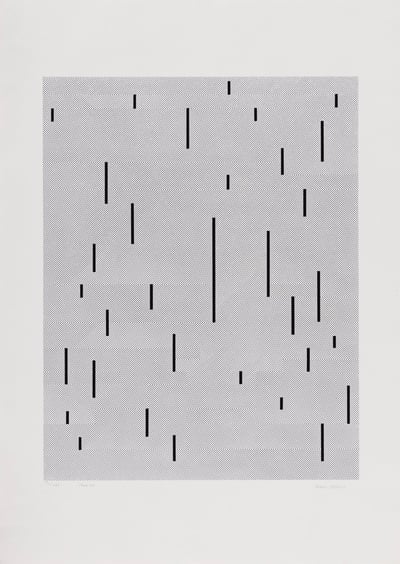
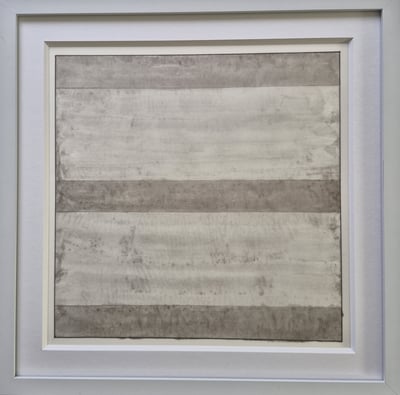
Anni Albers's Untitled 6 of 9 (from Connections), produced between 1925 and 1983, is a limited edition lithograph, part of her Connections series. Measuring 68.6 x 50.8 cm, the work presents a minimalist composition featuring thin, vertical black lines scattered across a subtly textured background of fine, grid-like patterns. The interplay between the dense grid and the elongated vertical lines creates a visual rhythm, evoking both order and randomness. This piece exemplifies Albers’s ability to merge the precision of textile design with the abstract aesthetics of modern art, highlighting her innovative approach to form and structure.
Anni Albers (Germany/USA, 1899–1994) was a visionary textile artist and printmaker who revolutionized modern weaving. A key figure in the Bauhaus movement, she combined geometric abstraction with traditional techniques. Albers’ writings, like On Weaving, and her innovative approach to textiles elevated the medium to a fine art, influencing generations of artists.
Lithograph Lithography is a printing method based on the principle that water and oil do not mix. It can be used to print artwork or text onto paper or other suitable materials. Traditionally, an image was drawn with wax, fat, or oil onto a lithographic limestone surface or plate. Today, metal plates and other surfaces are also used in lithographic printing.
From Connections 1925-1983
- Screenprint on 150-gram Umbria paper
- Signed, Dated and Numbered
Anni Albers's Untitled 6 of 9 (from Connections), produced between 1925 and 1983, is a limited edition lithograph, part of her Connections series. Measuring 68.6 x 50.8 cm, the work presents a minimalist composition featuring thin, vertical black lines scattered across a subtly textured background of fine, grid-like patterns. The interplay between the dense grid and the elongated vertical lines creates a visual rhythm, evoking both order and randomness. This piece exemplifies Albers’s ability to merge the precision of textile design with the abstract aesthetics of modern art, highlighting her innovative approach to form and structure.
Anni Albers (Germany/USA, 1899–1994) was a visionary textile artist and printmaker who revolutionized modern weaving. A key figure in the Bauhaus movement, she combined geometric abstraction with traditional techniques. Albers’ writings, like On Weaving, and her innovative approach to textiles elevated the medium to a fine art, influencing generations of artists.
You can't predict what a work of art will be like; it is a discovery.
- Anni Albers
Anni (Annelise) Albers is regarded as being a significant influence on the renaissance of abstract weaving as a viable and impressive art-form. Her work mainly consisted of textiles and prints in bold colors with a focus on geometric patterns.
Using experimental materials, including metallic thread and horsehair yarn, Anni Albers was is considered the first artist to combine avant-garde geometric abstractions and weaving, an impressive feat for an artist who chose weaving due to it being one of the few accessible disciplines available to women in the early 20th century.
Interesting to note is the evolution of Albers’ work following her move from Berlin to the United States where she found inspiration from pre-Columbian textiles which she incorporated into her later works. Where she originally focused on using old, largely forgotten techniques to create functional and aesthetically pleasing weavings, her later career saw her focus more on creating prints and drawings, with her growing reputation allowing her the freedom to chose commissions she felt passionate about.
Bauhaus was a school of art, design and architecture established in Weimar, Germany. Architect Wlater Gropius established it in 1919. Bauhaus used a method for teaching within a community of artists working together and incorporating art in the fundamentals of daily life.