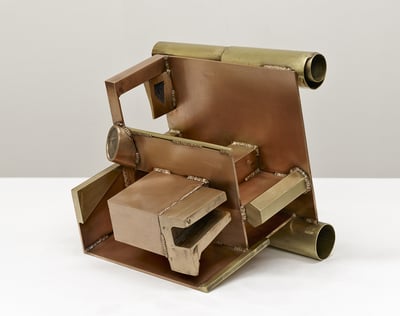
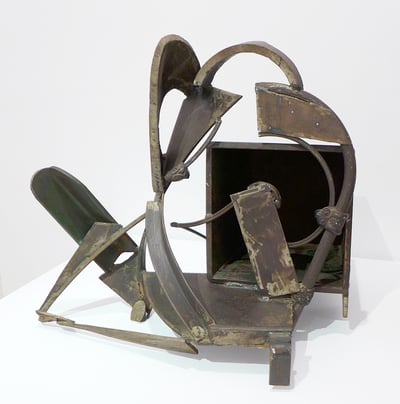
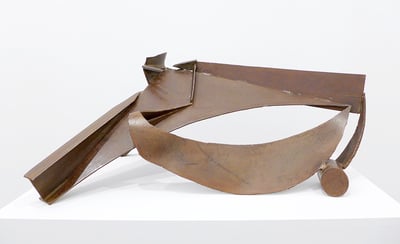
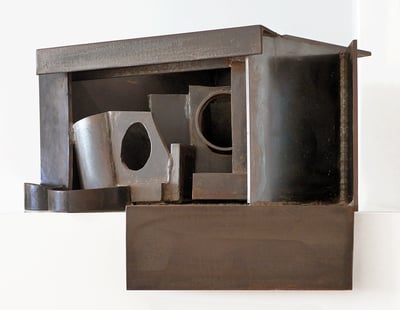
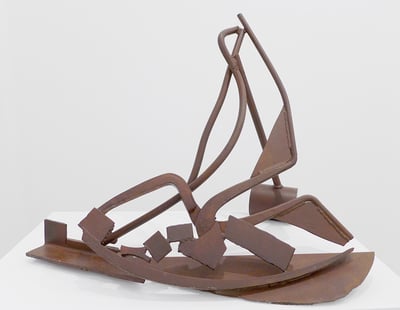
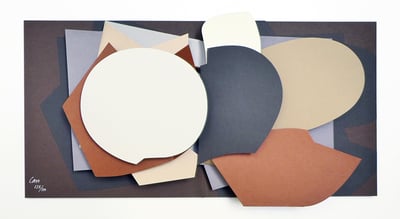
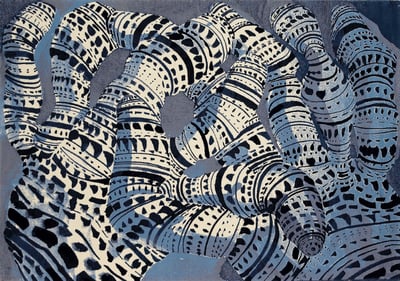
Low Table Piece CCCCXXXI by Anthony Caro, created in 1977, is a welded steel sculpture. Caro’s work is characterized by its abstract and dynamic forms, and this piece is no exception. Composed of intersecting and bending metal elements, the sculpture has an industrial, yet fluid quality. The rusty patina on the steel enhances its organic appearance, giving it a sense of both strength and impermanence. Placed on a table or low surface, the piece invites viewers to explore its angles and negative spaces, emphasizing Caro’s interest in how sculptures interact with their environment.
Anthony Caro (UK, 1924–2013) was a pioneering modernist sculptor known for his abstract, large-scale works in steel. Rejecting traditional pedestals, he placed sculptures directly on the ground, inviting viewer interaction. Influenced by Constructivism and American Abstract Expressionism, Caro transformed post-war sculpture, leaving a lasting legacy in contemporary art.
ObjectAn object in art refers to any tangible thing that exists and can be depicted in a work of art. Sometimes, the object becomes the focal point of a painting, drawing, or sculpture, meaning it is the most important element in the composition. An object can be anything that can be seen or touched, and it is often used to convey meaning or emphasize certain aspects of the artwork.
Low Table Piece CCCCXXXI by Anthony Caro, created in 1977, is a welded steel sculpture. Caro’s work is characterized by its abstract and dynamic forms, and this piece is no exception. Composed of intersecting and bending metal elements, the sculpture has an industrial, yet fluid quality. The rusty patina on the steel enhances its organic appearance, giving it a sense of both strength and impermanence. Placed on a table or low surface, the piece invites viewers to explore its angles and negative spaces, emphasizing Caro’s interest in how sculptures interact with their environment.
Anthony Caro (UK, 1924–2013) was a pioneering modernist sculptor known for his abstract, large-scale works in steel. Rejecting traditional pedestals, he placed sculptures directly on the ground, inviting viewer interaction. Influenced by Constructivism and American Abstract Expressionism, Caro transformed post-war sculpture, leaving a lasting legacy in contemporary art.
I don't think that sculpture belongs in everyday life like a table does, or like a chair.
- Anthony Caro
Sir Anthony Caro was an English sculptor who created abstract, geometrical metal pieces during his illustrious career. Anthony Caro’s style was derived from the modernist school after having being inspired and taught by Henry Moore early on. The artists experimented with abstract metal sculptors that were constructed from aluminum tubing, and steel beams, along with metal plates and rods. Often times, he referred to the materials as found industrial objects. Anthony Caro either welded or bolted these prefabricated pieces and materials together in order to form suggestive shapes. Anthony Caro would then paint the sculpture with a uniform color. Anthony Caro’s sculptures were typically large in size, linear in shape, and limitless in character. Some of his pieces stuck to far more uncompromising angles; for example Sailing Tonight, (1971-74) however the majority of his signature pieces suggest more flow and movement. Some even appear to suggest the feeling and sense of weightlessness. For example Anthony Caro’s Ledge Piece (1978) appears to pour over its high balance due to the pull of gravity.Later in his career, Anthony Caro returned to a far more traditional style. He sculpted semi abstract figures out bronze materials. Anthony Caro is considered to be one of the most important English sculptors ever born, and a tremendous influence on young sculptors to this day. (Artist website)
Minimalism is a style in music and visual arts characterized by pared-down designs and simplicity. It began in Western art after World War II, gaining prominence particularly in American visual arts. Minimalism draws heavily on aspects of modernism and is often viewed as a reaction against Abstract Expressionism, as well as a precursor to post-minimal art practices. Prominent minimalist artists include Agnes Martin, Donald Judd, Robert Morris, Frank Stella, and Dan Flavin.