Sheet: 67.5 x 62.5 cm
- Image: 50 x 60 cm
- Published by Georges Fall
- Printed by Artcay
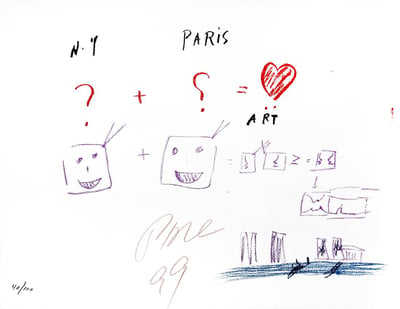
Ben Vautier’s N’importe qui peut avoir une idée is a conceptual lithograph that reflects the artist's playful and thought-provoking engagement with language. The black and white composition features the handwritten text, N’importe qui peut avoir une idée (Anyone can have an idea), positioned prominently in the center of the piece. The simple, casual script emphasizes the accessibility of ideas and creativity, challenging the notion that inspiration is reserved for a select few. Known for his contributions to the Fluxus movement, Vautier's work often blurs the boundaries between art, language, and everyday life. This print, published by Georges Fall and printed by Artcay, encapsulates Vautier’s message that art and ideas belong to everyone. The handwritten style further personalizes the message, giving it a direct and intimate quality, as if the artist is speaking to the viewer directly.
Ben Vautier (France, 1935) is an avant-garde artist known for his text-based art, provocative performances, and involvement in the Fluxus movement. His works often incorporate handwritten messages that challenge art conventions, social norms, and individual identity, making him a unique and influential figure in contemporary art.
Lithograph Lithography is a printing method based on the principle that water and oil do not mix. It can be used to print artwork or text onto paper or other suitable materials. Traditionally, an image was drawn with wax, fat, or oil onto a lithographic limestone surface or plate. Today, metal plates and other surfaces are also used in lithographic printing.
Sheet: 67.5 x 62.5 cm
- Image: 50 x 60 cm
- Published by Georges Fall
- Printed by Artcay
Ben Vautier’s N’importe qui peut avoir une idée is a conceptual lithograph that reflects the artist's playful and thought-provoking engagement with language. The black and white composition features the handwritten text, N’importe qui peut avoir une idée (Anyone can have an idea), positioned prominently in the center of the piece. The simple, casual script emphasizes the accessibility of ideas and creativity, challenging the notion that inspiration is reserved for a select few. Known for his contributions to the Fluxus movement, Vautier's work often blurs the boundaries between art, language, and everyday life. This print, published by Georges Fall and printed by Artcay, encapsulates Vautier’s message that art and ideas belong to everyone. The handwritten style further personalizes the message, giving it a direct and intimate quality, as if the artist is speaking to the viewer directly.
Ben Vautier (France, 1935) is an avant-garde artist known for his text-based art, provocative performances, and involvement in the Fluxus movement. His works often incorporate handwritten messages that challenge art conventions, social norms, and individual identity, making him a unique and influential figure in contemporary art.
One of the fundamental concepts of art is that of the new.
- Ben Vautier
Ben Vautier is a provocateur using the written word for much of his artistic work. In the early 1950's Ben Vautier was the leading international painter who worked with configurations that were composed of multiple individuals parts, similar to Dada. Inspired by Yves Klein, Marcel Duchamp and the Nouveaux Réalistes, Vautier's distinctive personal style was revealed through a number of political and social advante garde movements. Ben Vautier’s works displayed instructions and explanations written in cursive writing noted by past tones on different objects. In the late 1950's Ben met Yves Klein who suggests that he use Indian ink to compose his artistic poems which he did in his “Ben God” manuscript. French artist Ben Vautier was inspired by the “Fluxus” movement between 1962 and 1970, the “Figuration libre” with paintings that were done in acrylic and combined script and comic book components. Ben Vautier’s work were exhibited throughout France and abroad. His totem series of sculptures and his “Oiseaux” were assemblages of utilitarian objects mounted on various picture supports with commentaries. Ben Vautier stayed mainly with his acrylic style paintings during the 1980's, while also returning to his initial interest in publications especially those espousing a mutli-ethnic world - “Die erste ethnische Internationale.” He also continued painting by featuring various exhibitions, such as “Wie bei mir,” and “Sous le soleil exactement.” In the 1990's Ben Vautier continued his artistic work involving critical comments and publications in a magazine he started. His work and publications were centered around events occurring around the world, such as the Gulf War and the Bush era or in his thoughts, the elitist thinking of Parisian intellectuals. His 1990 works that involved statements both in the artsy written word and published text can be viewed online. A few of Ben Vautier's dramatic wording art works are entitled “signification,” “signification du mot signification,” and "il fait toujours beau quelque part un on ne peut pas toujours parler de memes.” Other unique art works include his “Edition Box,” which displayed a black wooden board with a white handwritten text ('everything will disappear') and a sliding screen. Also, his poster sized collage, stamped with the wording “Parti Du Tout Ben.” Ben Vautier is still politically and socially active and is living in France and Italy. Ben Vautier will continue to be known as an artist, art performer, movement organizer, linguistic inventor. Presently, the beautiful Museum Tinguely is hosting a Ben Vautier 20 year exhibition of his great artistic endeavors, which accounts for over 400 works and who remains a constant contributor to the world of art. (Artist website)
A found object is a term used to describe a man-made or natural object, or a fragment of one, that an artist discovers or purchases and keeps for inspiration or as a work of art. The artist may also modify the object or incorporate it into a collage or assemblage, transforming it into a new piece of art.