
Screen Print on Arches paper.
Hand-signed by the artist.
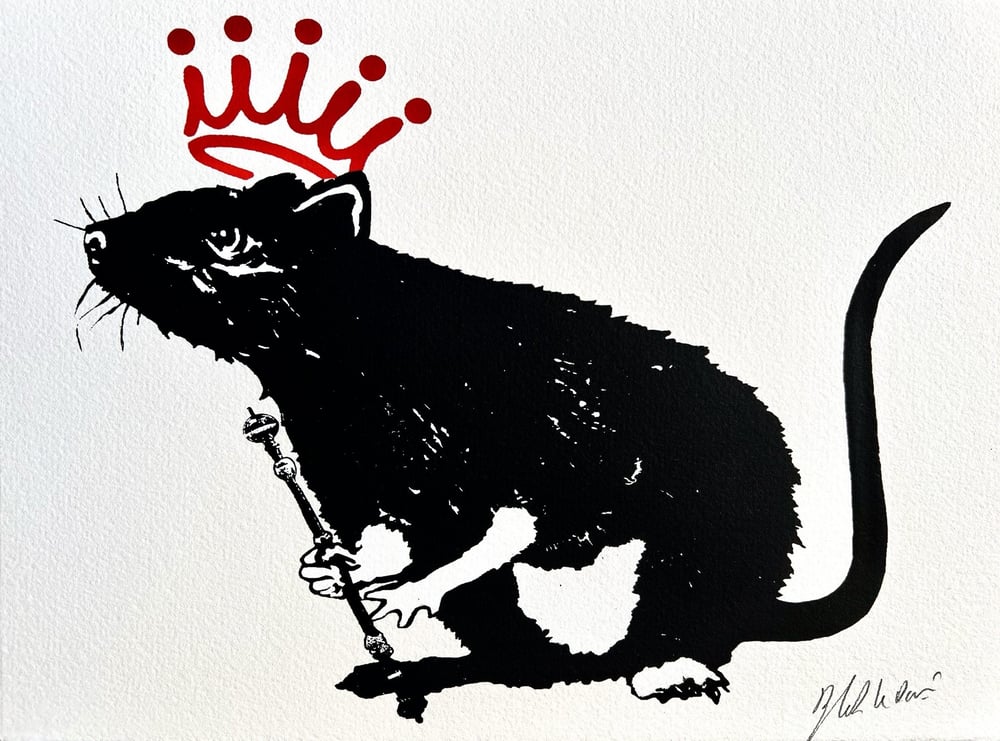
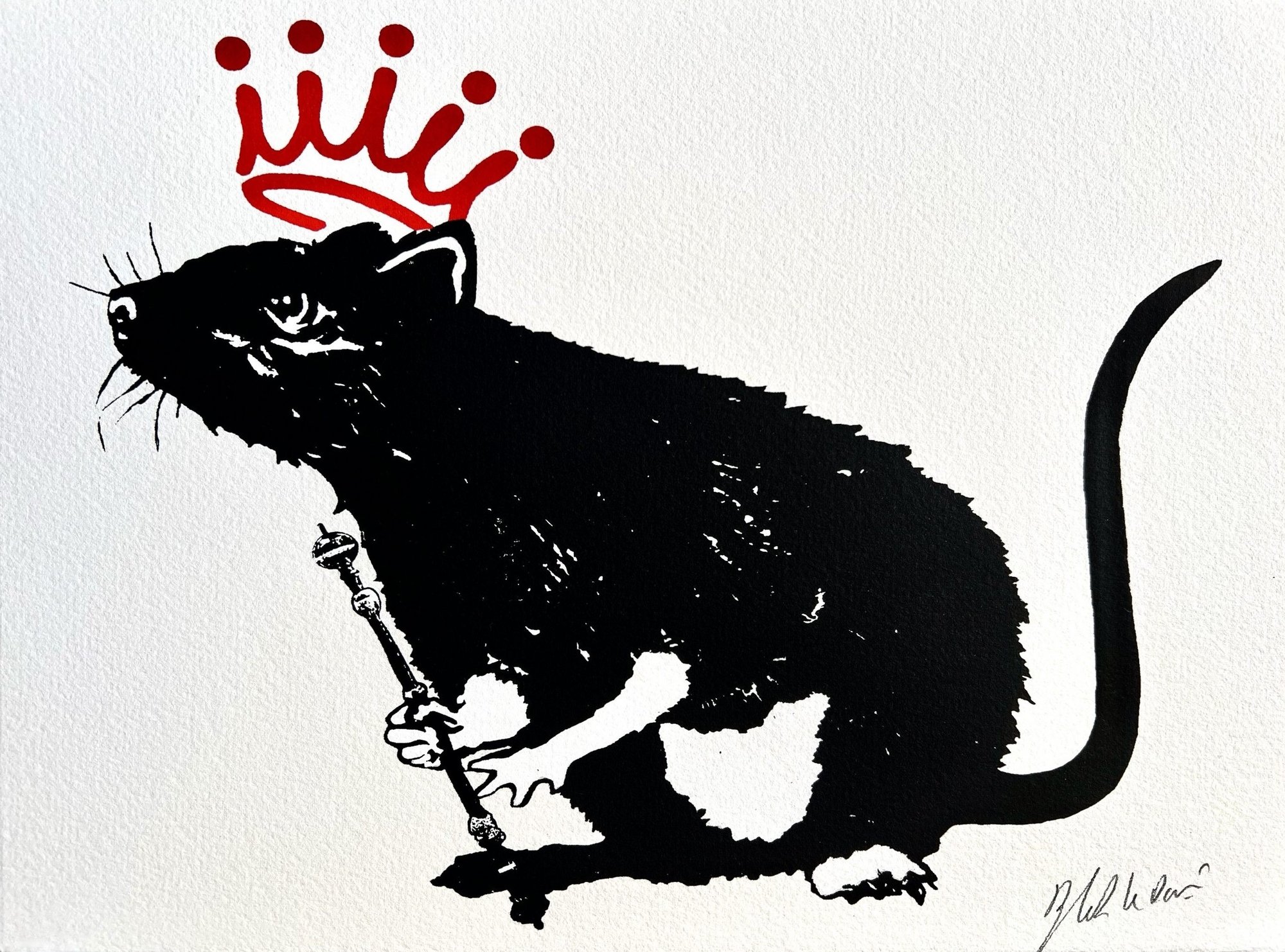
Blek Le Rat’s The King (2023) is a screen print on Arches paper that reinterprets the artist’s iconic rat motif through the lens of authority and symbolism. The composition presents a black rat rendered in bold stencil, holding a slender scepter while a vivid red crown hovers above its head. This unexpected coronation transforms the humble urban creature into a figure of power, suggesting irony and critique. As in much of Blek Le Rat’s work, the rat embodies marginality and survival, yet here it is elevated to regal status, challenging traditional hierarchies and notions of legitimacy. The stark contrast between black and white, punctuated by the red crown, heightens the visual impact and reinforces the tension between dominance and subversion.
Artwork Copyright © Blek Le RatBlek le Rat (France, 1951) is a pioneering street artist, often hailed as the 'Father of stencil graffiti.' He began stenciling rats on Parisian walls in 1981, symbolizing freedom and the spread of art. His innovative techniques have profoundly influenced urban art, notably inspiring artists like Banksy.
Artwork Copyright © Blek Le RatThe king, 2023
Form
Medium
Size
- Inches
- Centimeters
Edition
Price
- USD
- EUR
- GBP
- CHF
- Authenticity Guaranteed
- Insured Shipping
- Online Since 2005
●Inventory 16753
●Signed
●Comes with gallery invoice and certificate
●Sell Us a Similar Artwork. Learn more.
Screen Print on Arches paper.
Hand-signed by the artist.
Blek Le Rat’s The King (2023) is a screen print on Arches paper that reinterprets the artist’s iconic rat motif through the lens of authority and symbolism. The composition presents a black rat rendered in bold stencil, holding a slender scepter while a vivid red crown hovers above its head. This unexpected coronation transforms the humble urban creature into a figure of power, suggesting irony and critique. As in much of Blek Le Rat’s work, the rat embodies marginality and survival, yet here it is elevated to regal status, challenging traditional hierarchies and notions of legitimacy. The stark contrast between black and white, punctuated by the red crown, heightens the visual impact and reinforces the tension between dominance and subversion.
Artwork Copyright © Blek Le RatBlek le Rat (France, 1951) is a pioneering street artist, often hailed as the 'Father of stencil graffiti.' He began stenciling rats on Parisian walls in 1981, symbolizing freedom and the spread of art. His innovative techniques have profoundly influenced urban art, notably inspiring artists like Banksy.
Artwork Copyright © Blek Le RatAvailability
Size
Medium
SORT BY
Blek Le Rat
The king, 2023
Limited Edition Print
Screen-print
EUR 1,850

Blek Le Rat
L'anarchiste, 2020
Limited Edition Print
Screen-print
EUR 3,600

Blek Le Rat
The Homeless, 2022
Limited Edition Print
Screen-print
EUR 2,400

Blek Le Rat
Le Guerrier – édition spéciale, 2020
Limited Edition Print
Silkscreen
EUR 5,500
Blek Le Rat
Man Who Walks Through Walls, 2007
Limited Edition Print
Silkscreen
EUR 2,250
Related Artists


Artwork by Miles Aldridge
What is contemporary art?
Contemporary art refers to avant-garde or innovative art created in the recent past or present day. The exact starting point of contemporary art varies depending on the institution, often tied to the founding year of museums or galleries that showcase the style. Contemporary art is characterized by its focus on current ideas, diverse media, and the exploration of new concepts and techniques.

Blek Le Rat
The king, 2023
23 x 31 cm


