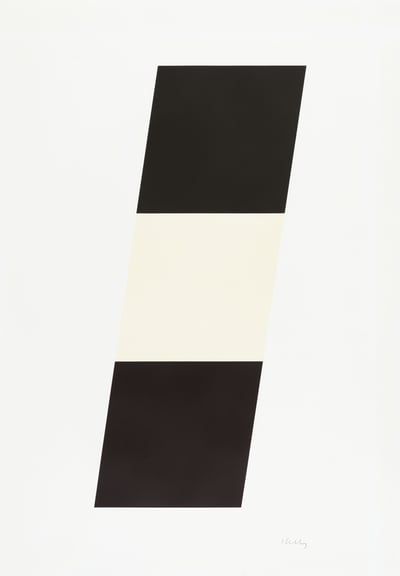
Lithograph on wove paper
- Signed and dated, front
Carmen Herrera's Untitled NRW (2017) is a striking lithograph that embodies her dedication to minimalism and geometric abstraction. The composition features a large, vibrant red quadrilateral, sharply angled, set against a stark white background. The bold simplicity of the piece draws attention to the dynamics of shape and space, creating a sense of movement and tension. The asymmetrical placement of the red form contrasts with the negative space, emphasizing Herrera’s skill in balancing bold color with empty space to evoke depth and energy. Printed on wove paper, the lithograph is signed and dated on the front, affirming its authenticity as part of an exclusive edition of 100. This work exemplifies Herrera’s mastery of minimalist principles, highlighting her ability to communicate intensity and clarity through simple, precise forms.
Carmen Herrera (Cuba/United States, 1915–2022) was a Cuban-American abstract painter and sculptor. Her minimalist, geometric works, characterized by bold colors and precise lines, gained significant recognition later in her life. Herrera's art challenged traditional boundaries, contributing notably to the development of geometric abstraction and minimalism.
Lithograph Lithography is a printing method based on the principle that water and oil do not mix. It can be used to print artwork or text onto paper or other suitable materials. Traditionally, an image was drawn with wax, fat, or oil onto a lithographic limestone surface or plate. Today, metal plates and other surfaces are also used in lithographic printing.
Lithograph on wove paper
- Signed and dated, front
Carmen Herrera's Untitled NRW (2017) is a striking lithograph that embodies her dedication to minimalism and geometric abstraction. The composition features a large, vibrant red quadrilateral, sharply angled, set against a stark white background. The bold simplicity of the piece draws attention to the dynamics of shape and space, creating a sense of movement and tension. The asymmetrical placement of the red form contrasts with the negative space, emphasizing Herrera’s skill in balancing bold color with empty space to evoke depth and energy. Printed on wove paper, the lithograph is signed and dated on the front, affirming its authenticity as part of an exclusive edition of 100. This work exemplifies Herrera’s mastery of minimalist principles, highlighting her ability to communicate intensity and clarity through simple, precise forms.
Carmen Herrera (Cuba/United States, 1915–2022) was a Cuban-American abstract painter and sculptor. Her minimalist, geometric works, characterized by bold colors and precise lines, gained significant recognition later in her life. Herrera's art challenged traditional boundaries, contributing notably to the development of geometric abstraction and minimalism.
Beauty comes from within, but it's up to us to use fashion and beauty to express who we are on the inside.
- Carmen Herrera
Carmen Herrera was born in 1915, in Cuba. After demonstrating a natural talent for art, Herrera began formal lessons at the age of 8. When she was 14 years old, her parents enrolled her in Marymount School in Paris where Carmen continued to study art. In 1937, Herrera moved to the United States with her husband and continued her education at the Art Students League in New York while also taking classes at the Brooklyn Museum of Art. Originally trained as an architect, Carmen Herrera creates artwork that features strong lines and symmetry. Her precision to detail, measurement, and scale leads to striking minimalist productions featuring very few colors with geometric form. Even after all her training, and the many works of art she has produced, Carmen Herrera was not discovered as an artist until she was 89 years old. At that time, she sold her first piece. At the age of 101, she finally had a show to display her work, in New York City's Whitney Museum.
Geometric abstraction is a form of abstract art that uses geometric shapes arranged in a non-illusionistic space (though not always) and combined into non-representational (non-objective) compositions. Based on years of artistic research, some artists have proposed that geometric abstraction offers a solution to modern challenges by rejecting traditional illusionistic practices in favor of clarity and simplicity.