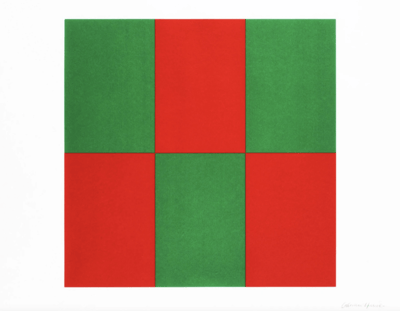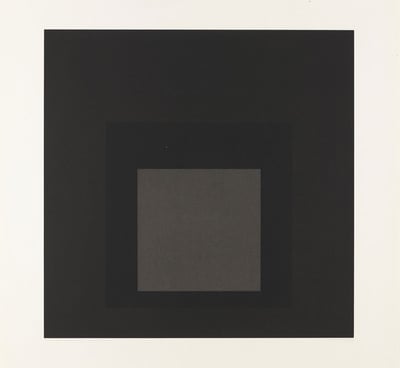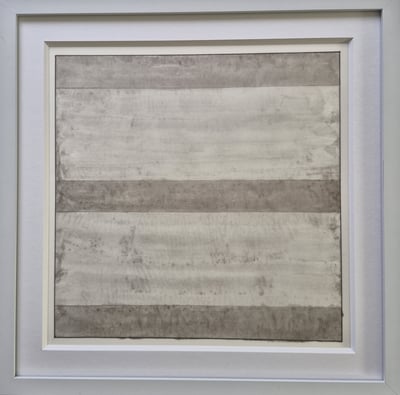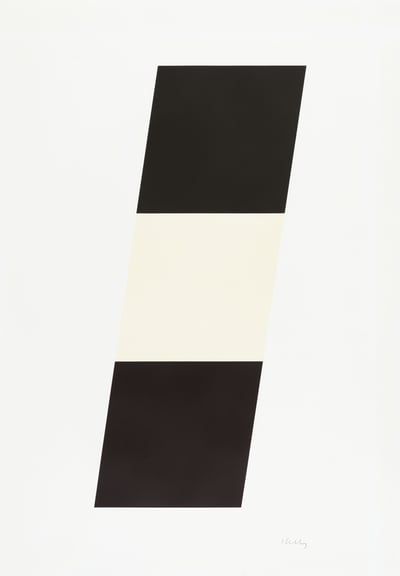
Lithograph on wove paper. Signed 'Carmen Herrera' and numbered on a gallery label affixed to the back of the print.
A single bar of saturated cadmium red descends vertically through a horizon line that divides white from deep graphite grey, the red form imperceptibly tapering as it falls. Nothing else is needed. Herrera began making pictures of this clarity decades before the art world caught up, and her late lithographs — issued in mature signature, numbered on a gallery label affixed to the verso — distil her lifelong commitment to pure line, geometry and saturated colour. To acquire a Herrera is to bring home one of the most quietly radical voices of twentieth-century abstraction.
Carmen Herrera (Cuba/United States, 1915–2022) was a Cuban-American abstract painter and sculptor. Her minimalist, geometric works, characterized by bold colors and precise lines, gained significant recognition later in her life. Herrera's art challenged traditional boundaries, contributing notably to the development of geometric abstraction and minimalism.
Lithograph Lithography is a printing method based on the principle that water and oil do not mix. It can be used to print artwork or text onto paper or other suitable materials. Traditionally, an image was drawn with wax, fat, or oil onto a lithographic limestone surface or plate. Today, metal plates and other surfaces are also used in lithographic printing.
Lithograph on wove paper. Signed 'Carmen Herrera' and numbered on a gallery label affixed to the back of the print.
A single bar of saturated cadmium red descends vertically through a horizon line that divides white from deep graphite grey, the red form imperceptibly tapering as it falls. Nothing else is needed. Herrera began making pictures of this clarity decades before the art world caught up, and her late lithographs — issued in mature signature, numbered on a gallery label affixed to the verso — distil her lifelong commitment to pure line, geometry and saturated colour. To acquire a Herrera is to bring home one of the most quietly radical voices of twentieth-century abstraction.
Carmen Herrera (Cuba/United States, 1915–2022) was a Cuban-American abstract painter and sculptor. Her minimalist, geometric works, characterized by bold colors and precise lines, gained significant recognition later in her life. Herrera's art challenged traditional boundaries, contributing notably to the development of geometric abstraction and minimalism.
Beauty comes from within, but it's up to us to use fashion and beauty to express who we are on the inside.
- Carmen Herrera
Carmen Herrera was born in 1915, in Cuba. After demonstrating a natural talent for art, Herrera began formal lessons at the age of 8. When she was 14 years old, her parents enrolled her in Marymount School in Paris where Carmen continued to study art. In 1937, Herrera moved to the United States with her husband and continued her education at the Art Students League in New York while also taking classes at the Brooklyn Museum of Art. Originally trained as an architect, Carmen Herrera creates artwork that features strong lines and symmetry. Her precision to detail, measurement, and scale leads to striking minimalist productions featuring very few colors with geometric form. Even after all her training, and the many works of art she has produced, Carmen Herrera was not discovered as an artist until she was 89 years old. At that time, she sold her first piece. At the age of 101, she finally had a show to display her work, in New York City's Whitney Museum.
Abstract Expressionism is an art movement that emerged in the United States during the 1940s and 1950s. Characterized by large, abstract canvases, the movement emphasized spontaneous, expressive brushwork and the use of color and form to convey emotion rather than represent reality. Artists like Jackson Pollock, Mark Rothko, and Willem de Kooning are key figures in this movement. Abstract Expressionism marked a shift in the art world, making New York City a center of the international art scene.