

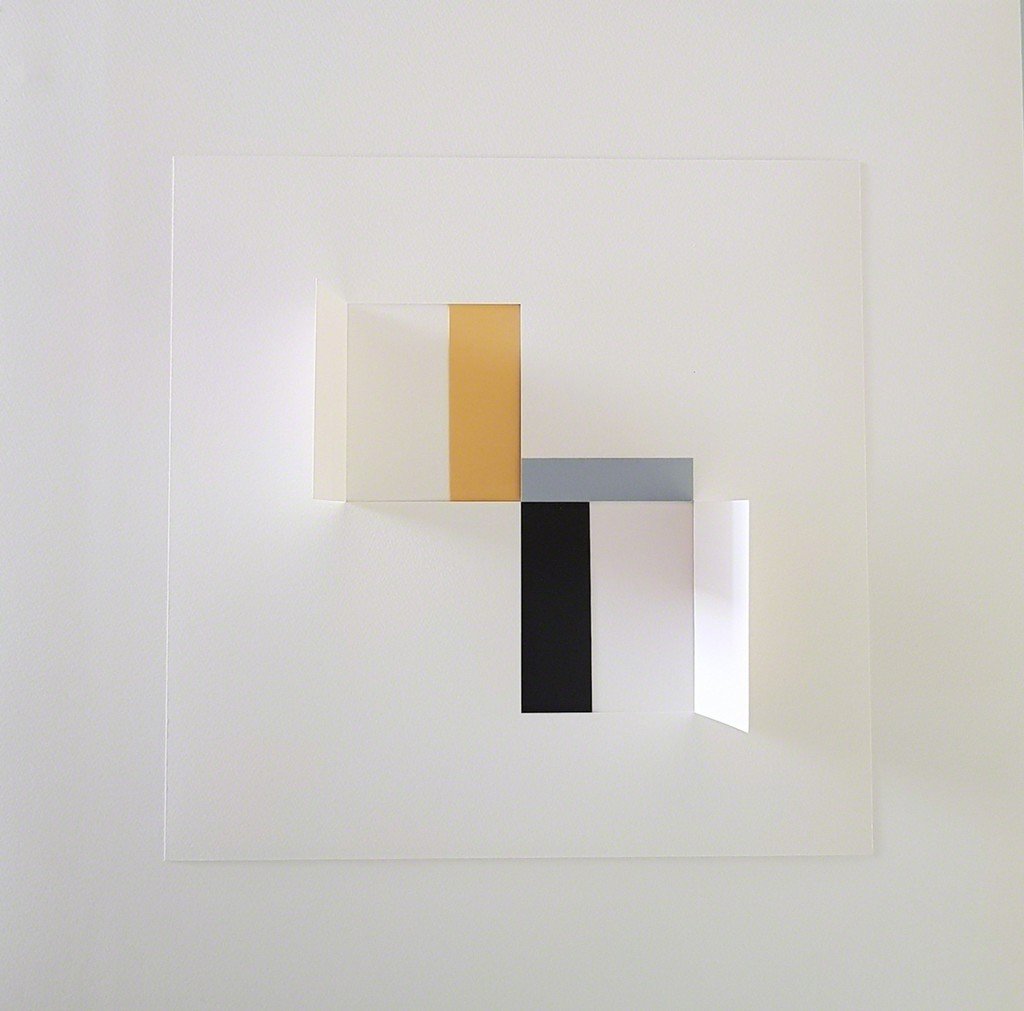
// César Paternosto’s Untitled 1 (2019) is a lithograph that showcases his commitment to minimalist and geometric abstraction. The composition features a carefully balanced arrangement of shapes in shades of white, beige, gray, and black. The overlapping rectangles and squares create an illusion of three-dimensionality, as if sections of the artwork are folding outward from the surface. This interplay of light, shadow, and form creates a sculptural effect, where simplicity is accentuated by subtle contrasts in color and depth. Paternosto’s work invites the viewer to consider the spatial relationship between the shapes and the flat plane, emphasizing the beauty found in minimalistic forms.
Artwork Copyright © César PaternostoCésar Paternosto (Argentina, 1931) is a painter and sculptor renowned for his contributions to geometric abstraction. His innovative works often feature color applied to the edges of canvases, challenging traditional perspectives. Paternosto's art is influenced by pre-Columbian aesthetics, exploring the intersection of modernism and ancient cultures.
Artwork Copyright © César PaternostoUntitled 1, 2019
Form
Medium
Size
- Inches
- Centimeters
Edition
Price
- USD
- EUR
- GBP
- CHF
- Authenticity Guaranteed
- Insured Shipping
- Online Since 2005
●Inventory 7869
●Signed
●Comes with gallery invoice and certificate
●Any questions?
// César Paternosto’s Untitled 1 (2019) is a lithograph that showcases his commitment to minimalist and geometric abstraction. The composition features a carefully balanced arrangement of shapes in shades of white, beige, gray, and black. The overlapping rectangles and squares create an illusion of three-dimensionality, as if sections of the artwork are folding outward from the surface. This interplay of light, shadow, and form creates a sculptural effect, where simplicity is accentuated by subtle contrasts in color and depth. Paternosto’s work invites the viewer to consider the spatial relationship between the shapes and the flat plane, emphasizing the beauty found in minimalistic forms.
Artwork Copyright © César PaternostoCésar Paternosto (Argentina, 1931) is a painter and sculptor renowned for his contributions to geometric abstraction. His innovative works often feature color applied to the edges of canvases, challenging traditional perspectives. Paternosto's art is influenced by pre-Columbian aesthetics, exploring the intersection of modernism and ancient cultures.
Artwork Copyright © César Paternosto- Recently Added
- Price (Low-High)
- Price (High-Low)
- Year (Low-High)
- Year (High-Low)

César Paternosto
Untitled 1, 2019
Limited Edition Print
Lithograph
EUR 2,000

César Paternosto
Argonaut , 2008
Limited Edition Print
Lithograph
Currently Not Available
Related Artists


Artwork by Carlos Cruz-Diez
What is Latin American art?
Latin American Art is a style which takes inspiration from its culture, society, politics, native traditions, religions and landscape. Op-Art and Kinetic Art figure prominently in Latin artworks. Colors in Latin American compositions are often bold. Latin American artists work in all media and movements.
César Paternosto
Untitled 1, 2019
60 x 60 cm


