Edition of 50 - Original Lithograph - Hand Signed by the Artist & Numbered - Published by Poligrafa, Barcelona Spain - In mint condition
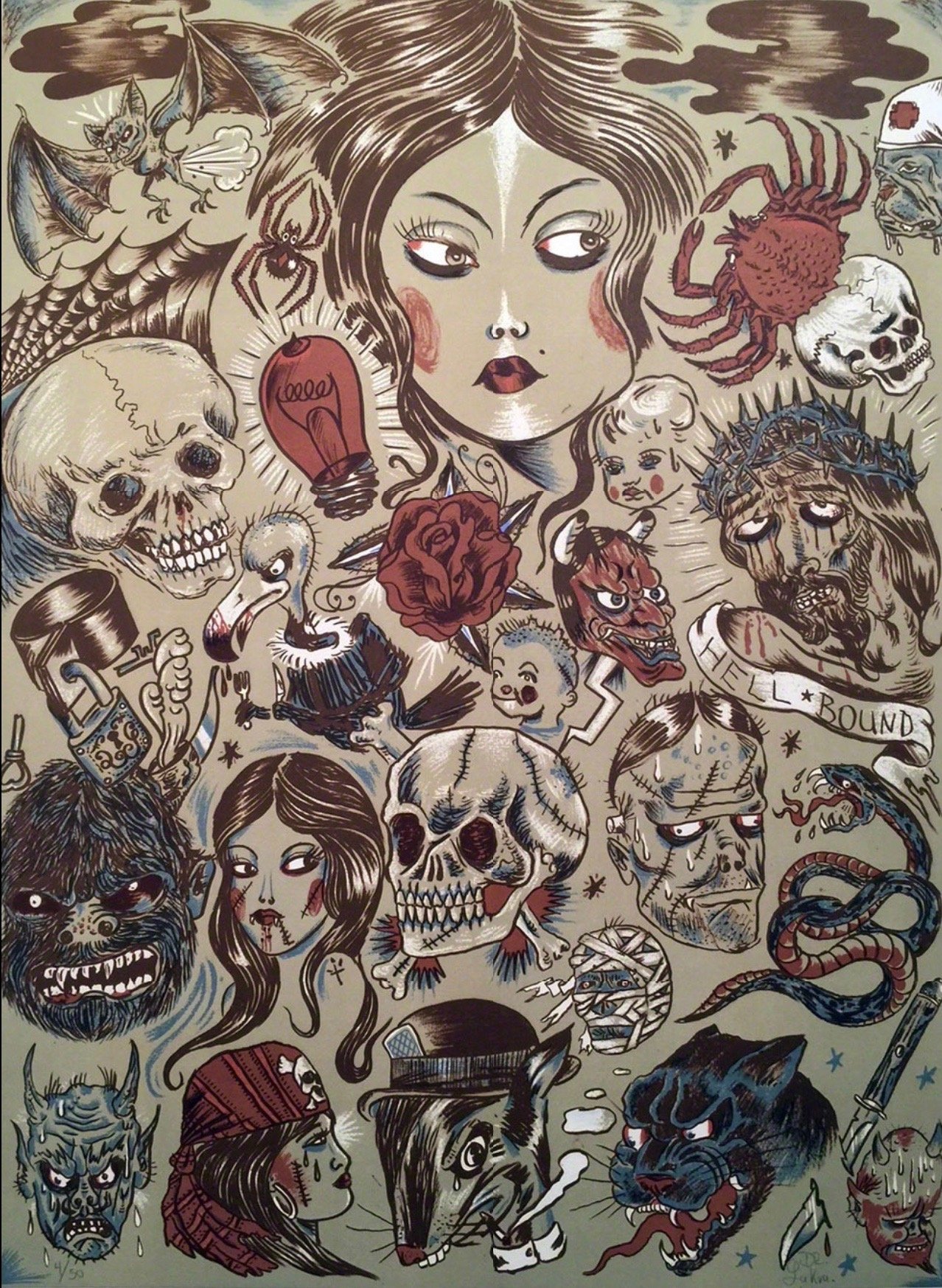
Untitled Green by Dr. Lakra, a lithograph created in 2008, presents a rich tapestry of tattoo-inspired imagery against a green-toned background. This limited edition piece, published by Poligrafa in Barcelona, reveals a central female face surrounded by a chaotic mix of symbols and figures in sepia, red, and blue hues. The artwork includes skulls, snakes, roses, a devilish figure, and an array of grotesque faces and mystical motifs, each rendered with intricate detail. The text Hell Bound appears as a tattoo on one figure, enhancing the rebellious and darkly humorous tone. Dr. Lakra’s work combines traditional tattoo aesthetics with elements of horror and fantasy, inviting viewers into a surreal narrative that explores themes of mortality, myth, and the uncanny. The layered composition captures a complex interplay of beauty and menace, characteristic of Dr. Lakra’s unique style.
Dr. Lakra (Mexico, 1972), born Jerónimo López Ramírez, is a contemporary artist renowned for his tattoo-inspired art. He transforms vintage illustrations, anatomical prints, and found objects by overlaying them with bold, graphic designs. His works explore themes of identity, culture, and the body, blending traditional tattoo aesthetics with fine art.
Lithograph Lithography is a printing method based on the principle that water and oil do not mix. It can be used to print artwork or text onto paper or other suitable materials. Traditionally, an image was drawn with wax, fat, or oil onto a lithographic limestone surface or plate. Today, metal plates and other surfaces are also used in lithographic printing.
Edition of 50 - Original Lithograph - Hand Signed by the Artist & Numbered - Published by Poligrafa, Barcelona Spain - In mint condition
Untitled Green by Dr. Lakra, a lithograph created in 2008, presents a rich tapestry of tattoo-inspired imagery against a green-toned background. This limited edition piece, published by Poligrafa in Barcelona, reveals a central female face surrounded by a chaotic mix of symbols and figures in sepia, red, and blue hues. The artwork includes skulls, snakes, roses, a devilish figure, and an array of grotesque faces and mystical motifs, each rendered with intricate detail. The text Hell Bound appears as a tattoo on one figure, enhancing the rebellious and darkly humorous tone. Dr. Lakra’s work combines traditional tattoo aesthetics with elements of horror and fantasy, inviting viewers into a surreal narrative that explores themes of mortality, myth, and the uncanny. The layered composition captures a complex interplay of beauty and menace, characteristic of Dr. Lakra’s unique style.
Dr. Lakra (Mexico, 1972), born Jerónimo López Ramírez, is a contemporary artist renowned for his tattoo-inspired art. He transforms vintage illustrations, anatomical prints, and found objects by overlaying them with bold, graphic designs. His works explore themes of identity, culture, and the body, blending traditional tattoo aesthetics with fine art.
In this modern society, people are focusing on the material, not the spiritual.
- Dr. Lakra
Dr. Lakra (b. 1972, Mexico) is the pseudonym of Jerónimo López Ramírez, a Mexican artist renowned for his distinctive style that blends tattoo art with traditional and contemporary iconography. Originally a tattoo artist, Dr. Lakra’s work has expanded into various mediums, including drawing, painting, and sculpture, where he often reinterprets classic images from popular culture, religious art, and indigenous Mexican traditions. His art is known for its provocative, humorous, and sometimes macabre elements, as he frequently embellishes vintage photographs, magazine covers, and found objects with tattoo-like designs. Dr. Lakra’s work explores themes of identity, mortality, and cultural hybridity, challenging conventional ideas of beauty and the boundaries between high and low art. His work has been exhibited internationally, including at the Tate Modern in London and the Museum of Modern Art in New York, making him a prominent figure in the global contemporary art scene
A found object is a term used to describe a man-made or natural object, or a fragment of one, that an artist discovers or purchases and keeps for inspiration or as a work of art. The artist may also modify the object or incorporate it into a collage or assemblage, transforming it into a new piece of art.