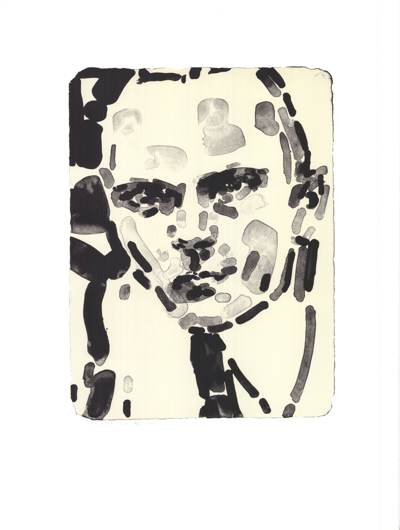
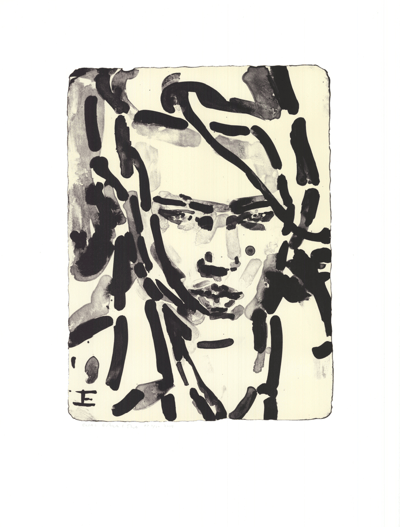
Original lithograph printed on 300 gr. Velin d'arches paper.
Signed and numbered.
Printed by Editions Copenhagen.
Emmelyn Butterfield-Rosen (2014) by Elizabeth Peyton is a lithograph portraying an introspective seated figure, composed in her distinctively linear, gestural style. The portrait is rendered in shades of burgundy, built from sharp, calligraphic strokes that define both the subject and a richly patterned background. Peyton captures the sitter in a reflective moment, framed by abstracted elements—floral motifs and spatial cues—that create a sense of interiority. The work emphasizes psychological presence over strict realism, offering a personal, contemplative mood. This edition is limited to just 30 prints.
Elizabeth Peyton (USA, 1965) is a contemporary painter celebrated for her intimate portraits of cultural icons, friends, and historical figures. Her work, characterized by its vibrant color palette and delicate brushstrokes, bridges personal and collective memory. Peyton’s depictions of figures like Kurt Cobain and Queen Elizabeth II have redefined portraiture in modern art.
Lithograph Lithography is a printing method based on the principle that water and oil do not mix. It can be used to print artwork or text onto paper or other suitable materials. Traditionally, an image was drawn with wax, fat, or oil onto a lithographic limestone surface or plate. Today, metal plates and other surfaces are also used in lithographic printing.
Original lithograph printed on 300 gr. Velin d'arches paper.
Signed and numbered.
Printed by Editions Copenhagen.
Emmelyn Butterfield-Rosen (2014) by Elizabeth Peyton is a lithograph portraying an introspective seated figure, composed in her distinctively linear, gestural style. The portrait is rendered in shades of burgundy, built from sharp, calligraphic strokes that define both the subject and a richly patterned background. Peyton captures the sitter in a reflective moment, framed by abstracted elements—floral motifs and spatial cues—that create a sense of interiority. The work emphasizes psychological presence over strict realism, offering a personal, contemplative mood. This edition is limited to just 30 prints.
Elizabeth Peyton (USA, 1965) is a contemporary painter celebrated for her intimate portraits of cultural icons, friends, and historical figures. Her work, characterized by its vibrant color palette and delicate brushstrokes, bridges personal and collective memory. Peyton’s depictions of figures like Kurt Cobain and Queen Elizabeth II have redefined portraiture in modern art.
You really need faith in yourself to make art and to stand up for what you believe in.
- Elizabeth Peyton
Elizabeth Peyton is an American painter who specializes in oils and has been popular since the middle of the 1990s. Her contemporary art features idealized and stylized renditions of her friends and paramours as well as monarchs from Europe and pop culture icons. The vast majority of her works have been small-scale portraits, and she claims that her inspiration comes from the work of Robert Mapplethorpe, Alfred Stieglitz and Nadar, all of whom took photographs of those close to them. Her oil works often have glazes that she allows to drip across the work, although she also has produced works in pencil, etching and watercolor. Many of her figures have feminine aspects but are generally ambiguous sexually. She uses photographs as the basis for her paintings and then paints from those. Elizabeth Peyton has also made prints -- monotypes, woodcuts and lithographs -- experimenting with a variety of techniques and different papers for the final product.
Neo-Figurative Art is a collective term that refers to the revival of figurative art in America and Europe during the 1960s, following a period dominated by abstraction. Michel Ragon, a French art critic, argued that this resurgence of figuration occurred during a critical time of social and political upheaval in both regions.