

Offset print with collage. Hand-signed and numbered.
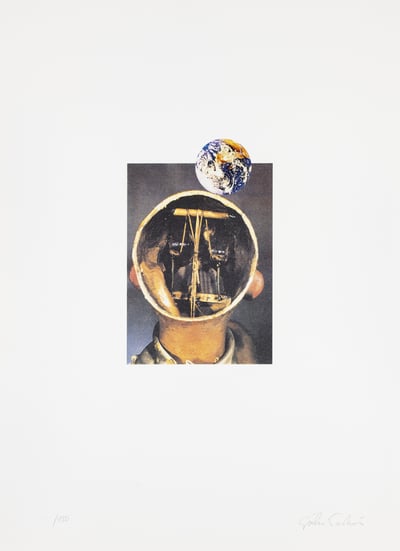
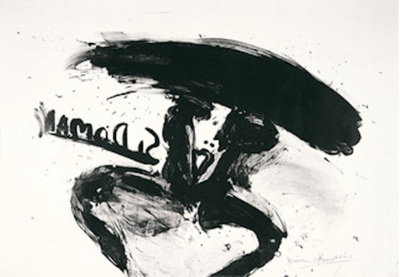
In Il sole nero Giulio Paolini opens the back of a man's head like a hollow vessel, revealing a small easel and a web of taut threads where thought should be, while a photographic globe of the Earth hovers above like a black sun. Set within generous white margins, the image layers classical contemplation, vision and cosmos into a single enigmatic emblem of the artist's mind. A leading figure of Arte Povera and Italian conceptualism, Paolini hand-signed and numbered this 1993 offset print with collage, a quietly profound meditation on seeing and creation.
Artwork Copyright © Giulio PaoliniGiulio Paolini (Italy, 1940) is a conceptual artist associated with the Arte Povera movement. His works, often rooted in classical art and philosophy, explore themes of perception, authorship, and the nature of art itself. Using objects like frames, books, and plaster casts, Paolini creates thought-provoking installations and sculptures.
Artwork Copyright © Giulio PaoliniIl sole nero, 1993
Form
Medium
Size
- Inches
- Centimeters
Edition
Price
- USD
- EUR
- GBP
- CHF
- Authenticity Guaranteed
- Insured Shipping
- Online Since 2005
●Inventory 17569
●Signed
●Comes with gallery invoice and certificate
●Sell Us a Similar Artwork. Learn more.
Offset print with collage. Hand-signed and numbered.
In Il sole nero Giulio Paolini opens the back of a man's head like a hollow vessel, revealing a small easel and a web of taut threads where thought should be, while a photographic globe of the Earth hovers above like a black sun. Set within generous white margins, the image layers classical contemplation, vision and cosmos into a single enigmatic emblem of the artist's mind. A leading figure of Arte Povera and Italian conceptualism, Paolini hand-signed and numbered this 1993 offset print with collage, a quietly profound meditation on seeing and creation.
Artwork Copyright © Giulio PaoliniGiulio Paolini (Italy, 1940) is a conceptual artist associated with the Arte Povera movement. His works, often rooted in classical art and philosophy, explore themes of perception, authorship, and the nature of art itself. Using objects like frames, books, and plaster casts, Paolini creates thought-provoking installations and sculptures.
Artwork Copyright © Giulio Paolini- Recently Added
- Price (Low-High)
- Price (High-Low)
- Year (Low-High)
- Year (High-Low)
Giulio Paolini
Il sole nero, 1993
Limited Edition Print
Mixed Media
EUR 1,600
Giulio Paolini
Elea, 2009
Sculpture / Object
Assemblage
EUR 2,300

Giulio Paolini
Signore e Signori…, 1988
Limited Edition Print
Silkscreen
EUR 1,250

Giulio Paolini
Senza titolo, 1973
Drawing / Watercolor
Collage
EUR 23,680
Related Artists

Artwork by Marcel Duchamp
What is Found Object?
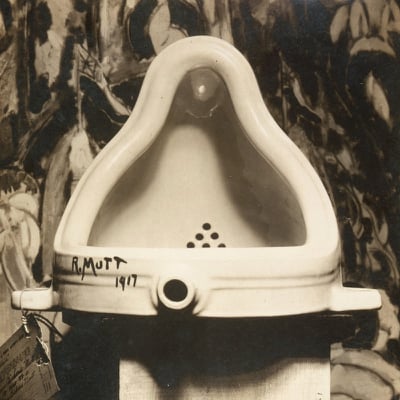
A found object is a term used to describe a man-made or natural object, or a fragment of one, that an artist discovers or purchases and keeps for inspiration or as a work of art. The artist may also modify the object or incorporate it into a collage or assemblage, transforming it into a new piece of art.


Giulio Paolini
Il sole nero, 1993
76 x 56 cm


