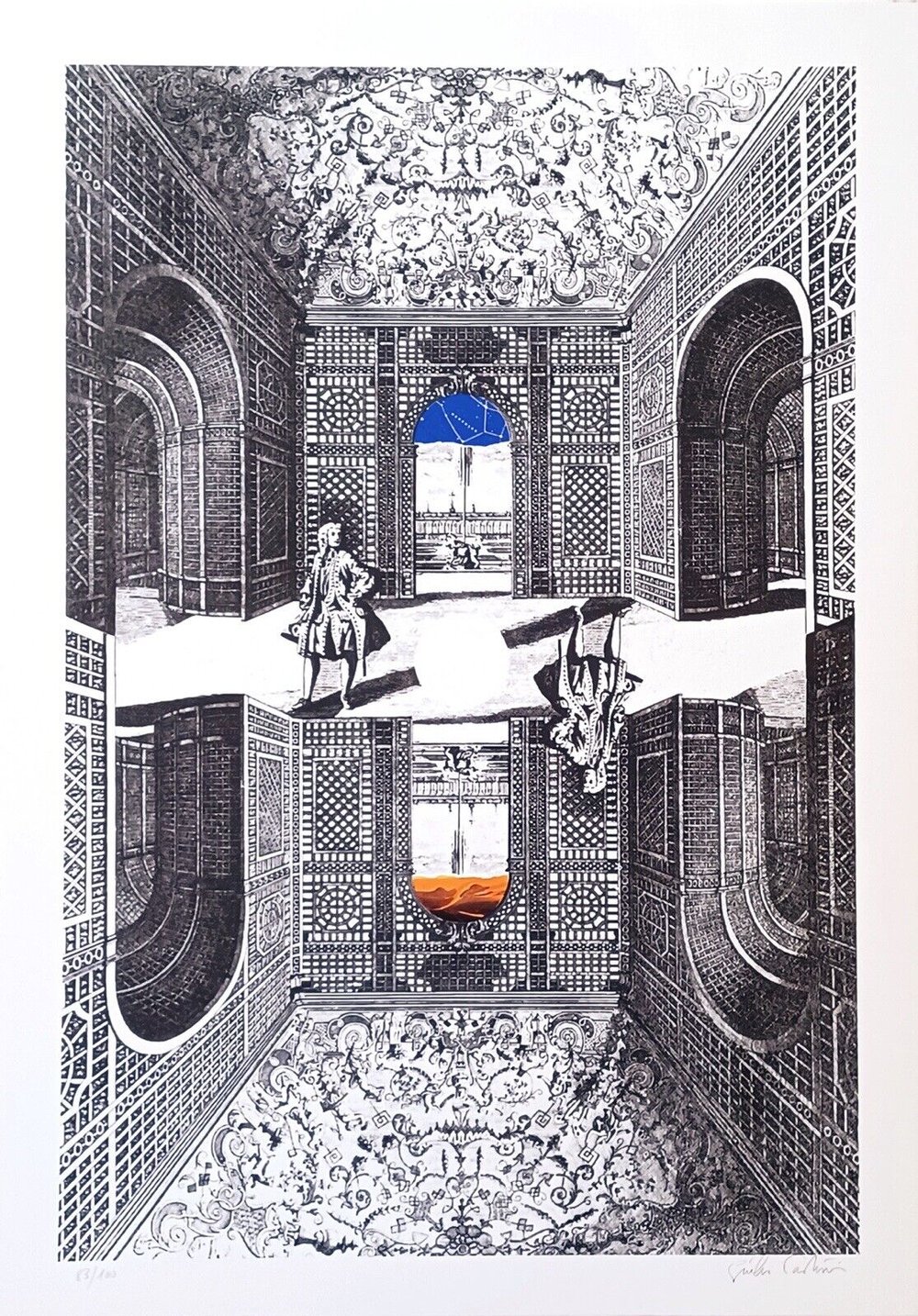
18-colour Silkscreen with pressings on white file paper from the Galvani Paper-Mill
- From the portfolio: "Counterpoints - 7 visual notations by Accardi, Boetti, Buren, Kounellis, LeWitt, Paolini and Pistoletto" published by A.E.I.O.U Edizioni d'arte (Rome) edited by Bruno Corà.
- Bibliography: Graphic impressions.
The graphic work 1967-1992 by Giulio Paolini, Marco Noire Editore, Turin 1992, cat. n. 68..
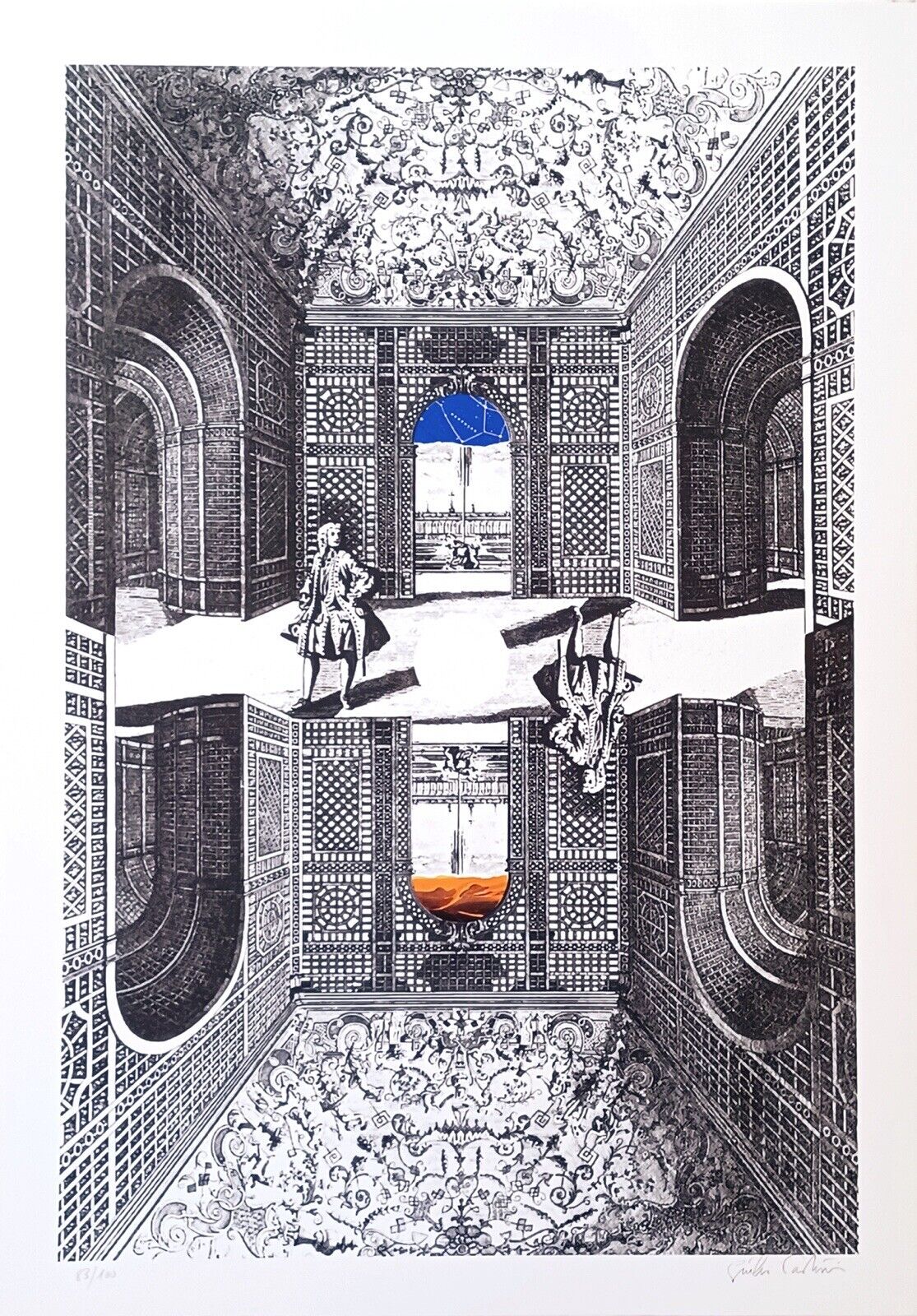
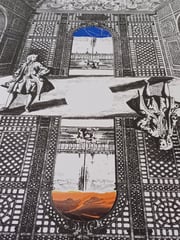
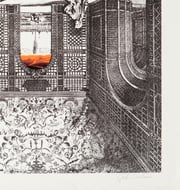
Giulio Paolini's Signore e Signori… is a striking silkscreen print that plays with notions of perspective, space, and historical imagery. The composition depicts a mirrored architectural interior, complete with ornate walls, arches, and an intricately detailed ceiling. Two figures, dressed in classical attire, are centrally positioned, their reflections further enhancing the symmetrical layout. The inclusion of two small, brightly colored elements—a blue window at the top and an orange window below—contrasts sharply with the otherwise monochromatic, historical setting. These vivid accents draw the eye and suggest a disruption or anomaly within the otherwise orderly environment. Published as part of a portfolio titled Counterpoints, this print is an exploration of visual dualities, inviting viewers to reflect on the interplay between past and present, real and imagined. Paolini’s work challenges perceptions of space and time, offering a poetic meditation on the nature of reality.
Giulio Paolini (Italy, 1940) is a conceptual artist associated with the Arte Povera movement. His works, often rooted in classical art and philosophy, explore themes of perception, authorship, and the nature of art itself. Using objects like frames, books, and plaster casts, Paolini creates thought-provoking installations and sculptures.
Silkscreen Silkscreen is a printmaking method that uses a screen made of silk or other mesh fabric. The screen is treated with a substance that blocks ink in certain areas, allowing ink to pass through only in the desired sections. Each color in the print requires a separate screen.
18-colour Silkscreen with pressings on white file paper from the Galvani Paper-Mill
- From the portfolio: "Counterpoints - 7 visual notations by Accardi, Boetti, Buren, Kounellis, LeWitt, Paolini and Pistoletto" published by A.E.I.O.U Edizioni d'arte (Rome) edited by Bruno Corà.
- Bibliography: Graphic impressions.
The graphic work 1967-1992 by Giulio Paolini, Marco Noire Editore, Turin 1992, cat. n. 68..
Giulio Paolini's Signore e Signori… is a striking silkscreen print that plays with notions of perspective, space, and historical imagery. The composition depicts a mirrored architectural interior, complete with ornate walls, arches, and an intricately detailed ceiling. Two figures, dressed in classical attire, are centrally positioned, their reflections further enhancing the symmetrical layout. The inclusion of two small, brightly colored elements—a blue window at the top and an orange window below—contrasts sharply with the otherwise monochromatic, historical setting. These vivid accents draw the eye and suggest a disruption or anomaly within the otherwise orderly environment. Published as part of a portfolio titled Counterpoints, this print is an exploration of visual dualities, inviting viewers to reflect on the interplay between past and present, real and imagined. Paolini’s work challenges perceptions of space and time, offering a poetic meditation on the nature of reality.
Giulio Paolini (Italy, 1940) is a conceptual artist associated with the Arte Povera movement. His works, often rooted in classical art and philosophy, explore themes of perception, authorship, and the nature of art itself. Using objects like frames, books, and plaster casts, Paolini creates thought-provoking installations and sculptures.
The artist is neither 'removed from the world,' nor 'in the world.'
- Giulio Paolini
Giulio Paolini worked in two major movements of the visual arts: Arte Povero, a movement which decried the corporate-isation of art and Conceptual Art. He was born in Genoa, Italy. Having a brother who worked as an architect, Paolini was influenced early by this type of design. His artistic research moved him quickly towards ideas of zeroing the image, which is a theory from Conceptual Art. Paolini takes an intense investigative approach to his artistic works, beginning with investigations into the artist’s own tools of creation and the spaces in which works of art are exhibited. His lines of enquiry have moved through photography, through to homages to George Luis Borges and Giorgio de Chirico. Giulio Paolini creates from the perspective of an artist in the programmatic line of succession which leads back to the artists who created before him. Paolini’s works were acknowledged by the avant-guard movement in the 1970’s. During this decade he explored ideas of whether vision is symmetrical, creating the oeuvre La Visione e Simmetrica? and concepts regarding the reproduction of art-works. Paolini’s theories about appearance, explored in the oeuvre in Teoria Della Apparenze make an enquiry into the artwork’s containment of past and future works. During the 1980’s and the 1990’s Giulio Paolini has continued to be exhibited in galleries across Europe. His lines of conceptual enquiry revolve around ideas of the exhibition space as well as oeuvres in which completion is postponed, leaving the viewer in a creative state of expectation. Paolini’s latest exhibition called Giorgio de Chirico- Giulio Paolini; Giulio Paolini-Giorgio De Chirico will be hung at the CIMA Gallery in New York from Oct, 2016 to June 2017.
A found object is a term used to describe a man-made or natural object, or a fragment of one, that an artist discovers or purchases and keeps for inspiration or as a work of art. The artist may also modify the object or incorporate it into a collage or assemblage, transforming it into a new piece of art.