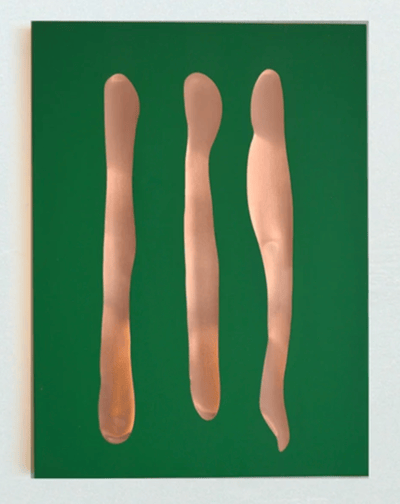
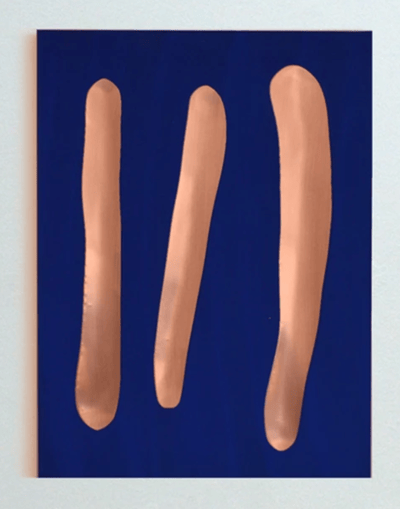
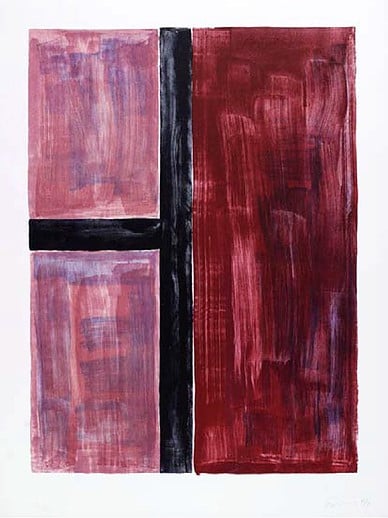
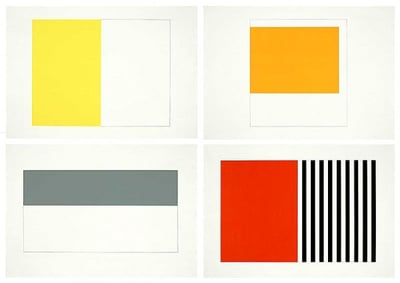
Charcoal on paper. Hand-signed by artist, Signed and dated lower right.
On warm cream paper, Förg lays four loose oval charcoal strokes in a vertical stack — sharp at the ends, smudged at the middle — held within a softly worked field of grey graphite atmosphere. The mark is gestural, almost calligraphic; the rhythm meditative. Charcoal on paper, hand-signed and dated Förg 88 lower right. Förg's drawings from the late 1980s are among the most desirable of his works on paper — reduced, lyrical, profoundly assured. A confident acquisition for collectors of late twentieth-century European abstraction at its most contemplative and pictorially honest, to collect.
Günther Förg (Germany, 1952–2013) was a multidisciplinary artist associated with modernism and abstraction. Known for his bold use of color, minimalist compositions, and architectural photography, his work explored materiality and space, bridging painting, sculpture, and photography.
CharcoalCharcoal is made from charred wood and is used in both initial sketches and finished drawings. It can be easily smudged or erased, making it versatile for corrections. To make charcoal drawings permanent, a fixative like resin or gum is required. It’s especially useful for sketching first ideas on walls or canvas.
Charcoal on paper. Hand-signed by artist, Signed and dated lower right.
On warm cream paper, Förg lays four loose oval charcoal strokes in a vertical stack — sharp at the ends, smudged at the middle — held within a softly worked field of grey graphite atmosphere. The mark is gestural, almost calligraphic; the rhythm meditative. Charcoal on paper, hand-signed and dated Förg 88 lower right. Förg's drawings from the late 1980s are among the most desirable of his works on paper — reduced, lyrical, profoundly assured. A confident acquisition for collectors of late twentieth-century European abstraction at its most contemplative and pictorially honest, to collect.
Günther Förg (Germany, 1952–2013) was a multidisciplinary artist associated with modernism and abstraction. Known for his bold use of color, minimalist compositions, and architectural photography, his work explored materiality and space, bridging painting, sculpture, and photography.
Highly recognised for his multi-faceted approach to art, Günther Förg has created work through the mediums of sculpture, painting, photography and printmaking and often combines these mediums to reach his final output. Förg has worked with a number of materials throughout his career; Alubilder is a series of work for which he had painted portrait photographs and linear patters on to sheets of aluminium; Förg also created a series of Lead Paintings - for this work, he wrapped lead sheets around wood and painted each individual surface with acrylic. Förg also received acclaim for his photography – between 1980 and 2006, he traveled the world and captured various architectural sites which were then printed on a large scale; the sites were often politically symbolical – Bauhaus structures in Jerusalem and Tel Aviv are just a few among the many sites he photographed.
Colour Field Painting is an abstract style characterized by large areas of a single color or simple, solid colors. The term was first used in the 1950s to describe the work of three American Abstract Expressionist painters—Barnett Newman, Mark Rothko, and Clyfford Still. Their work emphasized the emotional power of color and the creation of vast, meditative spaces through expansive color fields.