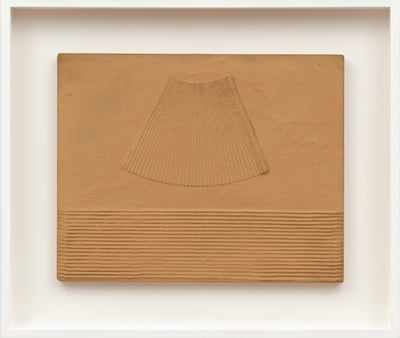
Corrugated cardboard and Sahara sand on wood. Signed and dated "76" on the reverse. Honisch catalogue raisonné 1986 no. 972.
Heinz Mack's "Sandflügel" from 1976 is a sculptural sand relief combining corrugated cardboard and Sahara sand on wood. The composition features a trapezoidal wing form with delicate cross-hatched texture above horizontal ridged lines, creating a dialogue between geometric precision and natural materiality. As co-founder of the ZERO movement, Mack pursued light and vibration as primary artistic concerns, and this work channels the desert landscapes he encountered during his Sahara expeditions. Catalogued as number 972 in the Honisch catalogue raisonné, it represents Mack's distinctive synthesis of structured form and elemental material.
Heinz Mack (Germany, 1931) is a visual artist renowned for his contributions to op art, light art, and kinetic art. As a co-founder of the ZERO movement in 1957, he explored the interplay of light and movement in his works. Mack's innovative sculptures and installations have been exhibited globally, influencing contemporary art.
Mixed MediaMixed media refers to artwork that incorporates more than one medium within a single piece. Unlike multimedia art, which combines distinct forms of visual art and often includes elements like sound, video, or digital media, mixed media focuses on combining traditional art materials, such as paint, ink, and collage. Mixed media art allows artists to achieve a wide range of effects and textures by layering and blending different materials.
Corrugated cardboard and Sahara sand on wood. Signed and dated "76" on the reverse. Honisch catalogue raisonné 1986 no. 972.
Heinz Mack's "Sandflügel" from 1976 is a sculptural sand relief combining corrugated cardboard and Sahara sand on wood. The composition features a trapezoidal wing form with delicate cross-hatched texture above horizontal ridged lines, creating a dialogue between geometric precision and natural materiality. As co-founder of the ZERO movement, Mack pursued light and vibration as primary artistic concerns, and this work channels the desert landscapes he encountered during his Sahara expeditions. Catalogued as number 972 in the Honisch catalogue raisonné, it represents Mack's distinctive synthesis of structured form and elemental material.
Heinz Mack (Germany, 1931) is a visual artist renowned for his contributions to op art, light art, and kinetic art. As a co-founder of the ZERO movement in 1957, he explored the interplay of light and movement in his works. Mack's innovative sculptures and installations have been exhibited globally, influencing contemporary art.
When I get to the studio, I completely forget how old I am.
- Heinz Mack
Heinz Mack, a German artist, is perhaps best known for being responsible for the creation of a movement, along with Otto Piene: Zero. Founded in 1957, this movement finds its basis in the design and aesthetic qualities that form ground zero. Several other artists have united in the name of Zero, including Yves Klein, Fontana, Manzoni, Castellani, Tinguely and Schoonhoven, which culminated in December 2008 with the foundation of the Zero Foundation, which researches and promotes the main ideas surrounding Zero. Through this movement, Mack was able to pursue one of the central themes which embodies his work: light. He created a number of sculptures, many of which revolve around the idea of light, including light-reflecting cubes and oscillating light-reliefs. His creative output has also included several other forms of art, including paintings, drawings, pastels, graphics, India ink, bibliophilic work and photography. (Artist website)
Hard Edge art is a style of abstract painting that became popular in the 1960s. It features areas of color separated by crisp, sharp edges that are painted with geometric precision. The term hard-edge painting was coined by art critic Jules Langsner to describe this approach, which contrasts with the softer, more fluid forms of other abstract styles.