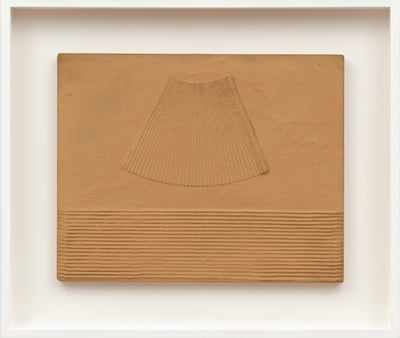
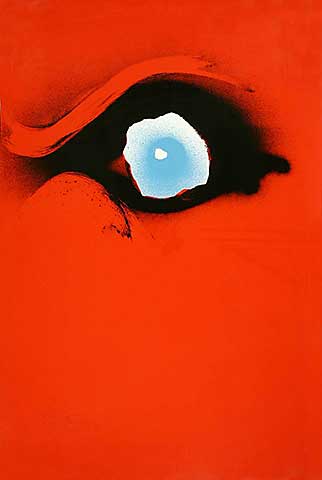
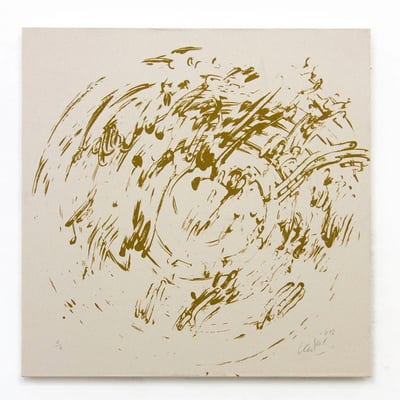
// Heinz Mack’s Silberflügel, Roter Fächer (1973) is a striking screen print that measures 49.5 x 60 cm. This limited edition piece captures a dynamic, fan-like form that radiates with intense red and orange hues against a metallic silver background, evoking the imagery of a glowing, fanned structure or wings. The interplay of color and texture gives the work a three-dimensional feel, as the intricate mesh of fine lines creates an optical effect of movement and depth. Mack, known for his exploration of light and kinetic art, employs these elements to immerse viewers in a study of luminosity and spatial perception. This work exemplifies Mack’s ability to transform simple forms into vibrant, almost tactile visual experiences.
Heinz Mack (Germany, 1931) is a visual artist renowned for his contributions to op art, light art, and kinetic art. As a co-founder of the ZERO movement in 1957, he explored the interplay of light and movement in his works. Mack's innovative sculptures and installations have been exhibited globally, influencing contemporary art.
Screen-print Screen printing is a technique where ink is transferred through a mesh onto a substrate, with areas blocked by a stencil to prevent ink from passing through. This method, also known as serigraphy or silkscreen printing, is commonly used to produce prints on posters, T-shirts, vinyl, stickers, wood, and other materials. The process is a type of stencil printing, allowing for vibrant, detailed designs on various surfaces.
// Heinz Mack’s Silberflügel, Roter Fächer (1973) is a striking screen print that measures 49.5 x 60 cm. This limited edition piece captures a dynamic, fan-like form that radiates with intense red and orange hues against a metallic silver background, evoking the imagery of a glowing, fanned structure or wings. The interplay of color and texture gives the work a three-dimensional feel, as the intricate mesh of fine lines creates an optical effect of movement and depth. Mack, known for his exploration of light and kinetic art, employs these elements to immerse viewers in a study of luminosity and spatial perception. This work exemplifies Mack’s ability to transform simple forms into vibrant, almost tactile visual experiences.
Heinz Mack (Germany, 1931) is a visual artist renowned for his contributions to op art, light art, and kinetic art. As a co-founder of the ZERO movement in 1957, he explored the interplay of light and movement in his works. Mack's innovative sculptures and installations have been exhibited globally, influencing contemporary art.
When I get to the studio, I completely forget how old I am.
- Heinz Mack
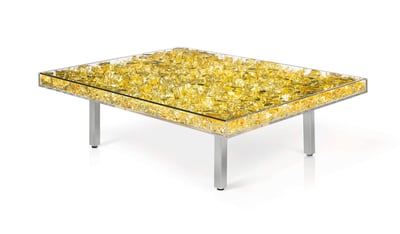
Heinz Mack, a German artist, is perhaps best known for being responsible for the creation of a movement, along with Otto Piene: Zero. Founded in 1957, this movement finds its basis in the design and aesthetic qualities that form ground zero. Several other artists have united in the name of Zero, including Yves Klein, Fontana, Manzoni, Castellani, Tinguely and Schoonhoven, which culminated in December 2008 with the foundation of the Zero Foundation, which researches and promotes the main ideas surrounding Zero. Through this movement, Mack was able to pursue one of the central themes which embodies his work: light. He created a number of sculptures, many of which revolve around the idea of light, including light-reflecting cubes and oscillating light-reliefs. His creative output has also included several other forms of art, including paintings, drawings, pastels, graphics, India ink, bibliophilic work and photography. (Artist website)
Concrete Art is an art movement founded by the Dutch artist Theo van Doesburg in the 1930s. The movement emphasizes pure abstraction, focusing on geometric shapes and colors without any reference to the natural world or symbolic meaning. Unlike other forms of abstract art, Concrete Art is entirely non-representational and is based on mathematical principles and precise execution. It aims to create universal, timeless works by using simple, clear forms that emphasize objectivity and clarity.