Javier Calleja’s diptych delves into the possibilities and complexities of life, presenting two contrasting yet interconnected scenes.
On the left, It Wasn’t Me depicts a playful, mischievous moment that teeters between innocence and trouble. On the right, Floating captures the lightness and boundless potential of daydreaming. Together, these two pieces form a subtle yet impactful narrative, holding each figure in a suspended, meaningful instant.
Each print is created through a detailed 15-color engraving technique, utilizing 4 photopolymer etching plates. The final color is carefully applied by hand by the printmaker, adding a unique, artisanal touch.
The diptych is composed of two prints, with an edition size of 250 for each. The unframed prints measure 56cm x 43cm. The image itself is 30.5cm x 22.5cm, printed on 65gsm Shin Inbe paper, mounted on 290gsm Fabriano Tiepolo paper. The background is digitally printed, while the finishing color is applied by hand, ensuring each print is distinct.
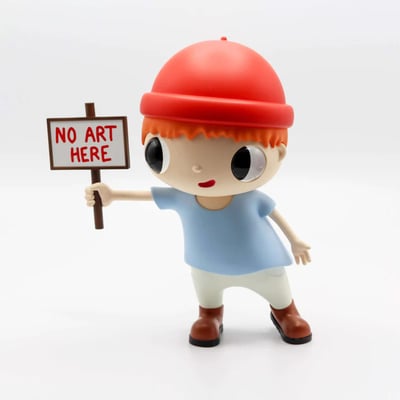
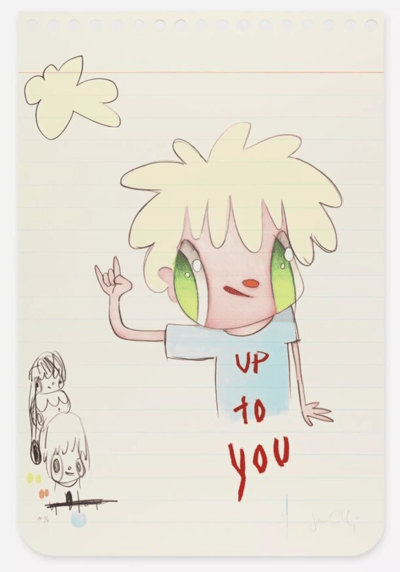
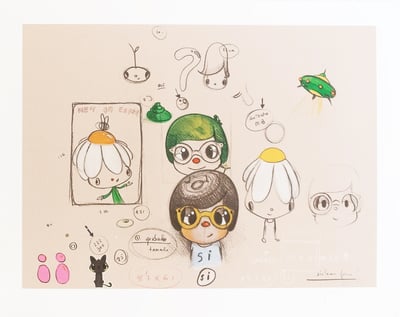
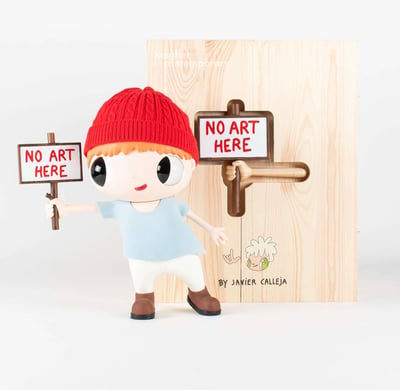
Javier Calleja (Spain, 1971) is a contemporary artist celebrated for his whimsical paintings and sculptures featuring wide-eyed characters. Blending humor and innocence, his works often incorporate text, creating playful interactions between image and word. Calleja’s distinctive style has earned him international acclaim, with exhibitions in leading galleries worldwide.
EtchingEtching is a technique where a design is created on a metal surface by using a strong acid or mordant to eat away the unprotected parts of the metal, leaving the desired pattern in relief (intaglio). In modern art and manufacturing, different chemicals may be used depending on the material being etched.
Javier Calleja’s diptych delves into the possibilities and complexities of life, presenting two contrasting yet interconnected scenes.
On the left, It Wasn’t Me depicts a playful, mischievous moment that teeters between innocence and trouble. On the right, Floating captures the lightness and boundless potential of daydreaming. Together, these two pieces form a subtle yet impactful narrative, holding each figure in a suspended, meaningful instant.
Each print is created through a detailed 15-color engraving technique, utilizing 4 photopolymer etching plates. The final color is carefully applied by hand by the printmaker, adding a unique, artisanal touch.
The diptych is composed of two prints, with an edition size of 250 for each. The unframed prints measure 56cm x 43cm. The image itself is 30.5cm x 22.5cm, printed on 65gsm Shin Inbe paper, mounted on 290gsm Fabriano Tiepolo paper. The background is digitally printed, while the finishing color is applied by hand, ensuring each print is distinct.
Javier Calleja (Spain, 1971) is a contemporary artist celebrated for his whimsical paintings and sculptures featuring wide-eyed characters. Blending humor and innocence, his works often incorporate text, creating playful interactions between image and word. Calleja’s distinctive style has earned him international acclaim, with exhibitions in leading galleries worldwide.
I like simple things. Simple, but not easy.
- Javier Calleja
Javier Calleja, born in 1971 in Málaga, Spain, is a contemporary artist renowned for his distinct visual language that often combines playful innocence with complex themes. He studied Fine Arts at the Polytechnic University of Valencia, where he honed his skills under mentors like Juan Carlos Eguillor and Manolo Valdés. Over time, Calleja has diversified his artistic mediums, transitioning from traditional painting to including drawings, sculptures, and installations in his repertoire.
His work is characterized by whimsical characters with oversized heads and diminutive bodies, situated in dreamlike environments. Despite their seemingly simplistic appearance, these characters explore multifaceted themes ranging from identity and the human psyche to the intricacies of daily life. Calleja uses irony and humor as effective tools to delve into deeper, more existential issues, making his art accessible yet profound.
Calleja’s works are a fusion of various art movements such as Surrealism, Cubism, and Pop Art, but they maintain a unique flair that sets him apart. His art has garnered international attention, captivating audiences across continents. With an expanding portfolio and a continually growing following, Calleja remains a significant figure in contemporary art, continuously challenging and engaging viewers with his emotive and intellectually stimulating creations.
Sometimes known as Figurativism, figurative art refers to sculptures and paintings that are clearly or specifically derived from real objects, making them representational. The term figurative art is often used in contrast to abstract art. However, since the emergence of abstract art, figurative art has come to describe any form of modern art that has strong references to the real world or actual situations.