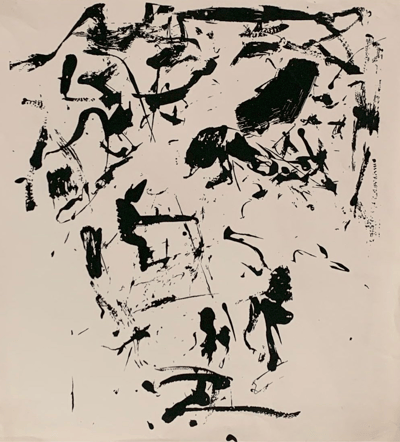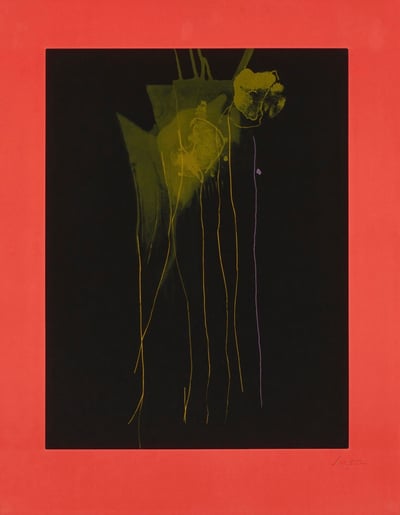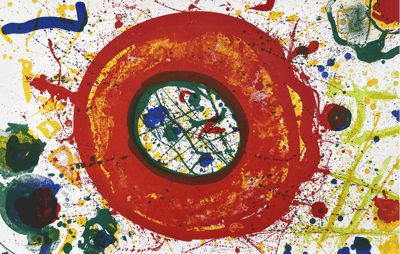
Joan Mitchell (USA, 1925–1992) was a leading Abstract Expressionist known for her dynamic, gestural brushwork and vibrant color palettes. Her large-scale canvases often drew inspiration from landscapes and emotions, blending abstraction with lyrical beauty. Mitchell was one of the few women to gain prominence in the male-dominated post-war art scene, leaving a lasting impact.
Lithograph Lithography is a printing method based on the principle that water and oil do not mix. It can be used to print artwork or text onto paper or other suitable materials. Traditionally, an image was drawn with wax, fat, or oil onto a lithographic limestone surface or plate. Today, metal plates and other surfaces are also used in lithographic printing.
Joan Mitchell (USA, 1925–1992) was a leading Abstract Expressionist known for her dynamic, gestural brushwork and vibrant color palettes. Her large-scale canvases often drew inspiration from landscapes and emotions, blending abstraction with lyrical beauty. Mitchell was one of the few women to gain prominence in the male-dominated post-war art scene, leaving a lasting impact.
Abstract is not a style. I simply want to make a surface work.
- Joan Mitchell
Joan Mitchell was a key figure of the painters in the American abstract expressionist movement, although much of her artistic career took place in France. Ms. Mitchell's earlier works were inspired by the images she found in the works of Wassily Kandinsky, Henri Matisse, Paul Cezanne, Willem de Kooning, and Franz Kline. Joan Mitchell’s artwork career goes through a progression as she continued to find herself and to become mature in her artistic thoughts, emotions, and visions. Joan Mitchell was known for her bold colors and sweeping brushstrokes, especially in her multi-paneled paintings. Her paintings were inspired by her love of nature, landscapes, and poetry. Mitchell's response to what her paintings convey, evoked her to say that her intent was not to create a recognizable image, but to convey emotions. Speaking of emotions, Joan Mitchell was known for her abrasive personality and very independent spirit, which were considered key factors in the interpretation of many of her paintings, that seemed to express rage, even violence. Joan Mitchell was introduced to her artistic technique when she painted and studied during her stay in New York City, which at the time was dominated by the Abstract Expressionist movement, highlighted by Arshile Gorky and Jackson Pollock, as well as poets like Frank O'Hara, James Schuyler and John Ashbery. With Joan Mitchell’s introduction into expressionism, her paintings, cubist cityscapes, figures, and interiors, became her progressive, mainstay style. Joan Mitchell painted and travelled from New York to France during the 50's and 60's. Her travels were the result of a different set of artistic friends, including Jean-Paul Riopelle, who became her paramour and artistic collaborator. Her different medium forms are displayed in her “Edrita Fried,” 1981 oil on canvas, four panel display; her “untitled” four paneled pencil and water color on paper; and her large colorful lithograph on three sheets, entitled “Little Weeds I.” Joan Mitchell eventually made the town of Vetheuil, Paris her permanent home, which she opened up to young artists to stay, sometimes for a summer and sometimes for just one night. On her death, the Joan Mitchell Foundation was formed at her request, in order to create, support, and recognize individual artists. The Foundation also promotes Joan Mitchell's legacy in the form her paintings, correspondence, photographs, and all archival materials related to her life and work. (Artist website)
Postmodernism is an art movement that emerged as a reaction against authority and traditional boundaries, seeking to blur the lines between art and everyday life. It aimed to bridge the gap between the cultural elite and the general public by embracing eclectic mixtures of earlier conventions and styles. Postmodernist art often challenges established norms and celebrates diversity, irony, and pastiche, making it a movement that reflects the complexities of contemporary culture.