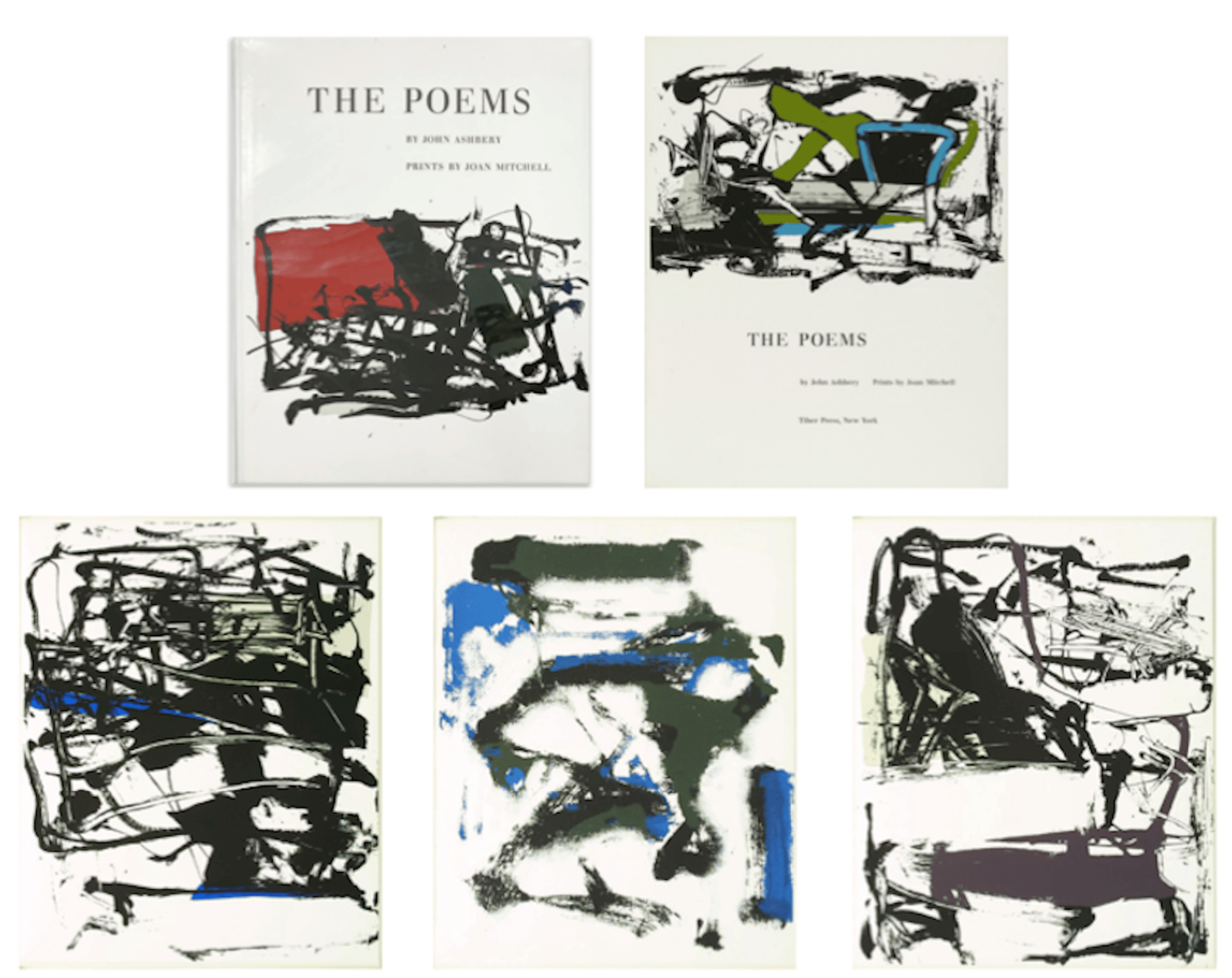
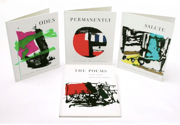
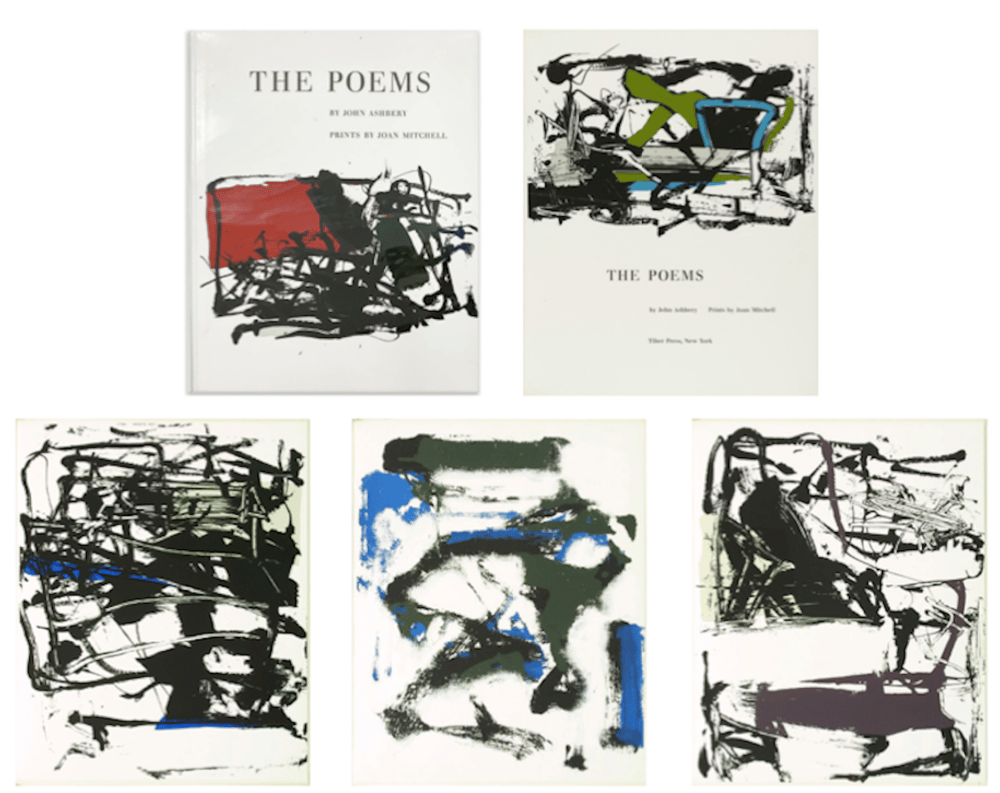
The complete set of four books, each containing 5 screen prints.
Each book is signed in ink by the artist and poet on the title page.
Published and printed by Tiber Press, New York.
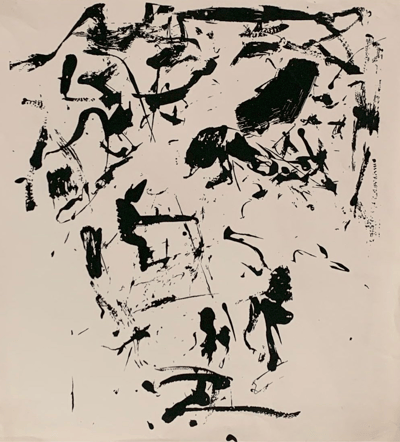
Joan Mitchell’s The New York School (1960) is a complete set of four artist books, each containing five screenprints that translate her gestural abstraction into the printed page. Bold black brushstrokes dominate the compositions, interwoven with passages of vivid color—blue, red, and green—creating rhythmic, layered surfaces. The works retain a sense of immediacy, as if capturing the movement of the artist’s hand. Published and printed by Tiber Press in New York in an edition of 200 plus 25 Roman numeral copies, and signed by both artist and poet, the set reflects the close dialogue between visual art and poetry central to the New York School.
Artwork Copyright © Joan MitchellJoan Mitchell (USA, 1925–1992) was a leading Abstract Expressionist known for her dynamic, gestural brushwork and vibrant color palettes. Her large-scale canvases often drew inspiration from landscapes and emotions, blending abstraction with lyrical beauty. Mitchell was one of the few women to gain prominence in the male-dominated post-war art scene, leaving a lasting impact.
Artwork Copyright © Joan MitchellThe New York School, 1960
Form
Medium
Size
- Inches
- Centimeters
Edition
Price
- USD
- EUR
- GBP
- CHF
- Authenticity Guaranteed
- Insured Shipping
- Online Since 2005
●Inventory 16727
●Signed on the colophon
●Comes with gallery invoice and certificate
●Sell Us a Similar Artwork. Learn more.
The complete set of four books, each containing 5 screen prints.
Each book is signed in ink by the artist and poet on the title page.
Published and printed by Tiber Press, New York.
Joan Mitchell’s The New York School (1960) is a complete set of four artist books, each containing five screenprints that translate her gestural abstraction into the printed page. Bold black brushstrokes dominate the compositions, interwoven with passages of vivid color—blue, red, and green—creating rhythmic, layered surfaces. The works retain a sense of immediacy, as if capturing the movement of the artist’s hand. Published and printed by Tiber Press in New York in an edition of 200 plus 25 Roman numeral copies, and signed by both artist and poet, the set reflects the close dialogue between visual art and poetry central to the New York School.
Artwork Copyright © Joan MitchellJoan Mitchell (USA, 1925–1992) was a leading Abstract Expressionist known for her dynamic, gestural brushwork and vibrant color palettes. Her large-scale canvases often drew inspiration from landscapes and emotions, blending abstraction with lyrical beauty. Mitchell was one of the few women to gain prominence in the male-dominated post-war art scene, leaving a lasting impact.
Artwork Copyright © Joan Mitchell- Recently Added
- Price (Low-High)
- Price (High-Low)
- Year (Low-High)
- Year (High-Low)
Joan Mitchell
Untitled (The Poems), ca. 1959
Limited Edition Print
Screen-print
USD 7,000

Joan Mitchell
Champs - Black, Grey and Green, 1991
Limited Edition Print
Lithograph
USD 17,000

Joan Mitchell
The New York School, 1960
Limited Edition Print
Screen-print
USD 12,000

Joan Mitchell
Tree I, 1990
Limited Edition Print
Lithograph
Currently Not Available
Related Artists
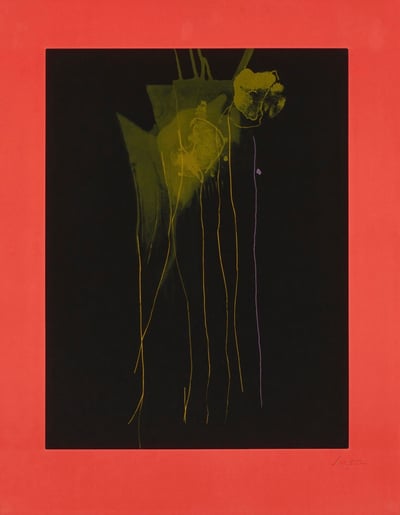


Artwork by Helen Frankenthaler
What is abstract expressionism?
Abstract Expressionism is an art movement that emerged in the United States during the 1940s and 1950s. Characterized by large, abstract canvases, the movement emphasized spontaneous, expressive brushwork and the use of color and form to convey emotion rather than represent reality. Artists like Jackson Pollock, Mark Rothko, and Willem de Kooning are key figures in this movement. Abstract Expressionism marked a shift in the art world, making New York City a center of the international art scene.