Mitchell, Joan | Sunflower III, 1972 — available on Composition Gallery
Color etching with aquatint, signed and numbered in pencil. Published by Maeght Editeur, Paris, and printed by Arte Adrien Maeght, Paris.
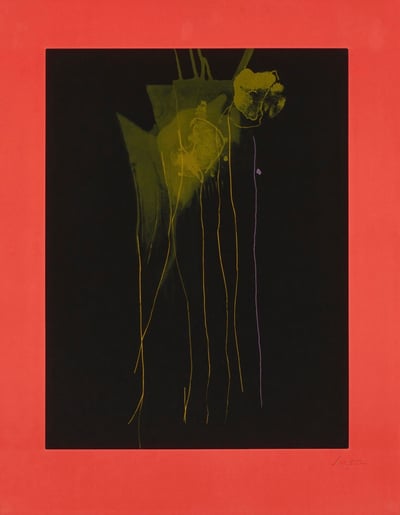
Joan Mitchell’s Sunflower III (1972) is an etching and aquatint that translates her painterly language into printmaking with remarkable intensity. Dense, gestural marks and layered textures build a turbulent composition, where earthy browns, ochres, and a vivid yellow form suggest the presence of a sunflower without defining it explicitly. The surface feels active and tactile, with scratches, splatters, and washes conveying movement and emotion. Published by Maeght Éditeur and printed by Arte Adrien Maeght in Paris in an edition of 75, the work reflects Mitchell’s engagement with nature as a source of memory and sensation rather than direct representation.
Artwork Copyright © Joan Mitchell
Joan Mitchell (USA, 1925–1992) was a leading Abstract Expressionist known for her dynamic, gestural brushwork and vibrant color palettes. Her large-scale canvases often drew inspiration from landscapes and emotions, blending abstraction with lyrical beauty. Mitchell was one of the few women to gain prominence in the male-dominated post-war art scene, leaving a lasting impact.
Artwork Copyright © Joan Mitchell

Sunflower III, 1972

Form

Medium

Edition

Price

Available works →
  • Authenticity Guaranteed
  • Insured Shipping
  • Online Since 2005
Inventory 16726
Signed
Comes with gallery invoice and certificate
Sell Us a Similar Artwork. Learn more.
Color etching with aquatint, signed and numbered in pencil. Published by Maeght Editeur, Paris, and printed by Arte Adrien Maeght, Paris.
Joan Mitchell’s Sunflower III (1972) is an etching and aquatint that translates her painterly language into printmaking with remarkable intensity. Dense, gestural marks and layered textures build a turbulent composition, where earthy browns, ochres, and a vivid yellow form suggest the presence of a sunflower without defining it explicitly. The surface feels active and tactile, with scratches, splatters, and washes conveying movement and emotion. Published by Maeght Éditeur and printed by Arte Adrien Maeght in Paris in an edition of 75, the work reflects Mitchell’s engagement with nature as a source of memory and sensation rather than direct representation.
Artwork Copyright © Joan Mitchell
Joan Mitchell (USA, 1925–1992) was a leading Abstract Expressionist known for her dynamic, gestural brushwork and vibrant color palettes. Her large-scale canvases often drew inspiration from landscapes and emotions, blending abstraction with lyrical beauty. Mitchell was one of the few women to gain prominence in the male-dominated post-war art scene, leaving a lasting impact.
Artwork Copyright © Joan Mitchell
SORT BY
  • Recently Added
  • Price (Low-High)
  • Price (High-Low)
  • Year (Low-High)
  • Year (High-Low)
Untitled (The Poems)

Joan Mitchell

Untitled (The Poems), ca. 1959

Limited Edition Print

Screen-print

USD 7,000

Champs - Black, Grey and Green

Joan Mitchell

Champs - Black, Grey and Green, 1991

Limited Edition Print

Lithograph

USD 17,000

The New York School

Joan Mitchell

The New York School, 1960

Limited Edition Print

Screen-print

USD 12,000

Tree I

Joan Mitchell

Tree I, 1990

Limited Edition Print

Lithograph

Currently Not Available

Available works by Joan Mitchell

See all →
Untitled (The Poems)

Joan Mitchell

Untitled (The Poems), ca. 1959

Limited Edition Print

Screen-print

USD 7,000

Champs - Black, Grey and Green

Joan Mitchell

Champs - Black, Grey and Green, 1991

Limited Edition Print

Lithograph

USD 17,000

The New York School

Joan Mitchell

The New York School, 1960

Limited Edition Print

Screen-print

USD 12,000

Stay Updated on Joan Mitchell

Subscribe to receive updates on new artworks, exhibitions and news about Joan Mitchell.

We respect your privacy and protect your information.
What is Postmodernism?

What is Postmodernism?

Postmodernism is an art movement that emerged as a reaction against authority and traditional boundaries, seeking to blur the lines between art and everyday life. It aimed to bridge the gap between the cultural elite and the general public by embracing eclectic mixtures of earlier conventions and styles. Postmodernist art often challenges established norms and celebrates diversity, irony, and pastiche, making it a movement that reflects the complexities of contemporary culture.

Est. 2005 — twenty years of collecting, online.