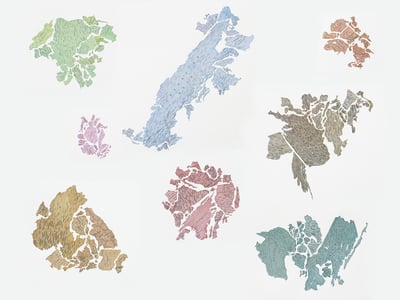
// New World by Jorge Macchi is a limited edition lithograph created in 2009, with an edition of 50. The artwork presents a series of colorful, abstract landmasses that resemble fragmented maps or islands, each isolated in its own shape and color. The varied hues—ranging from greens and blues to reds and purples—give each form a unique identity, creating a sense of dislocation and unfamiliarity. Macchi’s work often reflects on themes of geography, boundaries, and the way we perceive space, and in New World, he offers a reimagining of maps as subjective interpretations rather than fixed representations. This playful and thought-provoking composition invites viewers to ponder the concept of place and how cartography shapes our understanding of the world.
Jorge Macchi (Argentina, 1963) is a visual artist whose work spans painting, drawing, installation, sound, video, and sculpture. He is known for his minimalist approach, often using everyday materials to create pieces that explore themes of chance, time, and the ephemeral. Macchi's art frequently incorporates elements of music, literature, and architecture, using maps, sheet music, and cityscapes in unexpected ways. His signature style of poetic fragmentation transforms familiar objects into new, often broken forms, offering fresh interpretations of the ordinary.
LithographLithography is a printing method based on the principle that water and oil do not mix. It can be used to print artwork or text onto paper or other suitable materials. Traditionally, an image was drawn with wax, fat, or oil onto a lithographic limestone surface or plate. Today, metal plates and other surfaces are also used in lithographic printing.
Size
Inches
Centimeters
62 X 80 cm
Edition
Edition of 50
Price
USD
EUR
GBP
CHF
1,500EUR
?
+ VAT/import Duties (if applicable)
Authenticity Guaranteed
Insured Shipping
Online Since 2005
Share
●Inventory 3015
●Signed
●Comes with gallery invoice and certificate
●Any questions?
// New World by Jorge Macchi is a limited edition lithograph created in 2009, with an edition of 50. The artwork presents a series of colorful, abstract landmasses that resemble fragmented maps or islands, each isolated in its own shape and color. The varied hues—ranging from greens and blues to reds and purples—give each form a unique identity, creating a sense of dislocation and unfamiliarity. Macchi’s work often reflects on themes of geography, boundaries, and the way we perceive space, and in New World, he offers a reimagining of maps as subjective interpretations rather than fixed representations. This playful and thought-provoking composition invites viewers to ponder the concept of place and how cartography shapes our understanding of the world.
Jorge Macchi (Argentina, 1963) is a visual artist whose work spans painting, drawing, installation, sound, video, and sculpture. He is known for his minimalist approach, often using everyday materials to create pieces that explore themes of chance, time, and the ephemeral. Macchi's art frequently incorporates elements of music, literature, and architecture, using maps, sheet music, and cityscapes in unexpected ways. His signature style of poetic fragmentation transforms familiar objects into new, often broken forms, offering fresh interpretations of the ordinary.
Every time I start a new work I start with an image, that’s why I am not a conceptual artist.
- Jorge Macchi
Jorge Macchi (b. 1963 Argentina) is a prominent Argentine contemporary artist known for his multidisciplinary approach, which spans painting, drawing, installation, video, and sound art. Macchi’s work is characterized by its exploration of the intersection between the everyday and the extraordinary, often using simple, familiar materials to create pieces that evoke a sense of dislocation or disruption. His art frequently plays with concepts of time, memory, and fragility, subtly altering ordinary objects or situations to reveal hidden narratives or unexpected connections. Macchi’s installations and artworks often reflect a minimalist aesthetic, yet they carry deep emotional and conceptual weight. His work has been exhibited internationally, including at the Venice Biennale and the Museum of Modern Art in New York, and he is recognized as one of the leading figures in contemporary Latin American art. Macchi’s ability to transform the mundane into something profound and poetic has solidified his reputation as a significant voice in the art world. (Artist website)
Neo-Figurative Art is a collective term that refers to the revival of figurative art in America and Europe during the 1960s, following a period dominated by abstraction. Michel Ragon, a French art critic, argued that this resurgence of figuration occurred during a critical time of social and political upheaval in both regions.