

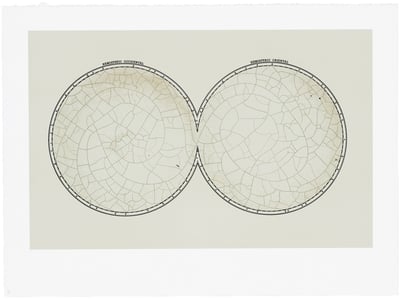
// Old World by Jorge Macchi is a limited edition lithograph from 2007, produced in an edition of 50. The artwork presents two overlapping circular forms resembling ancient cartographic maps, labeled “Hemisphere Occident” and “Hemisphere Orient.” The circles are filled with fractured, puzzle-like segments that resemble cracked earth or broken glass, suggesting the fragility and disintegration of what these hemispheres represent. By distorting the classic world map into fragmented sections, Macchi invites viewers to contemplate the fragility of historical and geographical constructs. The subtle, monochromatic palette emphasizes the timeless quality of the image while highlighting the intricate, delicate lines of each fractured segment.
Artwork Copyright © Jorge MacchiJorge Macchi (Argentina, 1963) is a visual artist whose work spans painting, drawing, installation, sound, video, and sculpture. He is known for his minimalist approach, often using everyday materials to create pieces that explore themes of chance, time, and the ephemeral. Macchi's art frequently incorporates elements of music, literature, and architecture, using maps, sheet music, and cityscapes in unexpected ways. His signature style of poetic fragmentation transforms familiar objects into new, often broken forms, offering fresh interpretations of the ordinary.
Artwork Copyright © Jorge MacchiOld World, 2007
Form
Medium
Size
- Inches
- Centimeters
Edition
Price
- USD
- EUR
- GBP
- CHF
- Authenticity Guaranteed
- Insured Shipping
- Online Since 2005
●Inventory 3016
●Signed
●Comes with gallery invoice and certificate
●Sell Us a Similar Artwork. Learn more.
// Old World by Jorge Macchi is a limited edition lithograph from 2007, produced in an edition of 50. The artwork presents two overlapping circular forms resembling ancient cartographic maps, labeled “Hemisphere Occident” and “Hemisphere Orient.” The circles are filled with fractured, puzzle-like segments that resemble cracked earth or broken glass, suggesting the fragility and disintegration of what these hemispheres represent. By distorting the classic world map into fragmented sections, Macchi invites viewers to contemplate the fragility of historical and geographical constructs. The subtle, monochromatic palette emphasizes the timeless quality of the image while highlighting the intricate, delicate lines of each fractured segment.
Artwork Copyright © Jorge MacchiJorge Macchi (Argentina, 1963) is a visual artist whose work spans painting, drawing, installation, sound, video, and sculpture. He is known for his minimalist approach, often using everyday materials to create pieces that explore themes of chance, time, and the ephemeral. Macchi's art frequently incorporates elements of music, literature, and architecture, using maps, sheet music, and cityscapes in unexpected ways. His signature style of poetic fragmentation transforms familiar objects into new, often broken forms, offering fresh interpretations of the ordinary.
Artwork Copyright © Jorge MacchiAvailability
SORT BY

Jorge Macchi
Agua de Jamaica, 2023
Limited Edition Print
Lithograph
EUR 1,200

Jorge Macchi
Islas vírgenes, 2023
Limited Edition Print
Lithograph
EUR 1,200
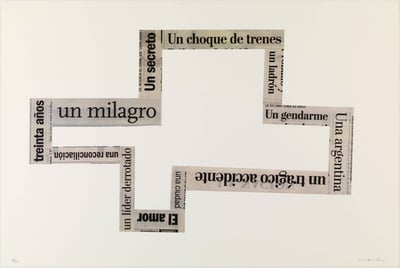
Jorge Macchi
El secreto, 2011
Limited Edition Print
Lithograph
EUR 1,200

Jorge Macchi
Las Horas, 2011
Limited Edition Print
Lithograph
EUR 1,200
Jorge Macchi
Old World, 2007
Limited Edition Print
Lithograph
EUR 1,000
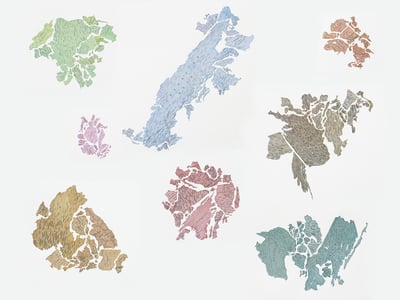
Jorge Macchi
New World, 2009
Limited Edition Print
Lithograph
EUR 1,500
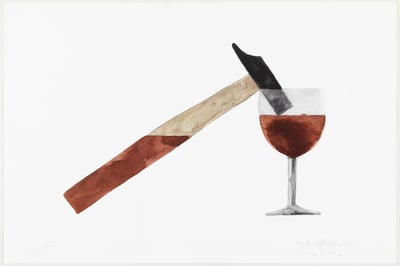
Jorge Macchi
Drunk, 2010
Limited Edition Print
Lithograph
EUR 1,200
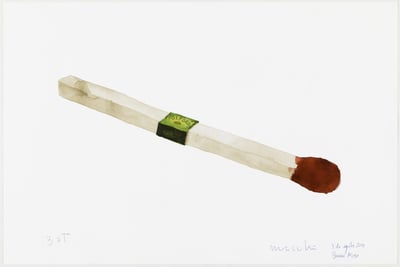
Jorge Macchi
Fósforo, 2010
Limited Edition Print
Lithograph
EUR 1,200
Related Artists


Artwork by Laure Prouvost
What is Lettrism?
Lettrism is an art form that uses letters, words, and symbols to create artwork. The movement was established in Paris in the 1940s and later gained popularity in the 1950s in America. Lettrisme is the French spelling of the movement's name, derived from the French word for letter.

Jorge Macchi
Old World, 2007
75 x 55 cm


