

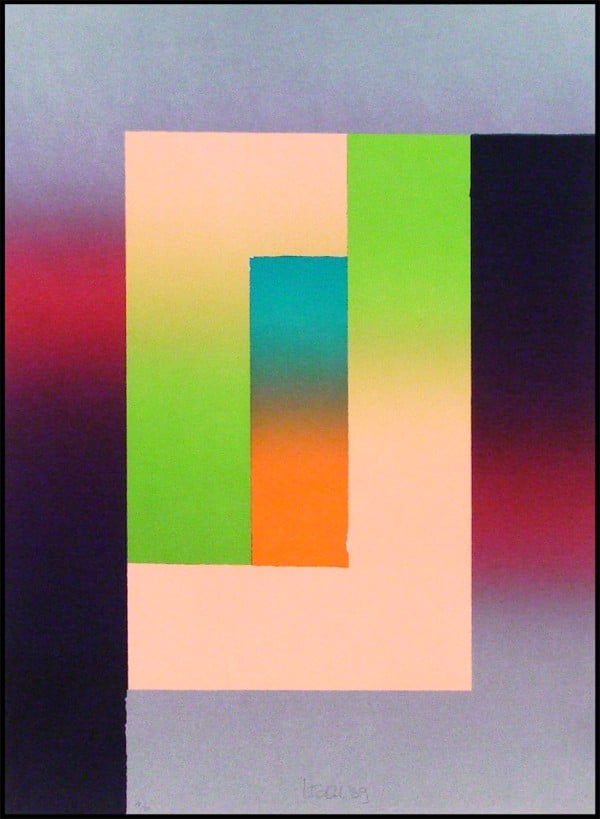
BARCELONA #5, 1988, color lithograph, signed in pencil, from the numbered editions 75, sheet 30 x 22
Barcelona #5 by Larry Bell, a color lithograph from 1988, captures the artist's exploration of light, color, and spatial perception. In this composition, overlapping rectangular shapes in vibrant shades of green, orange, pink, and teal contrast against a softly gradated background that shifts from deep purple to red and gray. The interplay of colors and geometric forms creates a sense of depth and illusion, making the flat surface appear multidimensional. Bell, known for his innovative work with light and shadow, invites viewers to experience a shifting visual perception as they take in the layered hues and forms. Limited to an edition of 75, this lithograph exemplifies Bell's refined approach to minimalist abstraction and his fascination with the boundaries of two-dimensional space.
Artwork Copyright © Larry BellLarry Bell (USA, 1939) is an American contemporary artist and sculptor, renowned for his innovative use of glass and light. A key figure in the Light and Space movement, he creates minimalist sculptures and installations that explore perception and optical phenomena. Bell's works are featured in major institutions, including the Museum of Modern Art in New York and the Tate Gallery in London.
Artwork Copyright © Larry BellBarcelona #5, 1988
Form
Medium
Size
- Inches
- Centimeters
Edition
Price
Available works →
- Authenticity Guaranteed
- Insured Shipping
- Online Since 2005
●
●Inventory 3208
●Signed
●Comes with gallery invoice and certificate
●Sell Us a Similar Artwork. Learn more.
BARCELONA #5, 1988, color lithograph, signed in pencil, from the numbered editions 75, sheet 30 x 22
Barcelona #5 by Larry Bell, a color lithograph from 1988, captures the artist's exploration of light, color, and spatial perception. In this composition, overlapping rectangular shapes in vibrant shades of green, orange, pink, and teal contrast against a softly gradated background that shifts from deep purple to red and gray. The interplay of colors and geometric forms creates a sense of depth and illusion, making the flat surface appear multidimensional. Bell, known for his innovative work with light and shadow, invites viewers to experience a shifting visual perception as they take in the layered hues and forms. Limited to an edition of 75, this lithograph exemplifies Bell's refined approach to minimalist abstraction and his fascination with the boundaries of two-dimensional space.
Artwork Copyright © Larry BellLarry Bell (USA, 1939) is an American contemporary artist and sculptor, renowned for his innovative use of glass and light. A key figure in the Light and Space movement, he creates minimalist sculptures and installations that explore perception and optical phenomena. Bell's works are featured in major institutions, including the Museum of Modern Art in New York and the Tate Gallery in London.
Artwork Copyright © Larry Bell- Recently Added
- Price (Low-High)
- Price (High-Low)
- Year (Low-High)
- Year (High-Low)

Larry Bell
Barcelona #5, 1988
Limited Edition Print
Lithograph
Currently Not Available

Larry Bell
Barcelona #10, 1988
Limited Edition Print
Lithograph
Currently Not Available
Related Artists


Artwork by Larry Bell
What is Entropy?
Entropy, in a broader sense, refers to the inevitable deterioration or decline of a society or system. In art, the concept was popularized by artist Robert Smithson in the 1960s. He used the term to critique what he saw as the static and overly simplified nature of contemporary minimalist art. Smithson's work often explored the idea of entropy as a force of chaos and decay, contrasting with the perceived order and purity of minimalist works.
Larry Bell
Barcelona #5, 1988
76.2 x 55.88 cm


