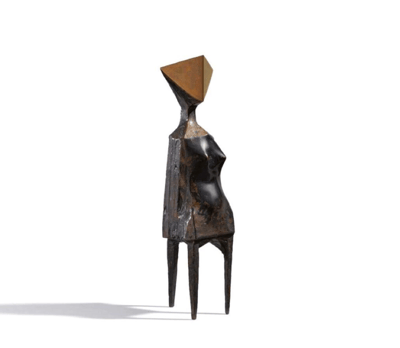
Bronze, partly dark brown patinated and polished.
Not signed.
Little Girl by Lynn Chadwick, created in 1970, is a bronze sculpture measuring 39 × 11.5 × 11 cm, issued in a limited edition of six. The figure is rendered in Chadwick’s distinctive geometric style, with a sharply faceted head shaped like a pyramid and a contrastingly organic, polished torso. The juxtaposition of angular abstraction and human form evokes a sense of mystery and stoic femininity. The sculpture’s dark patina and minimal features are characteristic of Chadwick’s exploration of figure and space, emphasizing both presence and restraint in this compact yet commanding work.
Lynn Chadwick (UK, 1914–2003) was a leading British sculptor known for his abstract, often angular figures crafted from metal. Influenced by Surrealism and the human form, his works evoke movement and tension. Chadwick gained international acclaim after winning the International Sculpture Prize at the 1956 Venice Biennale, cementing his legacy in modern sculpture.
BronzeBronze is a metal alloy made primarily of copper and tin, with a typical modern composition of 88% copper and 12% tin. Over time, bronze develops a patina, a surface color that often turns deep green due to oxidation. Large bronze objects, such as sculptures, are typically made in foundries. Bronze is valued for its durability and has been widely used throughout history for art, tools, and weapons.
Bronze, partly dark brown patinated and polished.
Not signed.
Little Girl by Lynn Chadwick, created in 1970, is a bronze sculpture measuring 39 × 11.5 × 11 cm, issued in a limited edition of six. The figure is rendered in Chadwick’s distinctive geometric style, with a sharply faceted head shaped like a pyramid and a contrastingly organic, polished torso. The juxtaposition of angular abstraction and human form evokes a sense of mystery and stoic femininity. The sculpture’s dark patina and minimal features are characteristic of Chadwick’s exploration of figure and space, emphasizing both presence and restraint in this compact yet commanding work.
Lynn Chadwick (UK, 1914–2003) was a leading British sculptor known for his abstract, often angular figures crafted from metal. Influenced by Surrealism and the human form, his works evoke movement and tension. Chadwick gained international acclaim after winning the International Sculpture Prize at the 1956 Venice Biennale, cementing his legacy in modern sculpture.
Lynn Chadwick (b. 1914 UK, d. 2003 UK) was a prominent British sculptor, celebrated for his innovative and often abstract sculptures that explored the tension between organic and geometric forms. Initially trained as an architectural draftsman, Chadwick transitioned to sculpture after World War II, gaining recognition for his distinctive works in welded metal. His sculptures, often depicting human and animal figures, are characterized by their angular shapes, sharp lines, and a sense of movement and balance. Chadwick's work played a significant role in the post-war revival of British sculpture, and he became a leading figure in the art world, winning the prestigious International Prize for Sculpture at the Venice Biennale in 1956. His ability to fuse modernist abstraction with figurative elements has left a lasting legacy in the world of contemporary art. (Artist website)
Postmodernism is an art movement that emerged as a reaction against authority and traditional boundaries, seeking to blur the lines between art and everyday life. It aimed to bridge the gap between the cultural elite and the general public by embracing eclectic mixtures of earlier conventions and styles. Postmodernist art often challenges established norms and celebrates diversity, irony, and pastiche, making it a movement that reflects the complexities of contemporary culture.