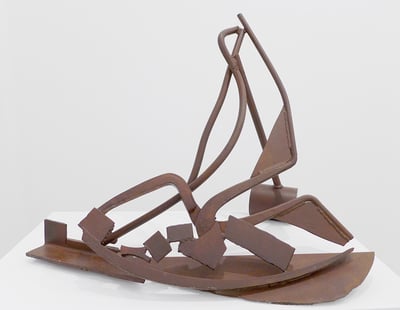
Bronze, stamped with monogram, dated '76, numbered '786' and numbered with edition number on the reverse. Signed in plate.
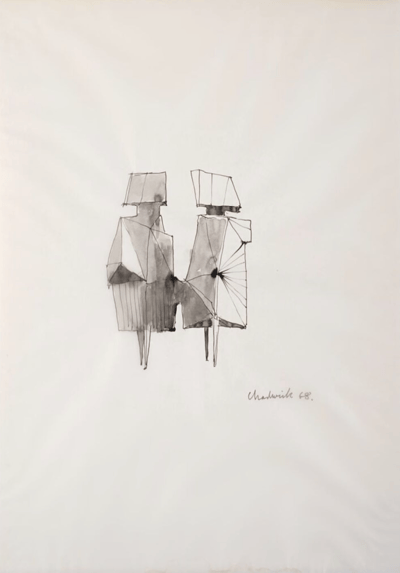
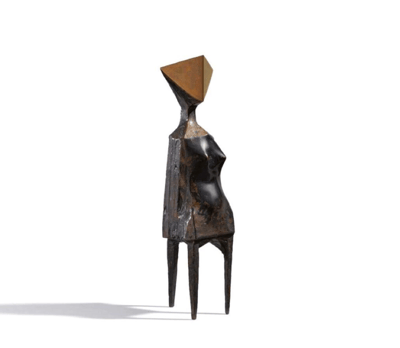
Two cloaked bronze figures stand close: the figure on the left wears a triangular pyramid head, the figure on the right a rectangular block, both rising from heavy, draped torsos perched on Chadwick's signature angular legs. Bronze, stamped with monogram, dated 76, numbered 786 with edition number on the reverse, signed in plate. The two-figure walking couple is Chadwick's most iconic motif of the post-war decades. A confident, sculpturally rigorous acquisition to collect — anchoring a collection in one of the great British modernists at full late maturity.
Lynn Chadwick (UK, 1914–2003) was a leading British sculptor known for his abstract, often angular figures crafted from metal. Influenced by Surrealism and the human form, his works evoke movement and tension. Chadwick gained international acclaim after winning the International Sculpture Prize at the 1956 Venice Biennale, cementing his legacy in modern sculpture.
BronzeBronze is a metal alloy made primarily of copper and tin, with a typical modern composition of 88% copper and 12% tin. Over time, bronze develops a patina, a surface color that often turns deep green due to oxidation. Large bronze objects, such as sculptures, are typically made in foundries. Bronze is valued for its durability and has been widely used throughout history for art, tools, and weapons.
Bronze, stamped with monogram, dated '76, numbered '786' and numbered with edition number on the reverse. Signed in plate.
Two cloaked bronze figures stand close: the figure on the left wears a triangular pyramid head, the figure on the right a rectangular block, both rising from heavy, draped torsos perched on Chadwick's signature angular legs. Bronze, stamped with monogram, dated 76, numbered 786 with edition number on the reverse, signed in plate. The two-figure walking couple is Chadwick's most iconic motif of the post-war decades. A confident, sculpturally rigorous acquisition to collect — anchoring a collection in one of the great British modernists at full late maturity.
Lynn Chadwick (UK, 1914–2003) was a leading British sculptor known for his abstract, often angular figures crafted from metal. Influenced by Surrealism and the human form, his works evoke movement and tension. Chadwick gained international acclaim after winning the International Sculpture Prize at the 1956 Venice Biennale, cementing his legacy in modern sculpture.
Lynn Chadwick (b. 1914 UK, d. 2003 UK) was a prominent British sculptor, celebrated for his innovative and often abstract sculptures that explored the tension between organic and geometric forms. Initially trained as an architectural draftsman, Chadwick transitioned to sculpture after World War II, gaining recognition for his distinctive works in welded metal. His sculptures, often depicting human and animal figures, are characterized by their angular shapes, sharp lines, and a sense of movement and balance. Chadwick's work played a significant role in the post-war revival of British sculpture, and he became a leading figure in the art world, winning the prestigious International Prize for Sculpture at the Venice Biennale in 1956. His ability to fuse modernist abstraction with figurative elements has left a lasting legacy in the world of contemporary art. (Artist website)
Geometric abstraction is a form of abstract art that uses geometric shapes arranged in a non-illusionistic space (though not always) and combined into non-representational (non-objective) compositions. Based on years of artistic research, some artists have proposed that geometric abstraction offers a solution to modern challenges by rejecting traditional illusionistic practices in favor of clarity and simplicity.