


20-colour silkscreen print on 410gsm Somerset Tub Sized Radiant White paper.
Hand-signed by the artist.
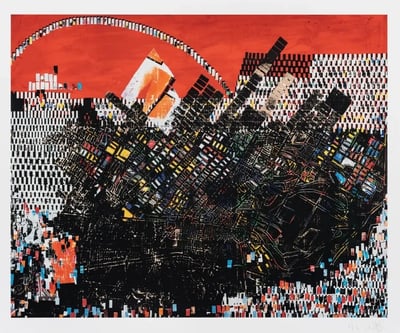
Scorched Earth by Mark Bradford is a 2025 silkscreen that reflects the artist’s layered approach to abstraction and his ongoing engagement with social, political, and urban themes. A dense network of black geometric forms dominates the composition, interrupted by vibrant fragments of color and set against a vivid red-orange background. The intricate surface evokes maps, city grids, and traces of construction or erosion, suggesting both creation and destruction. Bradford’s practice often draws inspiration from the textures and visual language of the urban environment, transforming complex patterns into powerful metaphors for history, inequality, and resilience. Published in an edition of 524, Scorched Earth demonstrates the artist’s ability to combine formal complexity with compelling conceptual depth through the medium of printmaking.
Artwork Copyright © Mark BradfordMark Bradford (USA, 1961) is a contemporary artist known for his large-scale abstract paintings and installations that incorporate materials like billboard paper and string. His work addresses themes of identity, race, and urban life, blending social commentary with layered, textural aesthetics. Bradford is a prominent figure in the global art scene.
Artwork Copyright © Mark BradfordScorched Earth, 2025
Form
Medium
Size
- Inches
- Centimeters
Edition
Price
- Authenticity Guaranteed
- Insured Shipping
- Online Since 2005
●Inventory 17701
●Signed
●Comes with gallery invoice and certificate
●Sell Us a Similar Artwork. Learn more.
20-colour silkscreen print on 410gsm Somerset Tub Sized Radiant White paper.
Hand-signed by the artist.
Scorched Earth by Mark Bradford is a 2025 silkscreen that reflects the artist’s layered approach to abstraction and his ongoing engagement with social, political, and urban themes. A dense network of black geometric forms dominates the composition, interrupted by vibrant fragments of color and set against a vivid red-orange background. The intricate surface evokes maps, city grids, and traces of construction or erosion, suggesting both creation and destruction. Bradford’s practice often draws inspiration from the textures and visual language of the urban environment, transforming complex patterns into powerful metaphors for history, inequality, and resilience. Published in an edition of 524, Scorched Earth demonstrates the artist’s ability to combine formal complexity with compelling conceptual depth through the medium of printmaking.
Artwork Copyright © Mark BradfordMark Bradford (USA, 1961) is a contemporary artist known for his large-scale abstract paintings and installations that incorporate materials like billboard paper and string. His work addresses themes of identity, race, and urban life, blending social commentary with layered, textural aesthetics. Bradford is a prominent figure in the global art scene.
Artwork Copyright © Mark Bradford- Recently Added
- Price (Low-High)
- Price (High-Low)
- Year (Low-High)
- Year (High-Low)
Mark Bradford
Scorched Earth, 2025
Limited Edition Print
Silkscreen
EUR 5,000 - 7,000

Mark Bradford
630C-MB03, 2003
Limited Edition Print
Lithograph
Currently Not Available
Related Artists


Artwork by Eduardo Chillida
What is abstract art?
Abstract art uses form, shape, line, and color to create a visual experience without attempting to represent external reality. The composition exists independently of the world's visual references, focusing on expressing ideas and emotions through non-representational means.


Mark Bradford
Scorched Earth, 2025
62.3 x 76 cm


