
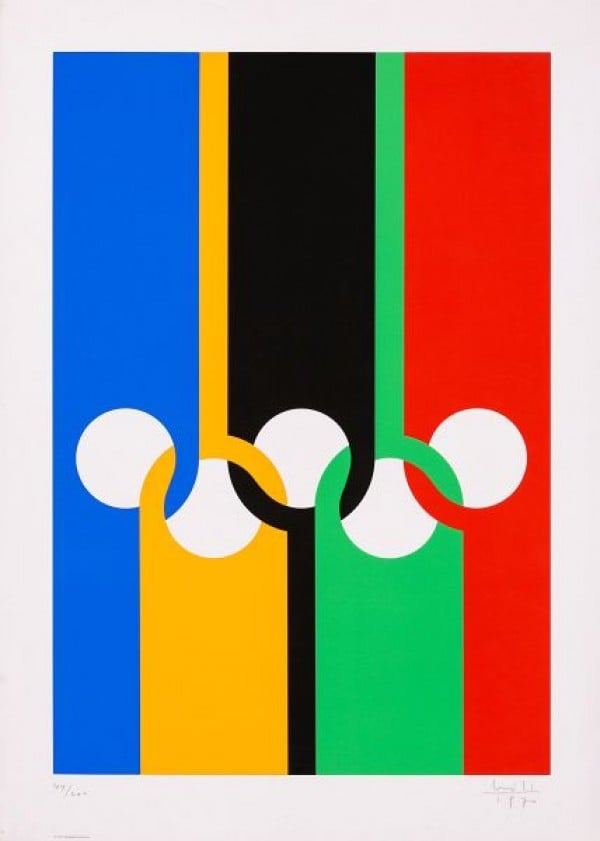
// Olympia München by Max Bill is a 1970 limited edition silkscreen print celebrating the Olympic Games with a bold, geometric design. The artwork features five vertical panels, each representing one of the Olympic colors: blue, yellow, black, green, and red. Each panel contains a circular cut-out that links with adjacent circles, symbolizing unity and connection, echoing the iconic Olympic rings. Bill’s minimalist approach and use of primary colors create a visually striking piece that encapsulates the spirit of the Olympics—diversity, unity, and international harmony. The crisp lines and vibrant colors showcase Bill’s mastery in merging art with graphic design.
Artwork Copyright © Max BillMax Bill (Switzerland, 1908–1994) was a multidisciplinary artist, architect, and designer associated with the Bauhaus and concrete art movements. Renowned for his geometric sculptures, paintings, and typography, he pioneered functional design aesthetics. His works often blur the line between art and utility, emphasizing clarity and precision.
Artwork Copyright © Max BillOlympia München, 1970
Form
Medium
Size
- Inches
- Centimeters
Edition
Price
Available works →
- Authenticity Guaranteed
- Insured Shipping
- Online Since 2005
●
●Inventory 4240
●Signed
●Comes with gallery invoice and certificate
●Sell Us a Similar Artwork. Learn more.
// Olympia München by Max Bill is a 1970 limited edition silkscreen print celebrating the Olympic Games with a bold, geometric design. The artwork features five vertical panels, each representing one of the Olympic colors: blue, yellow, black, green, and red. Each panel contains a circular cut-out that links with adjacent circles, symbolizing unity and connection, echoing the iconic Olympic rings. Bill’s minimalist approach and use of primary colors create a visually striking piece that encapsulates the spirit of the Olympics—diversity, unity, and international harmony. The crisp lines and vibrant colors showcase Bill’s mastery in merging art with graphic design.
Artwork Copyright © Max BillMax Bill (Switzerland, 1908–1994) was a multidisciplinary artist, architect, and designer associated with the Bauhaus and concrete art movements. Renowned for his geometric sculptures, paintings, and typography, he pioneered functional design aesthetics. His works often blur the line between art and utility, emphasizing clarity and precision.
Artwork Copyright © Max Bill- Recently Added
- Price (Low-High)
- Price (High-Low)
- Year (Low-High)
- Year (High-Low)

Max Bill
Untitled (Columbus In Search of a New Tomorrow), 1992
Limited Edition Print
Silkscreen
Currently Not Available

Max Bill
Olympia München, 1970
Limited Edition Print
Silkscreen
Currently Not Available
Related Artists



Artwork by Francois Morellet
What is geometric abstract art?
Geometric abstraction is a form of abstract art that uses geometric shapes arranged in a non-illusionistic space (though not always) and combined into non-representational (non-objective) compositions. Based on years of artistic research, some artists have proposed that geometric abstraction offers a solution to modern challenges by rejecting traditional illusionistic practices in favor of clarity and simplicity.

Max Bill
Olympia München, 1970
80 x 58 cm


