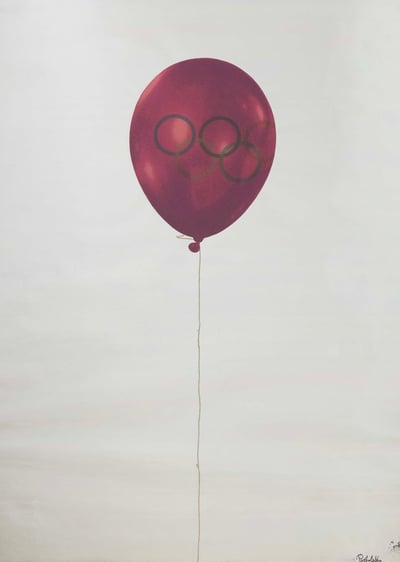
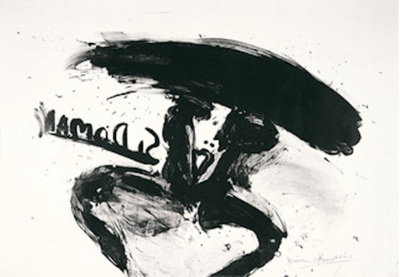
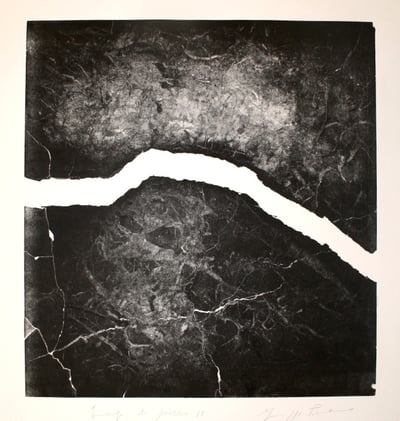
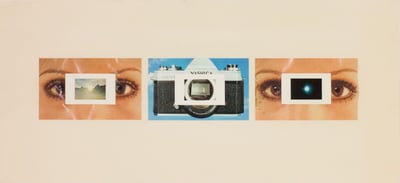
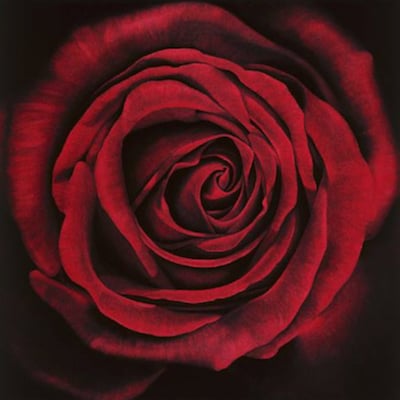
14-color silkscreen on white Murillo cardboard from Cartiere Miliani Fabriano.
- The Work is part of the portfolio "Counterpoints - 7 visual notations by Accardi, Boetti, Buren, Kounellis, LeWitt, Paolini and Pistoletto" published by A.E.I.O.U Edizioni d'arte (Rome)
- Subject is a study of the sculpture "Alter-Ego, 1984
- Complete with certificate of authenticity and origin (publisher's signature and dry stamp with photographic reference and numbering).
Michelangelo Pistoletto's Alter Ego is a striking 1984 screen print, part of the Counterpoints portfolio. The bold, abstract form, created with 14-color silkscreen on Murillo cardboard, represents a dynamic sculptural study of the same title. The artwork is rendered in intense black and white contrasts, evoking a sense of mystery and duality, which may suggest themes of identity, reflection, or the nature of self. The rough, gestural lines convey energy and movement, characteristic of Pistoletto’s exploration of the relationship between the object and its perception. This limited edition print is a testament to Pistoletto's profound engagement with conceptual art, complete with a certificate of authenticity from the publisher A.E.I.O.U Edizioni d'arte.
Michelangelo Pistoletto (Italy, 1933) is a key figure in Arte Povera and conceptual art. Renowned for his 'Mirror Paintings,' which incorporate reflective surfaces to engage viewers directly, he explores themes of identity, society, and time. Pistoletto's works, including the 'Third Paradise' project, have influenced generations of contemporary artists worldwide.
Screen-print Screen printing is a technique where ink is transferred through a mesh onto a substrate, with areas blocked by a stencil to prevent ink from passing through. This method, also known as serigraphy or silkscreen printing, is commonly used to produce prints on posters, T-shirts, vinyl, stickers, wood, and other materials. The process is a type of stencil printing, allowing for vibrant, detailed designs on various surfaces.
14-color silkscreen on white Murillo cardboard from Cartiere Miliani Fabriano.
- The Work is part of the portfolio "Counterpoints - 7 visual notations by Accardi, Boetti, Buren, Kounellis, LeWitt, Paolini and Pistoletto" published by A.E.I.O.U Edizioni d'arte (Rome)
- Subject is a study of the sculpture "Alter-Ego, 1984
- Complete with certificate of authenticity and origin (publisher's signature and dry stamp with photographic reference and numbering).
Michelangelo Pistoletto's Alter Ego is a striking 1984 screen print, part of the Counterpoints portfolio. The bold, abstract form, created with 14-color silkscreen on Murillo cardboard, represents a dynamic sculptural study of the same title. The artwork is rendered in intense black and white contrasts, evoking a sense of mystery and duality, which may suggest themes of identity, reflection, or the nature of self. The rough, gestural lines convey energy and movement, characteristic of Pistoletto’s exploration of the relationship between the object and its perception. This limited edition print is a testament to Pistoletto's profound engagement with conceptual art, complete with a certificate of authenticity from the publisher A.E.I.O.U Edizioni d'arte.
Michelangelo Pistoletto (Italy, 1933) is a key figure in Arte Povera and conceptual art. Renowned for his 'Mirror Paintings,' which incorporate reflective surfaces to engage viewers directly, he explores themes of identity, society, and time. Pistoletto's works, including the 'Third Paradise' project, have influenced generations of contemporary artists worldwide.
Art is the primary expression of human creativity.
- Michelangelo Pistoletto
Michelangelo Pistoletto is an Italian painter and art theorist. Moreover, he is also recognized as an action and object artist as well as acknowledged as one of the key figures behind the Italian Arte Povera movement. This avant-garde, modern art movement took major cities throughout Italy by storm (including Rome, Genoa, Venice, Turin, Milan, Bologna, and Naples) from 1967-1972. The artists involved were taking a radical stance and questioning the values of established institutions of culture, government, and industry. Michelangelo Pistoletto’s work mainly deals with the subject matter of reflection and the unification of art as well as everyday life and materials. He is seeking a Gesamtkunstwerk, which is a term associated with a total, ideal, or universal work of art. Pistoletto's style and use of mediums have evolved over the course of his career. During his early years, he worked under his father as an art restorer from 1947 to 1958. Moreover, Michelangelo Pistoletto also made many self-portraits and other figurative works during the 1950s. He went on to display his work at the Biennale di San Marino in 1959. Then, during the next year, he had his first one-man show at the Galleria Galatea. In the early '60s, Michelangelo Pistoletto continued to express himself via self-portraits and other related works. For these works, he used monochrome, metallic backgrounds. From there, the artist combined photography with paint via collage techniques on reflective backgrounds. Eventually, his techniques progressed over to printing photorealistic scenes on steel plates polished to a high finish. He achieved this medium via using the screen-printing method, which made the viewer nearly meld into the artwork. By the mid-1960s, the artist came to the attention of an international audience, thanks to gallery owner Ileana Sonnabend. Michelangelo Pistoletto's mirror paintings are some of his best-known artworks. He currently uses these forms of expression via his artwork and employs human size mirrors. Using these mirrors as basic material, the artist either prints photographic images or paints figures on them. While the artist has experienced significant international success including several exhibitions within the U.K. and U.S., the painter continues to live and work close to his roots in Biella as well as Turin, Italy. (Artist website)
A movement and style in art that originated in Italy during the 1960s. It integrates elements of minimalism, performance art, and conceptual art by using everyday or seemingly worthless materials, such as newspapers, stones, or rags. The goal was to challenge and subvert the commercialization of art.