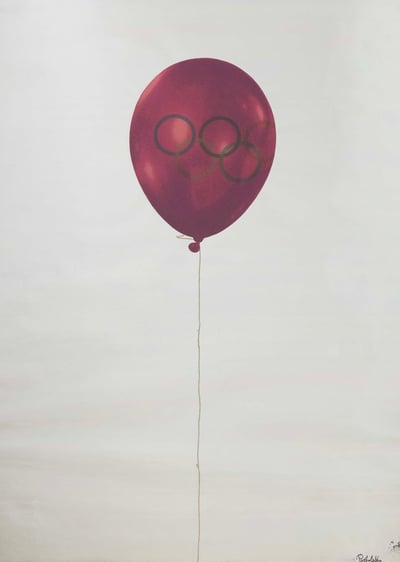
Original color silkscreen on aluminium foil on Arches paper. Signed and numbered.
This striking silkscreen by Michelangelo Pistoletto presents a single red-magenta balloon bearing the five Olympic rings, floating against a reflective aluminium foil ground with a long string trailing downward. Created for the 1984 Sarajevo Winter Olympics, the work embodies Pistoletto's Arte Povera practice of combining humble materials with conceptual depth — the mirror-like surface transforms the viewer into an active participant. The solitary balloon becomes a meditation on celebration, ephemerality, and collective aspiration, rendered with the elegant economy that defines Pistoletto's most powerful work.
Michelangelo Pistoletto (Italy, 1933) is a key figure in Arte Povera and conceptual art. Renowned for his 'Mirror Paintings,' which incorporate reflective surfaces to engage viewers directly, he explores themes of identity, society, and time. Pistoletto's works, including the 'Third Paradise' project, have influenced generations of contemporary artists worldwide.
Silkscreen Silkscreen is a printmaking method that uses a screen made of silk or other mesh fabric. The screen is treated with a substance that blocks ink in certain areas, allowing ink to pass through only in the desired sections. Each color in the print requires a separate screen.
Original color silkscreen on aluminium foil on Arches paper. Signed and numbered.
This striking silkscreen by Michelangelo Pistoletto presents a single red-magenta balloon bearing the five Olympic rings, floating against a reflective aluminium foil ground with a long string trailing downward. Created for the 1984 Sarajevo Winter Olympics, the work embodies Pistoletto's Arte Povera practice of combining humble materials with conceptual depth — the mirror-like surface transforms the viewer into an active participant. The solitary balloon becomes a meditation on celebration, ephemerality, and collective aspiration, rendered with the elegant economy that defines Pistoletto's most powerful work.
Michelangelo Pistoletto (Italy, 1933) is a key figure in Arte Povera and conceptual art. Renowned for his 'Mirror Paintings,' which incorporate reflective surfaces to engage viewers directly, he explores themes of identity, society, and time. Pistoletto's works, including the 'Third Paradise' project, have influenced generations of contemporary artists worldwide.
Art is the primary expression of human creativity.
- Michelangelo Pistoletto
Michelangelo Pistoletto is an Italian painter and art theorist. Moreover, he is also recognized as an action and object artist as well as acknowledged as one of the key figures behind the Italian Arte Povera movement. This avant-garde, modern art movement took major cities throughout Italy by storm (including Rome, Genoa, Venice, Turin, Milan, Bologna, and Naples) from 1967-1972. The artists involved were taking a radical stance and questioning the values of established institutions of culture, government, and industry. Michelangelo Pistoletto’s work mainly deals with the subject matter of reflection and the unification of art as well as everyday life and materials. He is seeking a Gesamtkunstwerk, which is a term associated with a total, ideal, or universal work of art. Pistoletto's style and use of mediums have evolved over the course of his career. During his early years, he worked under his father as an art restorer from 1947 to 1958. Moreover, Michelangelo Pistoletto also made many self-portraits and other figurative works during the 1950s. He went on to display his work at the Biennale di San Marino in 1959. Then, during the next year, he had his first one-man show at the Galleria Galatea. In the early '60s, Michelangelo Pistoletto continued to express himself via self-portraits and other related works. For these works, he used monochrome, metallic backgrounds. From there, the artist combined photography with paint via collage techniques on reflective backgrounds. Eventually, his techniques progressed over to printing photorealistic scenes on steel plates polished to a high finish. He achieved this medium via using the screen-printing method, which made the viewer nearly meld into the artwork. By the mid-1960s, the artist came to the attention of an international audience, thanks to gallery owner Ileana Sonnabend. Michelangelo Pistoletto's mirror paintings are some of his best-known artworks. He currently uses these forms of expression via his artwork and employs human size mirrors. Using these mirrors as basic material, the artist either prints photographic images or paints figures on them. While the artist has experienced significant international success including several exhibitions within the U.K. and U.S., the painter continues to live and work close to his roots in Biella as well as Turin, Italy. (Artist website)
Interactive art is a form of art where the spectator is actively involved by the artist to achieve the artwork's purpose. This involvement can include allowing the visitor to walk around, in, or on the art installation, or even becoming a part of the artwork itself. Works in this category often feature computers, sensors, and interfaces that respond to various inputs such as meteorological changes, heat, motion, or other types of data programmed by the artist.