Lambswool.
Signed on a sticker label.
Manufacturer: House of Voltaire.
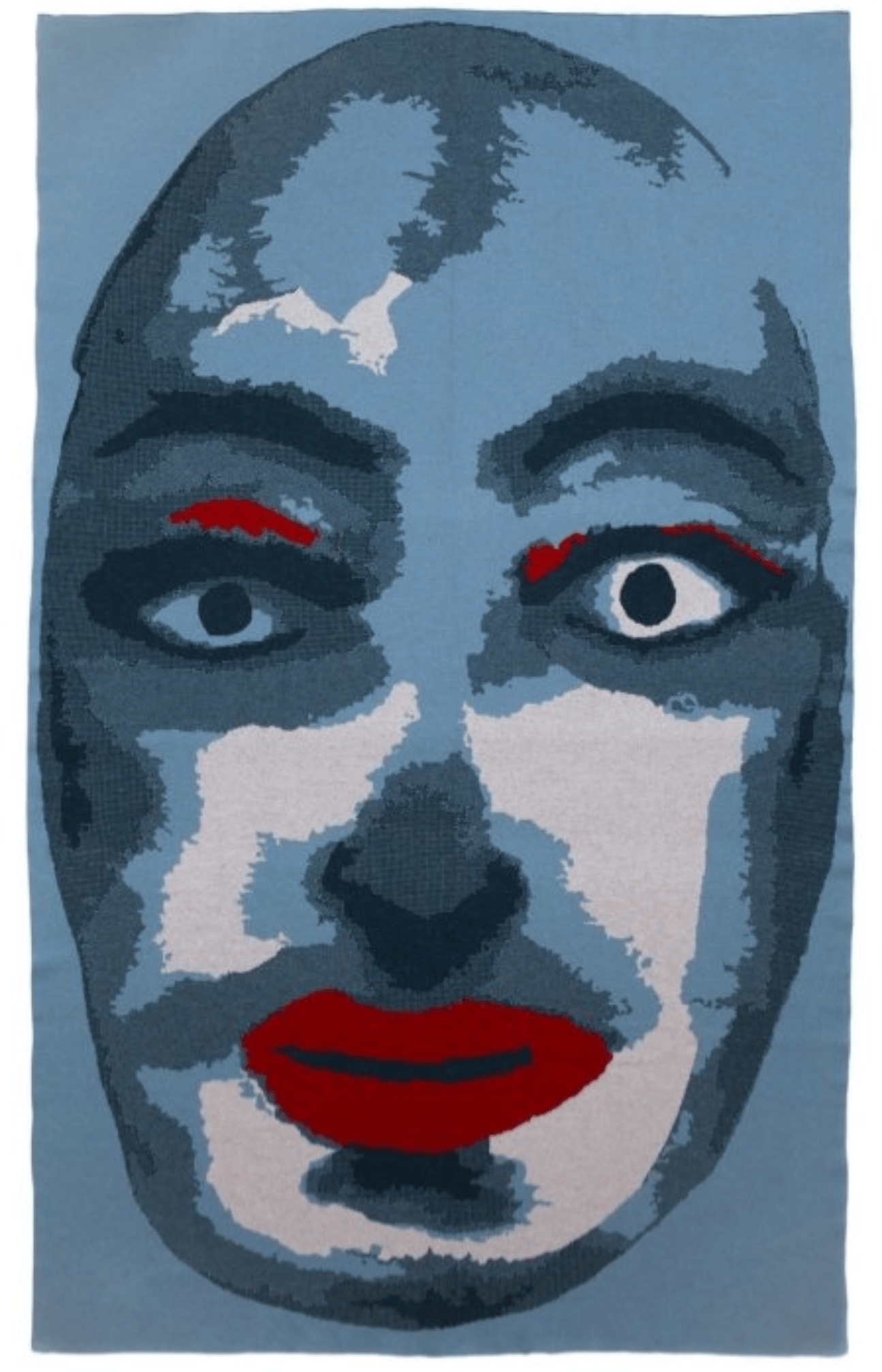
Nicolas Party’s Untitled (Artist’s Blanket) (2017) is a striking textile work that transforms his distinctive portrait style into a functional, woven medium. The piece features a stylized face in varying shades of blue, punctuated by vivid red lips and eyebrows. The exaggerated, almost surreal expression, with asymmetrical eyes—one wide and staring, the other more subdued—creates an unsettling yet captivating presence.
Known for his bold use of color and simplified, graphic forms, Party often explores themes of portraiture, art history, and the uncanny in his work. Here, the soft texture of lambswool contrasts with the striking composition, blurring the line between fine art and design. Produced in collaboration with House of Voltaire, this limited-edition textile is both a collectible artwork and a functional object, embodying Party’s unique approach to contemporary figurative art.
Nicolas Party (Switzerland, 1980) is a contemporary artist celebrated for his surreal, vividly colored landscapes and portraits. Working across painting, sculpture, and installation, he reimagines classical genres with a modern twist. Party’s art often features soft pastel as a primary medium, creating dreamlike atmospheres that captivate viewers.
Tapestry Tapestry is a heavy, handwoven textile featuring intricate designs or images woven directly into the fabric. Created by skilled weavers using materials like wool, linen, cotton, silk, and sometimes silver and gold threads, tapestries have historically served as art pieces, decorations, insulation, and symbols of authority.
Lambswool.
Signed on a sticker label.
Manufacturer: House of Voltaire.
Nicolas Party’s Untitled (Artist’s Blanket) (2017) is a striking textile work that transforms his distinctive portrait style into a functional, woven medium. The piece features a stylized face in varying shades of blue, punctuated by vivid red lips and eyebrows. The exaggerated, almost surreal expression, with asymmetrical eyes—one wide and staring, the other more subdued—creates an unsettling yet captivating presence.
Known for his bold use of color and simplified, graphic forms, Party often explores themes of portraiture, art history, and the uncanny in his work. Here, the soft texture of lambswool contrasts with the striking composition, blurring the line between fine art and design. Produced in collaboration with House of Voltaire, this limited-edition textile is both a collectible artwork and a functional object, embodying Party’s unique approach to contemporary figurative art.
Nicolas Party (Switzerland, 1980) is a contemporary artist celebrated for his surreal, vividly colored landscapes and portraits. Working across painting, sculpture, and installation, he reimagines classical genres with a modern twist. Party’s art often features soft pastel as a primary medium, creating dreamlike atmospheres that captivate viewers.
The contemporary painter, installation artist, and sculptor, Nicholas Party, is most well-known for the critically acclaimed way in which he unites a disquieting form of representation with otherwise soothing pastel colors and flowing, simplified organic shapes. Although his works characteristically feature sharp demarcations between the various subjects and elements of his compositions, they nevertheless reflect his early interest in graffiti art, exhibiting an air-brushed quality.
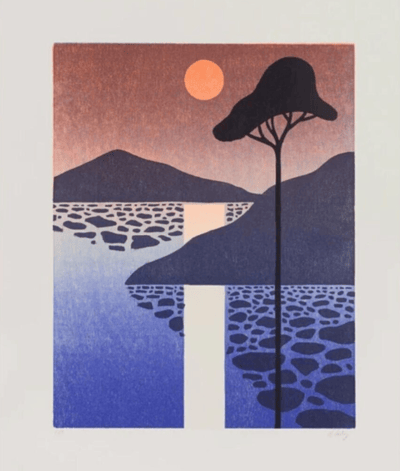
His landscapes feature highly stylized, abstracted depictions of trees, shrubs, and other flora, which are reminiscent of both Félix Vallotton's unemotional landscapes and Theodor Seuss Geisel's well-known illustrations.
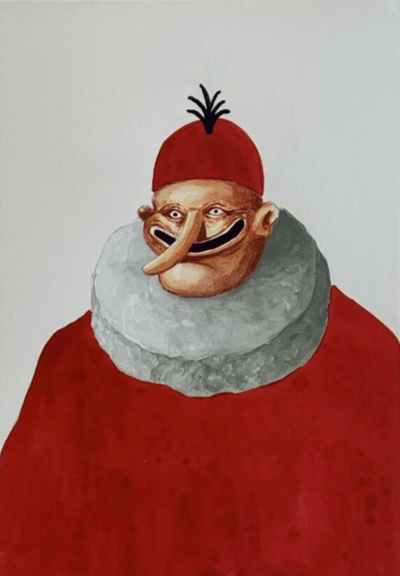
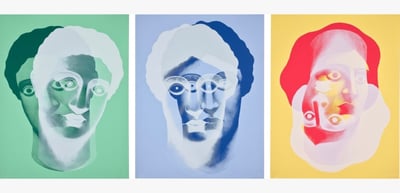
With respect to his portraits, Nicholas Party's figures appear both imposing and yet supple, owing to his skilled use of shading. Although irrealist in form, his subjects often stare out from the canvass with wide, penetrating eyes, much in the manner of Ferdinand Hodler's realist portraits. By denuding his own subjects of the detail associated with realist representations and depicting them as androgenous, Party's subjects appear uncanny and intense—features which are exacerbated by his use of solid backgrounds and the unusual perspective imposed upon them.
Sometimes known as Figurativism, figurative art refers to sculptures and paintings that are clearly or specifically derived from real objects, making them representational. The term figurative art is often used in contrast to abstract art. However, since the emergence of abstract art, figurative art has come to describe any form of modern art that has strong references to the real world or actual situations.