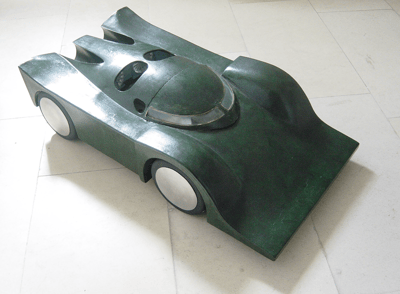
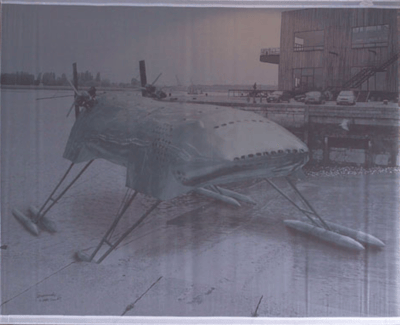
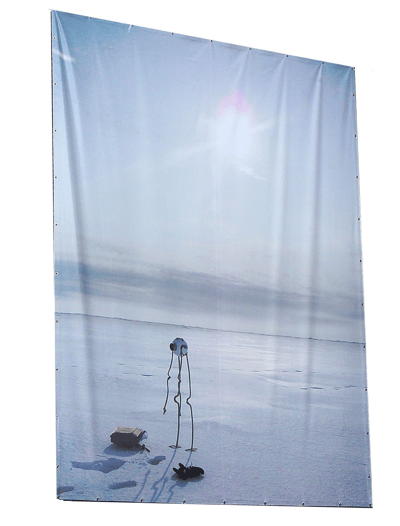
Scotch Gambit at Rijnkaai, Antwerpen (2001) by Panamarenko is a large-scale photoprint on banner measuring 400 x 500 cm. The artwork features a surreal and futuristic flying vehicle, Scotch Gambit, situated against the industrial backdrop of Rijnkaai in Antwerp. The vehicle, which resembles an insect or a sci-fi spacecraft, rests on elongated landing legs with ski-like feet. The grainy, monochromatic treatment of the image gives it the feel of an archival photograph or blueprint, aligning with Panamarenko’s fascination with flight, invention, and pseudo-scientific exploration. This unique monoprint underscores the artist's playful yet technically minded approach to imagined mobility and mechanical dreams.
Panamarenko (Belgium, 1940–2019) was a visionary artist and inventor celebrated for his fantastical flying machines, submarines, and vehicles. Blending art, science, and engineering, his works reflected a playful yet profound exploration of human ambition and technological possibilities. Iconic creations like Aeromodeller embody his imaginative approach to art and innovation.
MonoprintMonoprinting is a printmaking technique where a single impression is created from a re-printable surface, such as a lithographic stone, wood block, or metal plate. Unlike traditional printmaking, where multiple copies are produced, monoprinting results in a unique image. Techniques used in monoprinting include etching, lithography, and woodcut, but the key characteristic is that each print is one-of-a-kind.
Scotch Gambit at Rijnkaai, Antwerpen (2001) by Panamarenko is a large-scale photoprint on banner measuring 400 x 500 cm. The artwork features a surreal and futuristic flying vehicle, Scotch Gambit, situated against the industrial backdrop of Rijnkaai in Antwerp. The vehicle, which resembles an insect or a sci-fi spacecraft, rests on elongated landing legs with ski-like feet. The grainy, monochromatic treatment of the image gives it the feel of an archival photograph or blueprint, aligning with Panamarenko’s fascination with flight, invention, and pseudo-scientific exploration. This unique monoprint underscores the artist's playful yet technically minded approach to imagined mobility and mechanical dreams.
Panamarenko (Belgium, 1940–2019) was a visionary artist and inventor celebrated for his fantastical flying machines, submarines, and vehicles. Blending art, science, and engineering, his works reflected a playful yet profound exploration of human ambition and technological possibilities. Iconic creations like Aeromodeller embody his imaginative approach to art and innovation.
Is there anything scarier than growing up? Adults have no imagination.
- Panamarenko
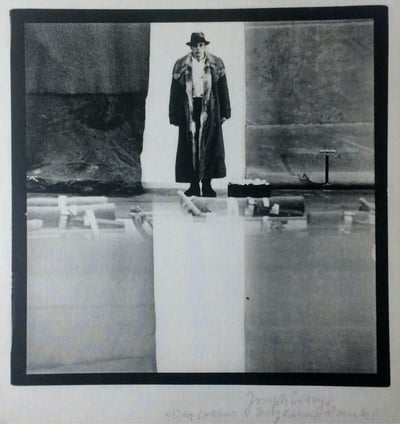
Renowned for modeling his work on aerodynamic engineering, Henri Van Herwegen - creating under the pseudonym of Panamarenko - is a mixed-media assemblagist whose work heavily features flying vehicles such as zeppelins, helicopters, and most notably aeroplanes; among his most acclaimed sculptures is his gallery-sized airship, Aeromodeller, and as is the case with other such works as Scotch Gambit, the machine’s flying capability is untested and as yet unknown – a purposely ironic nod to the Myth of Icarus. Panamarenko’s early career was heavily influenced by the Pop Art movement, as well as the works of Picasso and Beuys, but he soon developed an interest in human powered flights and began to create work pertaining to aviation and engineering as a metaphor for human exploration, hope and failure. (Artist website)
Space Art is an artistic genre that depicts the cosmic elements of the universe, including celestial bodies, interstellar space, and space exploration. It began in 1865 with the first science-based illustrations by A. de Neuville and Emile Bayard in Jules Verne’s novel From the Earth to the Moon. Space Art has since evolved to include various forms of visual art inspired by astronomical discoveries and the human imagination, playing a key role in visualizing the wonders of space.