

There are 30 similar but not identical "Emprintes de pierre" They are all different.
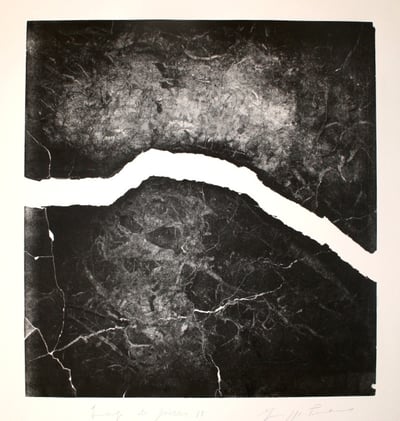
Empreinte de Pierre by Giuseppe Penone, created in 2011, is a lithographic exploration of texture and form. The piece captures the impression of a fractured stone, emphasizing the organic lines and rugged textures created by natural forces. Penone’s work often investigates the relationship between humanity and nature, and this lithograph exemplifies his fascination with natural imprints and geological surfaces. Each edition in the series of 30 is unique, bearing slight variations that reflect the distinct qualities of each imprint of stone. The interplay of light and dark tones enhances the depth and tactile quality, inviting viewers to contemplate the enduring impact of time on natural forms. Measuring 60 x 76 cm, this limited edition lithograph highlights Penone's dedication to capturing the subtle, powerful beauty of nature's imprints.
Artwork Copyright © Penone GiuseppeGiuseppe Penone (Italy, 1947) is an Italian artist and sculptor associated with the Arte Povera movement. His work explores the relationship between humans and nature, often using natural materials like wood and stone. Penone's sculptures frequently feature tree forms, emphasizing growth and transformation. In 2014, he received the Praemium Imperiale award for sculpture.
Artwork Copyright © Penone GiuseppeEmpreinte de Pierre, 2011
Form
Medium
Size
- Inches
- Centimeters
Edition
Price
Available works →
- Authenticity Guaranteed
- Insured Shipping
- Online Since 2005
●
●Inventory 2246
●Signed
●Comes with gallery invoice and certificate
●Sell Us a Similar Artwork. Learn more.
There are 30 similar but not identical "Emprintes de pierre" They are all different.
Empreinte de Pierre by Giuseppe Penone, created in 2011, is a lithographic exploration of texture and form. The piece captures the impression of a fractured stone, emphasizing the organic lines and rugged textures created by natural forces. Penone’s work often investigates the relationship between humanity and nature, and this lithograph exemplifies his fascination with natural imprints and geological surfaces. Each edition in the series of 30 is unique, bearing slight variations that reflect the distinct qualities of each imprint of stone. The interplay of light and dark tones enhances the depth and tactile quality, inviting viewers to contemplate the enduring impact of time on natural forms. Measuring 60 x 76 cm, this limited edition lithograph highlights Penone's dedication to capturing the subtle, powerful beauty of nature's imprints.
Artwork Copyright © Penone GiuseppeGiuseppe Penone (Italy, 1947) is an Italian artist and sculptor associated with the Arte Povera movement. His work explores the relationship between humans and nature, often using natural materials like wood and stone. Penone's sculptures frequently feature tree forms, emphasizing growth and transformation. In 2014, he received the Praemium Imperiale award for sculpture.
Artwork Copyright © Penone Giuseppe- Recently Added
- Price (Low-High)
- Price (High-Low)
- Year (Low-High)
- Year (High-Low)
Penone Giuseppe
Empreinte de Pierre, 2011
Limited Edition Print
Lithograph
Currently Not Available
Related Artists

Artwork by Antoni Tapies
What is Arte Povera?
A movement and style in art that originated in Italy during the 1960s. It integrates elements of minimalism, performance art, and conceptual art by using everyday or seemingly worthless materials, such as newspapers, stones, or rags. The goal was to challenge and subvert the commercialization of art.

Penone Giuseppe
Empreinte de Pierre, 2011
60 x 76 cm


