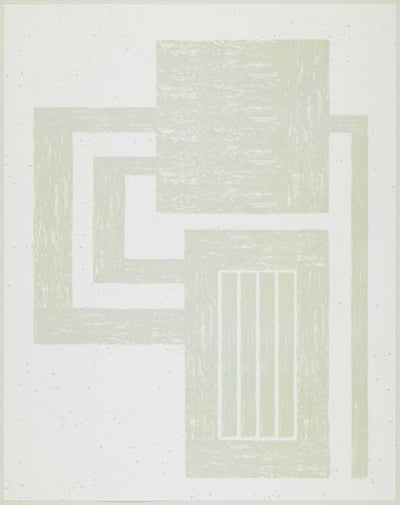
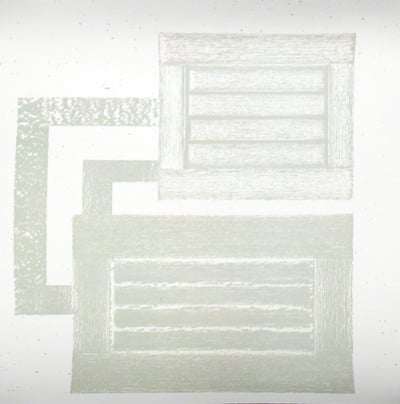
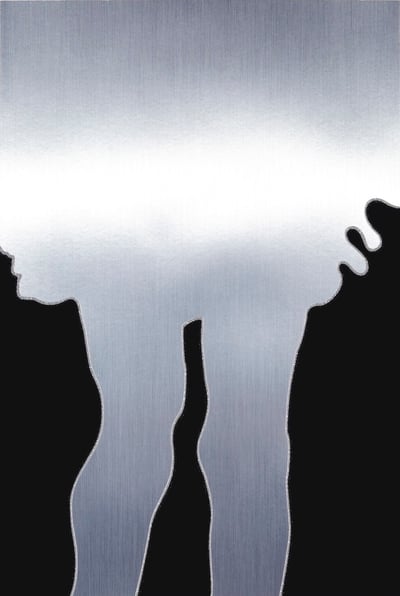
Pure-Play by Peter Halley is a 2015 limited edition print created through a combination of lithography and silkscreen techniques. This work embodies Halley’s geometric minimalism, featuring rectangular and square shapes intersecting in a structured composition. The soft, pale palette lends a subdued visual quality, allowing the interplay of textures to stand out. Halley’s work often explores themes of isolation and connection within modern digital and urban landscapes, transforming geometric forms into representations of confinement and connectivity. In Pure-Play , the layered shapes and patterns evoke a sense of order and restraint, inviting viewers to reflect on structure in contemporary spaces.
Peter Halley (United States, 1953) is an American artist and central figure in the Neo-Conceptualist movement of the 1980s. Renowned for his Day-Glo geometric paintings, Halley explores themes of urban isolation and technological confinement. His work often features motifs like 'cells' and 'conduits,' symbolizing modern life's structural and social systems.
Lithograph and silkscreenMixed media refers to artwork that incorporates more than one medium within a single piece. Unlike multimedia art, which combines distinct forms of visual art and often includes elements like sound, video, or digital media, mixed media focuses on combining traditional art materials, such as paint, ink, and collage. Mixed media art allows artists to achieve a wide range of effects and textures by layering and blending different materials.
Size
Inches
Centimeters
74 X 74 cm
Edition
Edition of 40
Price
USD
EUR
GBP
CHF
3,500EUR
?
+ VAT/import Duties (if applicable)
Authenticity Guaranteed
Insured Shipping
Online Since 2005
Share
●Inventory 2981
●Signed
●Comes with gallery invoice and certificate
●Any questions?
Lithograph and silkscreen
Pure-Play by Peter Halley is a 2015 limited edition print created through a combination of lithography and silkscreen techniques. This work embodies Halley’s geometric minimalism, featuring rectangular and square shapes intersecting in a structured composition. The soft, pale palette lends a subdued visual quality, allowing the interplay of textures to stand out. Halley’s work often explores themes of isolation and connection within modern digital and urban landscapes, transforming geometric forms into representations of confinement and connectivity. In Pure-Play , the layered shapes and patterns evoke a sense of order and restraint, inviting viewers to reflect on structure in contemporary spaces.
Peter Halley (United States, 1953) is an American artist and central figure in the Neo-Conceptualist movement of the 1980s. Renowned for his Day-Glo geometric paintings, Halley explores themes of urban isolation and technological confinement. His work often features motifs like 'cells' and 'conduits,' symbolizing modern life's structural and social systems.
For over 25 years New York City's Peter Halley has been exploring the world of geometry and color through his large-scale, artwork. First coming onto the art scene in the mid-80s, Halley quickly garnered critical attention with the interplay of his brightly colored, geometric abstractions he calls "prisons" or "cells", which are often connected by conduits and pipelines. These iconic square and rectangular shapes, and their relationship to each other, reflect society's growing compartmentalization and the reduction of open space, particularly in an urban environment. Peter Halley is most closely associated with the Minimalist Movement due to his nominal use of design elements and more specifically Halley's work is classified as Neo-Geo for his continuous rendering of geometric shapes. Halley works primarily with paint though he is known for printmaking as well. He generally works with Day-Glo acrylic colors, often employing a Roll-a-Tex texture additive, but sometimes utilizes Metallic acrylic to achieve the desired look and feel. In addition to his painting Halley is widely recognized for his critical writing on art and culture. An anthology of essays on post-structuralism, post-modernism, and the digital revolution called, Selected Essays 1981-2001, offers a perspective on art, culture, and history that is distinctly Halley's. From 1996 to 2005 Halley also published index magazine, a periodical focused on in-depth interviews with icons of the art and pop culture worlds. In 2014 the publication released index A to Z: Art, Design, Fashion, Film, and Music in the Indie Era, a book whose goal was to celebrate the indie era featuring many of the celebrities and cultural figures of the time. Today Halley continues to live and work in New York City. (Artist website)
Known as Neo-Geo for short, this movement uses geometric objects and shapes to create abstract artwork as a metaphor for society. Inspired by various 20th-century art styles, including minimalism and pop art, Neo-Geo emerged in the 1980s as a response to the industrialization and commercialization of the modern world. The movement reflects on the impact of mass production, consumerism, and technology, often critiquing the superficiality of contemporary culture through its abstract, geometric compositions.