Etching and aquatint on copper plate - Printed in 2 colors - Fabriano Rosaspina paper
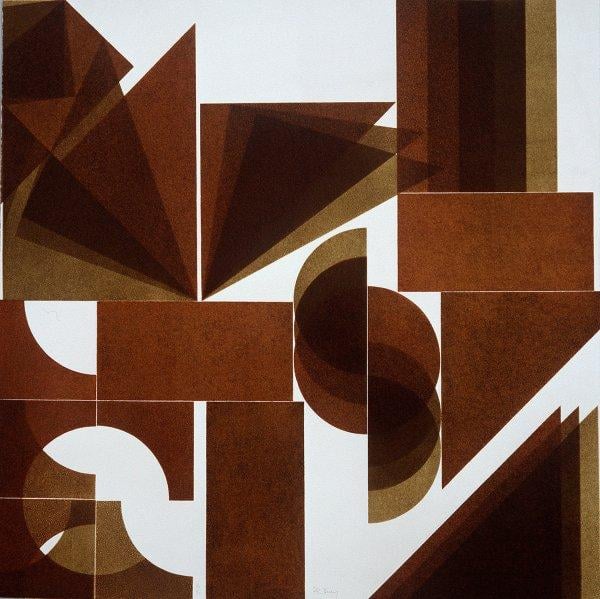
Presenza grafica by Pol Bury, created in 1973, is a limited-edition etching and aquatint print that plays with geometric abstraction and tonal contrast. Rendered on Fabriano Rosaspina paper, the work is characterized by overlapping rectangles, circles, and triangular forms that create a dynamic sense of movement and balance. The composition is executed in rich brown and earthy tones, which give the piece warmth and depth. Bury’s careful use of light and shadow within the shapes suggests a three-dimensionality, turning flat forms into a visually engaging, almost sculptural space. Known for his work in kinetic art and geometric abstraction, Bury explores themes of rhythm and tension, inviting viewers to engage with the subtleties of structure and form.
Pol Bury (Belgium, 1922–2005) was a sculptor and painter known for his kinetic art, blending motion and form to create meditative works. Influenced by surrealism and constructivism, he introduced slow-moving elements in his sculptures, inviting viewers to reflect on time and perception. His career also included jewelry and fountain designs.
Etching and AquatintEtching and aquatint are printmaking techniques. In aquatint, the printing plate is etched with a pattern of tiny pits and cracks to create a wide range of tonal gradations. This technique allows artists to replicate the broad, flat tones found in watercolor paintings and ink washes.
Etching and aquatint on copper plate - Printed in 2 colors - Fabriano Rosaspina paper
Presenza grafica by Pol Bury, created in 1973, is a limited-edition etching and aquatint print that plays with geometric abstraction and tonal contrast. Rendered on Fabriano Rosaspina paper, the work is characterized by overlapping rectangles, circles, and triangular forms that create a dynamic sense of movement and balance. The composition is executed in rich brown and earthy tones, which give the piece warmth and depth. Bury’s careful use of light and shadow within the shapes suggests a three-dimensionality, turning flat forms into a visually engaging, almost sculptural space. Known for his work in kinetic art and geometric abstraction, Bury explores themes of rhythm and tension, inviting viewers to engage with the subtleties of structure and form.
Pol Bury (Belgium, 1922–2005) was a sculptor and painter known for his kinetic art, blending motion and form to create meditative works. Influenced by surrealism and constructivism, he introduced slow-moving elements in his sculptures, inviting viewers to reflect on time and perception. His career also included jewelry and fountain designs.
I am searching for the point which exists between the moving and the non-moving.
- Pol Bury
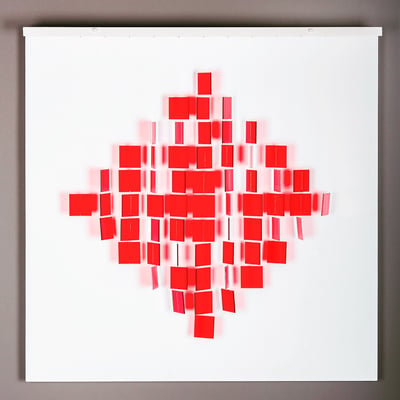
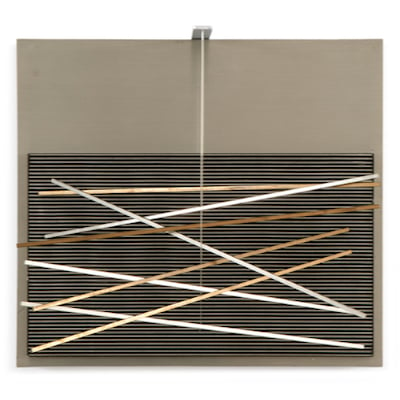
Born in Belgium, Pol Bury began his artistic evolution as a Surrealist painter, but eventually became widely known for his kinetic sculptures. His most famous work is usually cited as L’Octagon, a fountain-sculpture situated in San Francisco, for which he employed water as a means of emphasizing this work. Pol Bury was initially involved in the Surrealist movement, drawn in by the artistic endeavours of Yves Tanguy and Rene Margritte. However, he soon branched out into other forms of art and was notably struck by the work of Alexander Calder - this is what sparked the turn to sculpting. Bury’s work as a sculptor was heavily based on cinétisation, or kinetic art. He initially adopted the use of panels, cutting them into different shapes and using lighting disks or balls in order to create differences in how his work would look, dependent on the angle from which a viewer was looking - a technique used in his first exhibition, Plans Mobiles. For a time, Bury also used photographs as a way of manipulating his final output - he would cut up pictures of New York skyscrapers and then reassemble them to create an image of a buckling skyline. He eventually returned to sculpting and chose metal as his primary material, with his works focusing on the idea of attraction and repulsion. Movement was key in Pol Bury's work, but a lot of this movement was so minute and so slow that it was hardly even visible. Bury noted, however, that "speed limits space; slowness creates it". (Artist website)
Surrealism began in the 1920s as an art and literary movement with the goal of revealing the unconscious mind and unleashing the imagination by exploring unusual and dream-like imagery. Influenced by Sigmund Freud’s theories of psychoanalysis, Surrealist artists and writers sought to bring the unconscious into rational life, blurring the lines between reality and dreams. The movement aimed to challenge conventional perceptions and express the irrational aspects of the human experience.