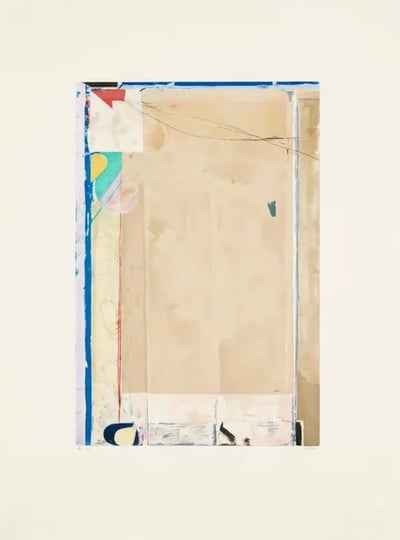
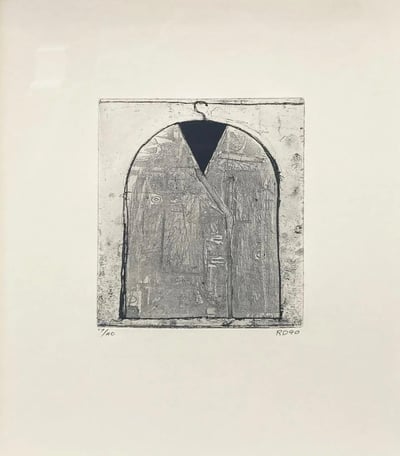
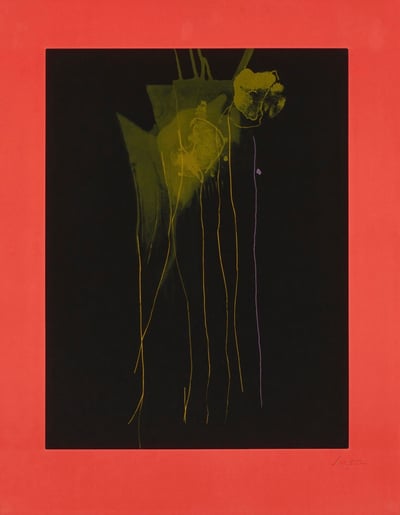
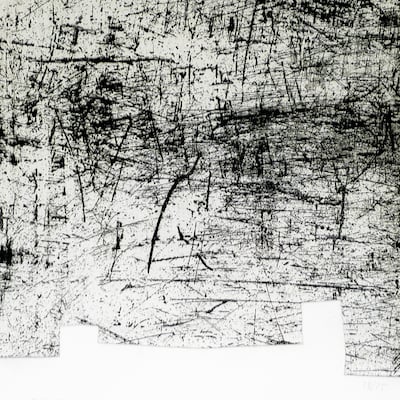
2-color lithograph
- Suite: Harvey Gantt Portfolio
- Hand signed, dated and numbered by the artist in pencil
Richard Diebenkorn’s Untitled (for Harvey Gantt) (1990) is a monochromatic lithograph that embodies the artist’s expressive and abstract approach. The composition features bold, gestural strokes that suggest a leaf-like form crossed by intersecting lines, set against a textured background of horizontal stripes. The raw, spontaneous quality of the marks reflects Diebenkorn’s exploration of abstraction while retaining a connection to organic shapes. Measuring 33 x 40 cm, this limited-edition print was created in support of Harvey Gantt, a politician and civil rights advocate, highlighting the artist’s engagement with social and cultural issues through his art.
Richard Diebenkorn (USA, 1922–1993) was a celebrated painter and printmaker, known for his transition from abstract expressionism to figurative work and back to abstraction. His Ocean Park series, inspired by the landscapes of California, features luminous, geometric compositions. Diebenkorn’s art bridges abstraction and representation, leaving a profound impact on modern art.
Lithograph Lithography is a printing method based on the principle that water and oil do not mix. It can be used to print artwork or text onto paper or other suitable materials. Traditionally, an image was drawn with wax, fat, or oil onto a lithographic limestone surface or plate. Today, metal plates and other surfaces are also used in lithographic printing.
2-color lithograph
- Suite: Harvey Gantt Portfolio
- Hand signed, dated and numbered by the artist in pencil
Richard Diebenkorn’s Untitled (for Harvey Gantt) (1990) is a monochromatic lithograph that embodies the artist’s expressive and abstract approach. The composition features bold, gestural strokes that suggest a leaf-like form crossed by intersecting lines, set against a textured background of horizontal stripes. The raw, spontaneous quality of the marks reflects Diebenkorn’s exploration of abstraction while retaining a connection to organic shapes. Measuring 33 x 40 cm, this limited-edition print was created in support of Harvey Gantt, a politician and civil rights advocate, highlighting the artist’s engagement with social and cultural issues through his art.
Richard Diebenkorn (USA, 1922–1993) was a celebrated painter and printmaker, known for his transition from abstract expressionism to figurative work and back to abstraction. His Ocean Park series, inspired by the landscapes of California, features luminous, geometric compositions. Diebenkorn’s art bridges abstraction and representation, leaving a profound impact on modern art.
Mistakes can't be erased, but they move you from your present position.
- Richard Diebenkorn
Arguably best known for his Ocean Park paintings, Richard Diebenkorn was a painter and printmaker with early roots in abstract expressionism and a later involvement with the Bay Area Figurative Movement throughout the 1950’s and 1960’s. His move to figuration saw works such as Girl On a Terrace come to light – he employed a range of soft, subtle colours to create his simple depictions of life at the time. Diebenkorn explored figuration for a decade or so before he returned to his abstraction origins – this is when he began to compile the Ocean Park series, a selection of works that, while abstract, still managed to capture the essence of the landscape and the times he was living among. While it could be stated that his artistic career was divided into three different segments – abstraction, figuration and abstraction once again – Diebenkorn was not afraid to mix the two, and his portraits were usually a striking blend of the two. His work has frequently been compared to that of Willem De Kooning – an artist that Diebenkorn has often cited as an inspiration. (Artist website)
Abstract art uses form, shape, line, and color to create a visual experience without attempting to represent external reality. The composition exists independently of the world's visual references, focusing on expressing ideas and emotions through non-representational means.