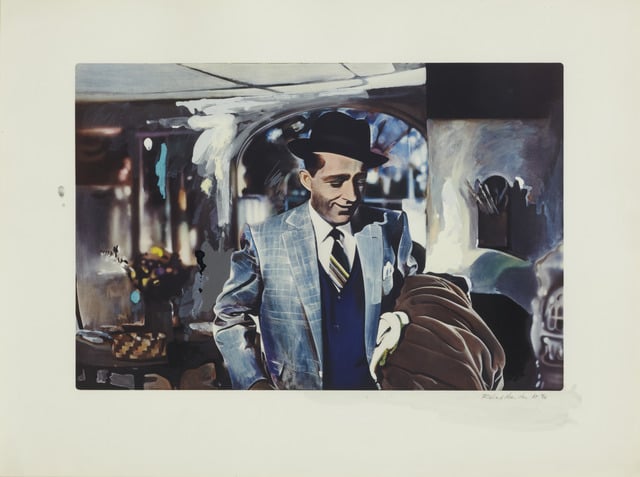
// I'm dreaming of a black Christmas by Richard Hamilton, created in 1971, is a screen print that presents an intriguing take on pop culture and celebrity iconography. The artwork features a man in a suit and fedora, with a contemplative expression, possibly drawing on the imagery of mid-century movie stars. The title, a twist on the well-known song White Christmas, adds an ironic, perhaps darker tone to the image. Hamilton, a pioneering figure in Pop Art, often critiqued consumerism and media through recontextualized images of familiar figures and scenes. Here, the use of layered colors and soft focus gives the piece a cinematic quality, evoking nostalgia while encouraging a reflection on the commercialization of holidays and icons. This limited edition print measures 75 x 100 cm, underscoring Hamilton’s skill in blending social commentary with visual appeal.
Richard Hamilton (United Kingdom, 1922–2011) was a British painter and collage artist, often regarded as the father of Pop Art. His 1956 collage 'Just what is it that makes today's homes so different, so appealing?' is considered one of the earliest works of the movement. Hamilton's innovative approach combined popular culture with fine art, influencing generations of artists.
Screenprint Screen printing is a technique where ink is transferred through a mesh onto a substrate, with areas blocked by a stencil to prevent ink from passing through. This method, also known as serigraphy or silkscreen printing, is commonly used to produce prints on posters, T-shirts, vinyl, stickers, wood, and other materials. The process is a type of stencil printing, allowing for vibrant, detailed designs on various surfaces.
// I'm dreaming of a black Christmas by Richard Hamilton, created in 1971, is a screen print that presents an intriguing take on pop culture and celebrity iconography. The artwork features a man in a suit and fedora, with a contemplative expression, possibly drawing on the imagery of mid-century movie stars. The title, a twist on the well-known song White Christmas, adds an ironic, perhaps darker tone to the image. Hamilton, a pioneering figure in Pop Art, often critiqued consumerism and media through recontextualized images of familiar figures and scenes. Here, the use of layered colors and soft focus gives the piece a cinematic quality, evoking nostalgia while encouraging a reflection on the commercialization of holidays and icons. This limited edition print measures 75 x 100 cm, underscoring Hamilton’s skill in blending social commentary with visual appeal.
Richard Hamilton (United Kingdom, 1922–2011) was a British painter and collage artist, often regarded as the father of Pop Art. His 1956 collage 'Just what is it that makes today's homes so different, so appealing?' is considered one of the earliest works of the movement. Hamilton's innovative approach combined popular culture with fine art, influencing generations of artists.
The artist in twentieth-century urban life is inevitably a consumer of mass culture and potentially a contributor to it.
- Richard Hamilton
As a painter and collage artist, Richard Hamilton is highly recognised as the founder of Pop Art – a lollipop from one of his earliest collages gave the style its name, and his work outlined many of the ideals and aims that now define the movement. Hamilton’s most notable works include his early piece - Just what is it that makes today’s homes so different, so appealing? - the piece depicts a muscly man posing provocatively with a Tootsie Pop, alongside a bare-breasted woman wearing a lampshade for a hat; both of these figures are surrounded by 1950’s emblems of affluence such as canned ham and a vacuum cleaner. Throughout his career, Hamilton experimented with numerous materials including acrylic glass, plasticisers and plywood – extreme care was taken to preserve the plastics used in his work after previous complications had led to certain works being damaged.
Readymade is the term coined by French artist Marcel Duchamp to describe artworks created from manufactured objects. Duchamp selected ordinary, functional items that he felt had visual indifference, turning them into art simply by choosing and presenting them in a new context. This concept challenged traditional notions of art and continues to influence artists who adopt similar approaches today.