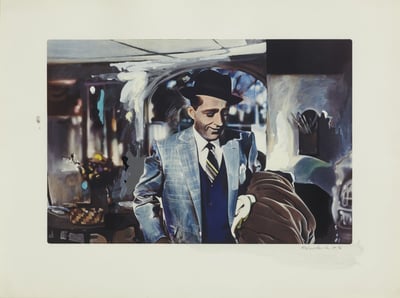
Richard Hamilton (United Kingdom, 1922–2011) was a British painter and collage artist, often regarded as the father of Pop Art. His 1956 collage 'Just what is it that makes today's homes so different, so appealing?' is considered one of the earliest works of the movement. Hamilton's innovative approach combined popular culture with fine art, influencing generations of artists.
Etching and AquatintEtching and aquatint are printmaking techniques. In aquatint, the printing plate is etched with a pattern of tiny pits and cracks to create a wide range of tonal gradations. This technique allows artists to replicate the broad, flat tones found in watercolor paintings and ink washes.
Richard Hamilton (United Kingdom, 1922–2011) was a British painter and collage artist, often regarded as the father of Pop Art. His 1956 collage 'Just what is it that makes today's homes so different, so appealing?' is considered one of the earliest works of the movement. Hamilton's innovative approach combined popular culture with fine art, influencing generations of artists.
The artist in twentieth-century urban life is inevitably a consumer of mass culture and potentially a contributor to it.
- Richard Hamilton
As a painter and collage artist, Richard Hamilton is highly recognised as the founder of Pop Art – a lollipop from one of his earliest collages gave the style its name, and his work outlined many of the ideals and aims that now define the movement. Hamilton’s most notable works include his early piece - Just what is it that makes today’s homes so different, so appealing? - the piece depicts a muscly man posing provocatively with a Tootsie Pop, alongside a bare-breasted woman wearing a lampshade for a hat; both of these figures are surrounded by 1950’s emblems of affluence such as canned ham and a vacuum cleaner. Throughout his career, Hamilton experimented with numerous materials including acrylic glass, plasticisers and plywood – extreme care was taken to preserve the plastics used in his work after previous complications had led to certain works being damaged.
Pop Art is an art movement that began in Britain in 1955 and in the late 1950s in the U.S. It challenged traditional fine arts by incorporating imagery from popular culture, such as news, advertising, and comic books. Pop Art often isolates and recontextualizes materials, combining them with unrelated elements. The movement is more about the attitudes and ideas that inspired it than the specific art itself. Pop Art is seen as a reaction against the dominant ideas of Abstract Expressionism, bringing everyday consumer culture into the realm of fine art.